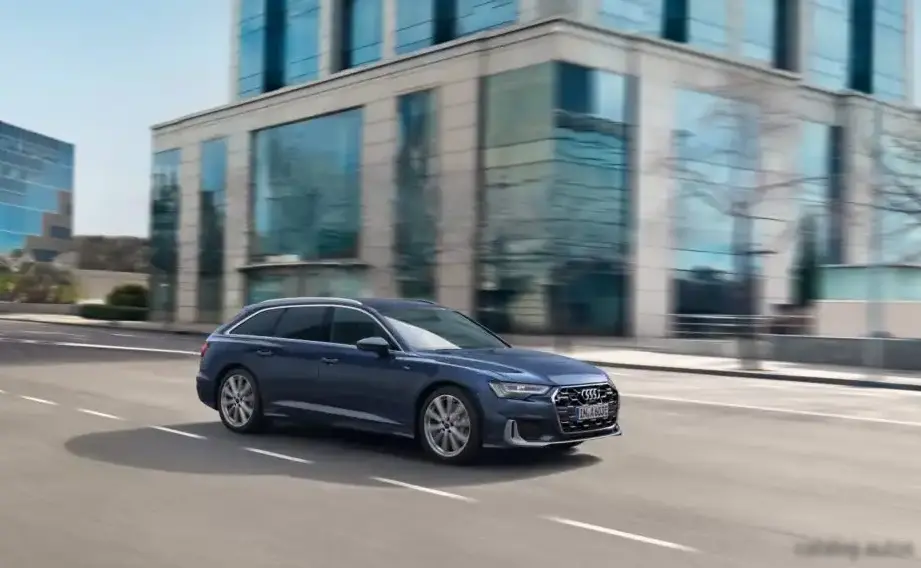
The Audi A6 Avant 55 TFSI e, introduced in June 2023 as part of the C8 facelift, represents Audi’s commitment to plug-in hybrid technology within its executive wagon lineup. Positioned as a mid-to-high range offering, this variant combines a 2.0-liter turbocharged four-cylinder gasoline engine with an electric motor, delivering a combined system output of 367 horsepower. Production continued until March 2025, catering primarily to the European market where demand for efficient and technologically advanced wagons remains strong. The “55 TFSI e” designation signifies its power output level within Audi’s naming convention, and the “e” denotes its plug-in hybrid capability. It builds upon the established A6 Avant (C8) platform, known for its blend of luxury, practicality, and driving dynamics.
Technical Specifications
| Brand | Audi |
| Model | A6 |
| Generation | A6 Avant (C8, facelift 2023) |
| Type | 55 TFSI e (367 Hp) Plug-in Hybrid quattro ultra S tronic |
| Start of production | June, 2023 |
| End of production | March, 2025 |
| Powertrain Architecture | PHEV (Plug-in Hybrid Electric Vehicle) |
| Body type | Station wagon (estate) |
| Seats | 5 |
| Doors | 5 |
| Combined fuel consumption (WLTP) | 1.4-1.6 l/100 km (168 – 147 US mpg, 201.8 – 176.6 UK mpg, 71.4 – 62.5 km/l) |
| CO2 emissions (WLTP) | 32-37 g/km |
| Fuel Type | Petrol / electricity |
| Acceleration 0 – 100 km/h | 5.7 sec |
| Acceleration 0 – 62 mph | 5.7 sec |
| Acceleration 0 – 60 mph | 5.4 sec |
| Maximum speed | 250 km/h (155.34 mph) |
| Emission standard | Euro 6e |
| Weight-to-power ratio | 5.7 kg/Hp, 176.9 Hp/tonne |
| Weight-to-torque ratio | 4.2 kg/Nm, 241 Nm/tonne |
| Gross battery capacity | 17.9 kWh |
| Net (usable) battery capacity | 14.4 kWh |
| Battery voltage | 400 V |
| Battery technology | Lithium-ion (Li-Ion) |
| Battery location | Under the trunk |
| All-electric range (WLTP) | 60-66 km (37.28 – 41.01 mi) |
| Average Energy consumption (WLTP) | 20.2-21.5 kWh/100 km (32.51 – 34.6 kWh/100 mi, 104 – 97 MPGe, 5 – 4.7 km/kWh, 3.1 – 2.9 mi/kWh) |
| Max speed (electric) | 135 km/h (83.89 mph) |
| Electric motor power | 143 Hp |
| Electric motor Torque | 350 Nm (258.15 lb.-ft.) |
| Electric motor location | Between the combustion engine and the transmission |
| Electric motor type | Synchronous |
| System power | 367 Hp |
| System torque | 500 Nm (368.78 lb.-ft.) |
| Power | 265 Hp @ 5250-6500 rpm |
| Torque | 370 Nm @ 1600-4500 rpm (272.9 lb.-ft. @ 1600-4500 rpm) |
| Engine layout | Front, Longitudinal |
| Engine Model/Code | EA888evo4 |
| Engine displacement | 1984 cm3 (121.07 cu. in.) |
| Number of cylinders | 4 |
| Engine configuration | Inline |
| Cylinder Bore | 82.5 mm (3.25 in.) |
| Piston Stroke | 92.8 mm (3.65 in.) |
| Compression ratio | 9.6:1 |
| Number of valves per cylinder | 4 |
| Fuel injection system | Direct injection |
| Engine aspiration | Turbocharger, Intercooler |
| Valvetrain | DOHC |
| Engine oil capacity | 5.2 l (5.49 US qt | 4.58 UK qt) |
| Coolant | 16.9 l (17.86 US qt | 14.87 UK qt) |
| Kerb Weight | 2075 kg (4574.59 lbs.) |
| Max. weight | 2675 kg (5897.37 lbs.) |
| Max load | 600 kg (1322.77 lbs.) |
| Trunk (boot) space – minimum | 405 l (14.3 cu. ft.) |
| Trunk (boot) space – maximum | 1535 l (54.21 cu. ft.) |
| Fuel tank capacity | 52 l (13.74 US gal | 11.44 UK gal) |
| Max. roof load | 100 kg (220.46 lbs.) |
| Permitted trailer load with brakes (8%) | 2000 kg (4409.25 lbs.) |
| Permitted trailer load with brakes (12%) | 2000 kg (4409.25 lbs.) |
| Permitted trailer load without brakes | 750 kg (1653.47 lbs.) |
| Permitted towbar download | 95 kg (209.44 lbs.) |
| Length | 4939 mm (194.45 in.) |
| Width | 1886 mm (74.25 in.) |
| Width including mirrors | 2110 mm (83.07 in.) |
| Height | 1494 mm (58.82 in.) |
| Wheelbase | 2924 mm (115.12 in.) |
| Front track | 1624 mm (63.94 in.) |
| Rear (Back) track | 1611 mm (63.43 in.) |
| Front overhang | 920 mm (36.22 in.) |
| Rear overhang | 1095 mm (43.11 in.) |
| Drag coefficient (Cd) | 0.29 |
| Minimum turning circle (turning diameter) | 12.1 m (39.7 ft.) |
| Approach angle | 12.4° |
| Departure angle | 16.3° |
| Drivetrain Architecture | The Internal combustion engine (ICE) and the electric motor permanently drive the front wheels of the vehicle, capable of running in full electric or mixed mode, and if necessary through the electrically or mechanically controlled clutch, the rear wheels are driven. |
| Drive wheel | All wheel drive (4×4) |
| Number of gears and type of gearbox | 7 gears, automatic transmission S tronic |
| Front suspension | Independent multi-link suspension |
| Rear suspension | Independent multi-link suspension |
| Front brakes | Ventilated discs, 375 mm |
| Rear brakes | Ventilated discs, 330 mm |
Powertrain & Engine Architecture
At the heart of the A6 Avant 55 TFSI e lies the EA888evo4, a 2.0-liter turbocharged inline-four cylinder gasoline engine. This engine, a staple in the Volkswagen Group’s portfolio, utilizes direct injection and a single twin-scroll turbocharger to produce 265 horsepower at 5250-6500 rpm and 370 Nm (272.9 lb-ft) of torque between 1600-4500 rpm. The engine’s design prioritizes efficiency and responsiveness. Paired with the engine is a 143 hp electric motor integrated between the engine and the seven-speed S tronic dual-clutch transmission. This placement allows for seamless transitions between electric, hybrid, and gasoline power. The 17.9 kWh (14.4 kWh usable) lithium-ion battery pack, located under the trunk floor, provides an all-electric range of 60-66 km (37.28 – 41.01 mi) according to WLTP standards. The S tronic transmission is crucial for quick and smooth gear changes, optimizing both performance and fuel economy. The quattro all-wheel drive system intelligently distributes power between the front and rear axles, enhancing traction and stability.
Driving Characteristics
The 55 TFSI e offers a distinctly different driving experience compared to A6 Avants equipped with solely gasoline engines. In electric mode, the car provides near-silent acceleration and instant torque, making it ideal for urban driving. The combined system output of 367 hp and 500 Nm (368.78 lb-ft) delivers brisk performance, with a 0-60 mph time of around 5.4 seconds. The S tronic transmission’s quick shifts contribute to this responsiveness. While the added weight of the battery pack (approximately 300 kg) slightly impacts handling compared to lighter A6 variants, the quattro system maintains a secure and planted feel. The gear ratios are optimized for both electric efficiency and gasoline-powered performance, providing ample power across a wide speed range. The hybrid system intelligently manages power delivery, seamlessly switching between electric, hybrid, and gasoline modes based on driving conditions and driver input.
Equipment & Trim Levels
The A6 Avant 55 TFSI e typically came well-equipped, reflecting its position as a premium offering. Standard features included Audi’s Virtual Cockpit digital instrument cluster, a large touchscreen infotainment system with navigation, leather upholstery, three-zone automatic climate control, and a suite of advanced driver-assistance systems such as adaptive cruise control, lane keeping assist, and automatic emergency braking. Optional extras included features like a Bang & Olufsen sound system, massaging front seats, and a head-up display. Interior trim options varied, allowing buyers to personalize the cabin with different wood or aluminum inlays. The exterior styling was largely consistent with other A6 Avant models, with subtle “TFSI e” badging to denote its plug-in hybrid status.
Chassis & Braking
The A6 Avant 55 TFSI e utilizes an independent multi-link suspension setup at both the front and rear axles, providing a comfortable and controlled ride. The suspension is tuned to balance handling and comfort, absorbing road imperfections effectively. Braking duties are handled by ventilated discs on all four wheels, with larger discs (375mm front, 330mm rear) providing ample stopping power. The car is equipped with ABS (Anti-lock Braking System), electronic brake-force distribution, and brake assist. Due to the increased weight, the braking system is slightly more robust compared to lower-spec A6 variants. Stabilizer bars are fitted front and rear to minimize body roll during cornering.
Market Reception & Comparison
The A6 Avant 55 TFSI e was generally well-received by automotive critics, who praised its blend of performance, efficiency, and practicality. Its all-electric range and low CO2 emissions were particularly highlighted. Compared to the A6 45 TFSI (2.0-liter gasoline), the 55 TFSI e offered significantly improved fuel economy and lower running costs, albeit at a higher initial purchase price. Against the A6 40 TDI (2.0-liter diesel), the hybrid offered a more refined driving experience and reduced reliance on fossil fuels, but the diesel variant typically provided longer range on a single tank. Reliability reports have been generally positive, with the EA888 engine proving to be a durable unit. However, the complexity of the hybrid system does introduce potential for additional maintenance requirements.
Legacy
The Audi A6 Avant 55 TFSI e represents a significant step in Audi’s transition towards electrification. While production was relatively short-lived, the model demonstrated the viability of plug-in hybrid technology in the executive wagon segment. On the used car market, these models hold their value reasonably well, appealing to buyers seeking a technologically advanced and environmentally conscious vehicle. The EA888 engine, coupled with the S tronic transmission, is known for its reliability, although regular maintenance of the hybrid components is crucial to ensure long-term durability. The A6 Avant 55 TFSI e paved the way for Audi’s future fully electric models and continues to be a compelling option for those seeking a blend of luxury, performance, and efficiency.