Technical Specifications
| Brand | Audi |
| Model | A6 |
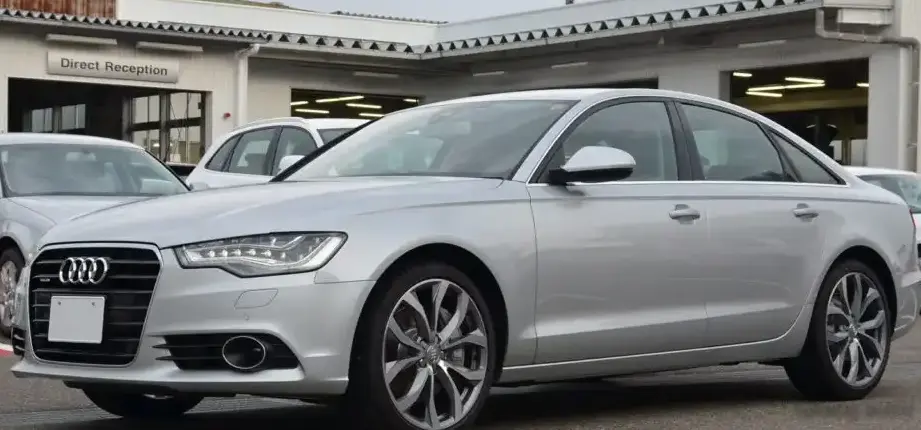
| Generation | A6 Sedan (4G, C7) |
| Type (Engine) | 2.0 TDI (136 Hp) Multitronic |
| Start of production | 2011 |
| End of production | 2014 |
| Powertrain Architecture | Internal Combustion engine |
| Body type | Sedan |
| Seats | 5 |
| Doors | 4 |
| Fuel consumption (urban) | 6 l/100 km (39.2 US mpg, 47.1 UK mpg, 16.7 km/l) |
| Fuel consumption (extra urban) | 4.4 l/100 km (53.5 US mpg, 64.2 UK mpg, 22.7 km/l) |
| Fuel consumption (combined) | 5 l/100 km (47 US mpg, 56.5 UK mpg, 20 km/l) |
| CO2 emissions | 132 g/km |
| Fuel Type | Diesel |
| Acceleration 0 – 100 km/h | 10.1 sec |
| Acceleration 0 – 62 mph | 10.1 sec |
| Acceleration 0 – 60 mph | 9.6 sec |
| Maximum speed | 205 km/h (127.38 mph) |
| Emission standard | Euro 5 |
| Weight-to-power ratio | 12.2 kg/Hp, 81.9 Hp/tonne |
| Weight-to-torque ratio | 4.7 kg/Nm, 210.8 Nm/tonne |
| Power | 136 Hp @ 4200 rpm |
| Power per litre | 69.1 Hp/l |
| Torque | 350 Nm @ 1750-2500 rpm (258.15 lb.-ft. @ 1750-2500 rpm) |
| Engine layout | Front, Longitudinal |
| Engine Model/Code | CSUE, CGLE |
| Engine displacement | 1968 cm3 (120.09 cu. in.) |
| Number of cylinders | 4 |
| Engine configuration | Inline |
| Cylinder Bore | 81 mm (3.19 in.) |
| Piston Stroke | 95.5 mm (3.76 in.) |
| Compression ratio | 19.5:1 |
| Number of valves per cylinder | 4 |
| Fuel injection system | Diesel Commonrail |
| Engine aspiration | Turbocharger, Intercooler |
| Engine oil capacity | 5 l (5.28 US qt | 4.4 UK qt) |
| Kerb Weight | 1660 kg (3659.67 lbs.) |
| Max. weight | 2165 kg (4773.01 lbs.) |
| Max load | 505 kg (1113.33 lbs.) |
| Trunk (boot) space – minimum | 530 l (18.72 cu. ft.) |
| Trunk (boot) space – maximum | 995 l (35.14 cu. ft.) |
| Fuel tank capacity | 65 l (17.17 US gal | 14.3 UK gal) |
| Max. roof load | 100 kg (220.46 lbs.) |
| Permitted trailer load without brakes | 750 kg (1653.47 lbs.) |
| Permitted towbar download | 85 kg (187.39 lbs.) |
| Length | 4915 mm (193.5 in.) |
| Width | 1874 mm (73.78 in.) |
| Width including mirrors | 2086 mm (82.13 in.) |
| Height | 1468 mm (57.8 in.) |
| Wheelbase | 2912 mm (114.65 in.) |
| Front track | 1627 mm (64.06 in.) |
| Rear (Back) track | 1618 mm (63.7 in.) |
| Front overhang | 912 mm (35.91 in.) |
| Rear overhang | 1091 mm (42.95 in.) |
| Ride height (ground clearance) | 117 mm (4.61 in.) |
| Drag coefficient (Cd) | 0.26 |
| Minimum turning circle (turning diameter) | 11.9 m (39.04 ft.) |
| Drivetrain Architecture | The Internal combustion engine (ICE) drives the front wheels of the vehicle. |
| Drive wheel | Front wheel drive |
| Number of gears and type of gearbox | automatic transmission Multitronic |
| Front suspension | Independent multi-link suspension |
| Rear suspension | Independent on trapezoidal lever |
| Front brakes | Ventilated discs |
| Rear brakes | Disc |
| Assisting systems | ABS (Anti-lock braking system) |
| Steering type | Steering rack and pinion |
| Power steering | Electric Steering |
| Tires size | 225/55 R17 |
| Wheel rims size | 17 |
The Audi A6 Sedan (4G, C7) 2.0 TDI 136 hp Multitronic, launched in 2011, was a core model within Audi’s A6 lineup. Built on the Volkswagen Group’s MLB platform (specifically the 4HX0/A3 variant for longitudinal engine layouts), it represented a move towards greater efficiency and refinement in the executive sedan segment. This variant was particularly popular in Europe, where diesel engines were favored for their fuel economy and torque characteristics. The 136 hp output and Multitronic transmission combination positioned it as a sensible, comfortable, and relatively affordable entry point into the A6 range, appealing to drivers prioritizing practicality and running costs over outright performance.
Powertrain & Engine Architecture
At the heart of the A6 2.0 TDI Multitronic lies the Volkswagen Group’s common rail diesel engine, specifically the CSUE or CGLE engine code depending on the specific production year and market. This 1968cc inline-four cylinder engine utilizes a turbocharger with an intercooler to boost power and efficiency. The engine features four valves per cylinder and a high compression ratio of 19.5:1, contributing to its thermal efficiency. Fuel is delivered via a Bosch common rail direct injection system, allowing for precise fuel metering and optimized combustion. The Multitronic transmission is a continuously variable transmission (CVT) offering smooth, stepless gear changes. Unlike traditional automatic transmissions with fixed gear ratios, the Multitronic uses a chain-driven system to provide an infinite number of ratios within its operating range, optimizing engine speed for efficiency or performance. This particular Multitronic variant is an eight-speed unit, offering a wide range of ratios for both fuel economy and responsiveness.
Driving Characteristics
The 136 hp 2.0 TDI Multitronic A6 delivers a comfortable and refined driving experience, prioritizing smoothness and fuel efficiency over sporty acceleration. While not a performance-oriented variant, the 350 Nm (258 lb-ft) of torque available from 1750-2500 rpm provides adequate pulling power for everyday driving and overtaking maneuvers. The Multitronic transmission contributes to a seamless driving experience, eliminating the shift shocks associated with traditional automatics. However, the CVT can sometimes feel less engaging than a traditional gearbox, and may exhibit a slight “rubber band” effect under hard acceleration. The 0-60 mph time of around 9.6 seconds is respectable but not particularly quick. The Multitronic’s programming prioritizes fuel economy, resulting in relatively conservative gear changes. Manual override is available, allowing drivers to select specific ratios, but the transmission’s response can feel somewhat delayed compared to a dual-clutch transmission.
Equipment & Trim Levels
The A6 2.0 TDI 136 hp Multitronic typically came equipped with a generous level of standard features. These included automatic climate control, a multi-function steering wheel, power windows and mirrors, and an Audi Concert audio system. Interior upholstery was typically cloth, although leather options were available as upgrades. Trim levels varied by market, but common options included upgraded alloy wheels, parking sensors, a sunroof, and a navigation system. The A6 also offered a range of driver assistance systems, such as adaptive cruise control and lane departure warning, as optional extras. The dashboard layout was typical of Audi at the time, featuring a clean and minimalist design with high-quality materials.
Chassis & Braking
The C7 A6 featured a sophisticated chassis design, incorporating lightweight construction techniques to reduce weight and improve handling. The front suspension utilized an independent multi-link setup, while the rear suspension employed an independent trapezoidal link design. This configuration provided a comfortable ride and good handling characteristics. Braking duties were handled by ventilated discs at the front and solid discs at the rear. Anti-lock braking system (ABS) and electronic stability control (ESC) were standard features, enhancing safety and stability. The steering system was a rack-and-pinion setup with electric power assistance, providing precise and responsive steering feel.
Market Reception & Comparison
The Audi A6 2.0 TDI 136 hp Multitronic was generally well-received by automotive critics. It was praised for its fuel efficiency, comfortable ride, and refined interior. However, some critics noted that the engine lacked outright performance and that the Multitronic transmission could feel somewhat detached. Compared to the more powerful 3.0 TDI variants, the 2.0 TDI offered significantly lower running costs but lacked the same level of performance. Against competitors such as the BMW 520d and Mercedes-Benz E220 CDI, the A6 2.0 TDI offered a compelling combination of features, efficiency, and refinement. The Multitronic transmission, while smooth, was sometimes criticized for its lack of engagement compared to the traditional automatic transmissions offered by BMW and Mercedes-Benz.
Legacy
The 2.0 TDI engine and Multitronic transmission combination proved to be relatively reliable, although the Multitronic transmission requires regular servicing, including fluid changes, to ensure longevity. The 2.0 TDI engine is known for its durability and fuel efficiency. On the used car market, the A6 2.0 TDI 136 hp Multitronic represents a good value proposition, offering a comfortable and well-equipped executive sedan at an affordable price. However, potential buyers should be aware of the maintenance requirements of the Multitronic transmission and ensure that it has been properly serviced. The C7 A6, in general, is considered a well-built and reliable car, and the 2.0 TDI variant remains a popular choice for drivers seeking a practical and efficient executive sedan.