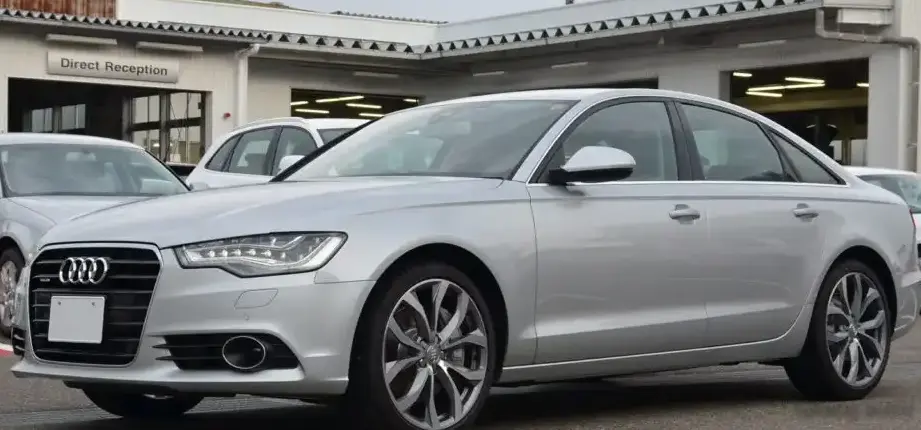
The Audi A6 Sedan (4G, C7) 3.0 TFSI V6 quattro Tiptronic Start-Stop represents a sophisticated iteration of Audi’s mid-size executive car, produced between 2013 and 2015. Positioned as a high-performance variant within the C7 generation (2011-2018), it combined a potent supercharged V6 engine with Audi’s renowned quattro all-wheel-drive system and a smooth-shifting eight-speed Tiptronic automatic transmission. This model aimed to deliver a blend of luxury, performance, and efficiency, appealing to buyers seeking a premium driving experience. It sat near the top of the A6 range, below the even more potent S6 model, and offered a significant step up in performance from the 2.0 TFSI and 3.0 TDI options.
Technical Specifications
| Brand | Audi |
| Model | A6 |
| Generation | A6 Sedan (4G, C7) |
| Type (Engine) | 3.0 TFSI V6 (310 Hp) quattro Tiptronic Start-Stop |
| Start of production | 2013 |
| End of production | 2015 |
| Powertrain Architecture | Internal Combustion engine |
| Body type | Sedan |
| Seats | 5 |
| Doors | 4 |
| Fuel consumption (economy) – urban (EPA) | 13.1 l/100 km (18 US mpg, 21.6 UK mpg, 7.6 km/l) |
| Fuel consumption (economy) – extra urban (EPA) | 8.4 l/100 km (28 US mpg, 33.6 UK mpg, 11.9 km/l) |
| Fuel consumption (economy) – combined (EPA) | 10.7 l/100 km (22 US mpg, 26.4 UK mpg, 9.3 km/l) |
| Fuel Type | Petrol (Gasoline) |
| Acceleration 0 – 60 mph | 5.3 sec |
| Maximum speed | 209 km/h (129.87 mph), Electronically limited |
| Emission standard | ULEV 2 |
| Weight-to-power ratio | 6 kg/Hp, 166.7 Hp/tonne |
| Weight-to-torque ratio | 4.2 kg/Nm, 236.6 Nm/tonne |
| Power | 310 Hp @ 5500-6500 rpm |
| Power per litre | 103.5 Hp/l |
| Torque | 440 Nm @ 2900-4500 rpm (324.53 lb.-ft. @ 2900-4500 rpm) |
| Engine layout | Front, Longitudinal |
| Engine Model/Code | EA837 / CTUA |
| Engine displacement | 2995 cm3 (182.77 cu. in.) |
| Number of cylinders | 6 |
| Engine configuration | V-engine |
| Cylinder Bore | 84.5 mm (3.33 in.) |
| Piston Stroke | 89 mm (3.5 in.) |
| Compression ratio | 10.3:1 |
| Number of valves per cylinder | 4 |
| Fuel injection system | Direct injection |
| Engine aspiration | Supercharger, Intercooler |
| Valvetrain | DOHC |
| Engine oil capacity | 6.8 l (7.19 US qt | 5.98 UK qt) |
| Coolant | 12 l (12.68 US qt | 10.56 UK qt) |
| Kerb Weight | 1860 kg (4100.6 lbs.) |
| Trunk (boot) space – minimum | 530 l (18.72 cu. ft.) |
| Trunk (boot) space – maximum | 995 l (35.14 cu. ft.) |
| Fuel tank capacity | 75 l (19.81 US gal | 16.5 UK gal) |
| Length | 4925 mm (193.9 in.) |
| Width | 1875 mm (73.82 in.) |
| Width including mirrors | 2086 mm (82.13 in.) |
| Height | 1468 mm (57.8 in.) |
| Wheelbase | 2912 mm (114.65 in.) |
| Front track | 1627 mm (64.06 in.) |
| Rear (Back) track | 1618 mm (63.7 in.) |
| Drag coefficient (Cd) | 0.28 |
| Minimum turning circle (turning diameter) | 11.9 m (39.04 ft.) |
| Drivetrain Architecture | The Internal combustion engine (ICE) drives permanently the four wheels of the vehicle. |
| Drive wheel | All wheel drive (4×4) |
| Number of gears and type of gearbox | 8 gears, automatic transmission Tiptronic |
| Front suspension | Coil spring, Independent multi-link suspension, Transverse stabilizer |
| Rear suspension | Independent on trapezoidal lever, Transverse stabilizer, Coil spring |
| Front brakes | Ventilated discs, 356 mm |
| Rear brakes | Ventilated discs, 330 mm |
| Assisting systems | ABS (Anti-lock braking system) |
| Steering type | Steering rack and pinion |
| Power steering | Electric Steering |
| Tires size | 225/55 R17; 245/45 R18; 255/40 R19; 255/35 R20 |
| Wheel rims size | 8J x 17; 8J x 18; 8.5J x 19; 8.5J x 20 |
Powertrain & Engine Architecture
At the heart of the A6 3.0 TFSI lies the EA837 engine, a 3.0-liter V6 gasoline engine. This engine utilizes a mechanically driven supercharger in conjunction with direct fuel injection to deliver a broad torque curve and responsive acceleration. The supercharger provides instant boost at low engine speeds, eliminating turbo lag, while direct injection optimizes combustion efficiency. The engine produces 310 horsepower at 5500-6500 rpm and 440 Nm (324.53 lb-ft) of torque between 2900 and 4500 rpm. The CTUA engine code specifically denotes this configuration. The eight-speed Tiptronic automatic transmission is a torque-converter type, offering smooth and quick shifts. It allows for both fully automatic operation and manual gear selection via steering wheel-mounted paddles or the gear selector. The Start & Stop system, standard on this model, automatically shuts off the engine when the vehicle is stationary to improve fuel economy.
Driving Characteristics
The 3.0 TFSI with the Tiptronic transmission delivers a refined and effortless driving experience. Acceleration is brisk, with a 0-60 mph time of 5.3 seconds. The supercharger provides immediate power delivery, making overtaking maneuvers easy and confident. Compared to the 2.0 TFSI, the 3.0 TFSI offers significantly more power and torque throughout the rev range. While the manual transmission versions of the A6 offered a more engaging driving experience, the Tiptronic provides a smoother, more comfortable ride, particularly in city traffic. The quattro all-wheel-drive system ensures excellent traction in all weather conditions, enhancing stability and control. The Tiptronic’s gear ratios are tuned for a balance of performance and fuel efficiency, with taller gears for highway cruising and shorter gears for quick acceleration.
Equipment & Trim Levels
The A6 3.0 TFSI quattro Tiptronic typically came well-equipped as standard. Features included leather upholstery, tri-zone automatic climate control, a premium sound system, and Audi’s Multi Media Interface (MMI) infotainment system with a central display screen. Optional extras included features like adaptive cruise control, a head-up display, ventilated front seats, and a panoramic sunroof. Trim levels varied slightly by market, but generally offered options for upgraded interior materials and exterior styling elements. The standard interior featured elegant wood or aluminum trim, and the seats provided excellent support and comfort.
Chassis & Braking
The A6 C7 utilizes a sophisticated chassis design featuring an independent suspension at all four wheels. The front suspension employs a multi-link setup with coil springs and a transverse stabilizer bar, while the rear suspension uses a trapezoidal link design with similar components. This configuration provides a comfortable ride while maintaining precise handling. Braking duties are handled by ventilated disc brakes on all four wheels, with larger discs at the front for increased stopping power. The A6 is equipped with ABS (Anti-lock Braking System) and electronic stability control as standard safety features. The steering is a rack-and-pinion system with electric power assistance, providing precise and responsive steering feel.
Market Reception & Comparison
The Audi A6 3.0 TFSI quattro Tiptronic was generally well-received by automotive critics. It was praised for its powerful engine, smooth transmission, comfortable ride, and luxurious interior. Compared to its rivals, such as the BMW 535i and Mercedes-Benz E350, the A6 offered a compelling combination of performance, refinement, and technology. Fuel economy was considered reasonable for a vehicle of its class, although it was not as efficient as the diesel-powered A6 TDI models. Reliability was generally good, although some owners reported minor issues with the infotainment system and electrical components.
Legacy
The EA837 3.0 TFSI engine has proven to be a durable and reliable powerplant when properly maintained. The Tiptronic transmission is also known for its longevity. On the used car market, the A6 3.0 TFSI quattro Tiptronic remains a desirable option for buyers seeking a premium mid-size sedan with strong performance and a luxurious interior. Regular maintenance, including oil changes and timing chain inspections, is crucial to ensure the long-term reliability of this powertrain. The C7 A6, particularly this variant, continues to be appreciated for its blend of sophistication, performance, and all-weather capability.