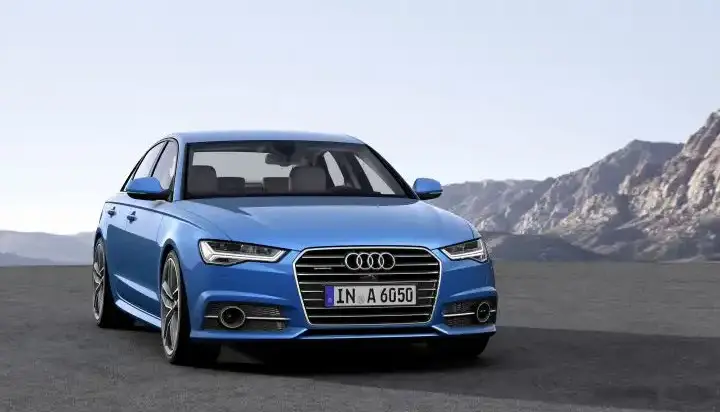
The Audi A6 Sedan (4G, C7 facelift) 2.0 TFSI quattro S tronic, produced from 2015 to 2016, represents a significant iteration of Audi’s mid-size executive car. This variant occupied a strong position within the C7 facelift range, offering a blend of performance, technology, and all-weather capability. It was positioned as a premium offering, bridging the gap between the entry-level 1.8 TFSI models and the higher-performance S6 and RS6 variants. The C7 facelift, introduced in 2014, brought revised styling, updated technology, and more efficient engine options to the A6 lineup, solidifying its competitive standing in the luxury sedan segment.
Technical Specifications
| Brand | Audi |
| Model | A6 |
| Generation | A6 Sedan (4G, C7 facelift 2014) |
| Type (Engine) | 2.0 TFSI (252 Hp) quattro S tronic |
| Start of production | 2015 |
| End of production | 2016 |
| Powertrain Architecture | Internal Combustion engine |
| Body type | Sedan |
| Seats | 5 |
| Doors | 4 |
| Fuel consumption (urban) | 8.3-8.4 l/100 km (28.3 – 28 US mpg, 34 – 33.6 UK mpg, 12 – 11.9 km/l) |
| Fuel consumption (extra urban) | 5.8-6 l/100 km (40.6 – 39.2 US mpg, 48.7 – 47.1 UK mpg, 17.2 – 16.7 km/l) |
| Fuel consumption (combined) | 6.7-6.9 l/100 km (35.1 – 34.1 US mpg, 42.2 – 40.9 UK mpg, 14.9 – 14.5 km/l) |
| CO2 emissions | 153-158 g/km |
| Fuel Type | Petrol (Gasoline) |
| Acceleration 0 – 100 km/h | 6.5 sec |
| Acceleration 0 – 62 mph | 6.5 sec |
| Acceleration 0 – 60 mph | 6.2 sec |
| Maximum speed | 250 km/h (155.34 mph) |
| Emission standard | Euro 6 |
| Weight-to-power ratio | 6.6 kg/Hp, 151.8 Hp/tonne |
| Weight-to-torque ratio | 4.5 kg/Nm, 222.9 Nm/tonne |
| Power | 252 Hp @ 5000-5900 rpm |
| Power per litre | 127 Hp/l |
| Torque | 370 Nm @ 1600-4700 rpm (272.9 lb.-ft. @ 1600-4700 rpm) |
| Engine layout | Front, Longitudinal |
| Engine Model/Code | EA888 / CYPA |
| Engine displacement | 1984 cm3 (121.07 cu. in.) |
| Number of cylinders | 4 |
| Engine configuration | Inline |
| Cylinder Bore | 82.5 mm (3.25 in.) |
| Piston Stroke | 92.8 mm (3.65 in.) |
| Compression ratio | 9.6:1 |
| Number of valves per cylinder | 4 |
| Fuel injection system | Direct injection and Multi-port manifold injection |
| Engine aspiration | Turbocharger, Intercooler |
| Valvetrain | DOHC |
| Engine oil capacity | 4.7 l (4.97 US qt | 4.14 UK qt) |
| Coolant | 8.5 l (8.98 US qt | 7.48 UK qt) |
| Kerb Weight | 1660 kg (3659.67 lbs.) |
| Max. weight | 2270 kg (5004.49 lbs.) |
| Max load | 610 kg (1344.82 lbs.) |
| Trunk (boot) space – minimum | 530 l (18.72 cu. ft.) |
| Trunk (boot) space – maximum | 995 l (35.14 cu. ft.) |
| Fuel tank capacity | 65 l (17.17 US gal | 14.3 UK gal) |
| Max. roof load | 100 kg (220.46 lbs.) |
| Permitted trailer load with brakes (8%) | 1800 kg (3968.32 lbs.) |
| Permitted trailer load with brakes (12%) | 1600 kg (3527.4 lbs.) |
| Permitted trailer load without brakes | 750 kg (1653.47 lbs.) |
| Permitted towbar download | 85 kg (187.39 lbs.) |
| Length | 4933 mm (194.21 in.) |
| Width | 1874 mm (73.78 in.) |
| Width including mirrors | 2086 mm (82.13 in.) |
| Height | 1455 mm (57.28 in.) |
| Wheelbase | 2912 mm (114.65 in.) |
| Front track | 1627 mm (64.06 in.) |
| Rear (Back) track | 1618 mm (63.7 in.) |
| Front overhang | 930 mm (36.61 in.) |
| Rear overhang | 1091 mm (42.95 in.) |
| Drag coefficient (Cd) | 0.28 |
| Minimum turning circle (turning diameter) | 11.9 m (39.04 ft.) |
| Drivetrain Architecture | The Internal combustion engine (ICE) drives permanently the four wheels of the vehicle. |
| Drive wheel | All wheel drive (4×4) |
| Number of gears and type of gearbox | 7 gears, automatic transmission S tronic |
| Front suspension | Independent multi-link suspension, Transverse stabilizer |
| Rear suspension | Independent on trapezoidal lever, Transverse stabilizer |
| Front brakes | Ventilated discs |
| Rear brakes | Ventilated discs |
| Assisting systems | ABS (Anti-lock braking system) |
| Steering type | Steering rack and pinion |
| Power steering | Electric Steering |
| Tires size | 225/55 R17 |
| Wheel rims size | 8J x 17 |
Powertrain & Engine Architecture
At the heart of the A6 2.0 TFSI quattro S tronic lies the EA888 engine, specifically the CYPA code variant. This 1984cc, turbocharged, inline-four cylinder engine is a cornerstone of the Volkswagen Group’s powertrain strategy. The CYPA features direct fuel injection combined with multi-point injection, optimizing combustion efficiency and reducing emissions. The engine utilizes a single turbocharger with an intercooler to deliver 252 horsepower at 5000-5900 rpm and 370 Nm (272.9 lb-ft) of torque between 1600 and 4700 rpm. The S tronic 7-speed dual-clutch transmission (DCT) is integral to the driving experience, offering rapid and smooth gear changes. This transmission is known for its efficiency and responsiveness, contributing to the car’s overall performance.
Driving Characteristics
The 2.0 TFSI quattro with the S tronic transmission delivers a refined and capable driving experience. Acceleration from 0-60 mph takes approximately 6.2 seconds, making it a brisk performer for a mid-size executive sedan. The quattro all-wheel-drive system provides excellent traction in various weather conditions, enhancing stability and confidence. The S tronic transmission’s quick shifts contribute to a feeling of immediacy, while the engine’s broad torque band ensures strong acceleration throughout the rev range. Compared to the base 1.8 TFSI, the 2.0 TFSI offers a noticeable performance upgrade. While not as overtly sporty as the S6, it provides ample power for everyday driving and long-distance cruising. The automatic transmission, while convenient, may not offer the same level of driver engagement as a manual gearbox.
Equipment & Trim Levels
The 2.0 TFSI quattro S tronic typically came well-equipped as standard. Features included leather upholstery, tri-zone automatic climate control, a multi-function steering wheel, and Audi’s MMI infotainment system with a central display screen. Standard safety features encompassed ABS, electronic stability control, and multiple airbags. Optional extras included features like a navigation system, a premium sound system (Bang & Olufsen), adaptive cruise control, and parking assistance systems. Trim levels varied slightly by market, but generally offered options for upgraded interior finishes and exterior styling elements.
Chassis & Braking
The A6 C7 utilizes a sophisticated chassis design featuring independent suspension all around. The front suspension employs a multi-link setup, while the rear utilizes a trapezoidal link configuration. Both ends are equipped with transverse stabilizers to minimize body roll. The 2.0 TFSI quattro models were typically fitted with ventilated disc brakes on all four wheels, providing ample stopping power. The quattro all-wheel-drive system distributes power between the front and rear axles as needed, optimizing traction and stability. The steering is a rack-and-pinion system with electric power assistance, offering precise and responsive control.
Market Reception & Comparison
The Audi A6 2.0 TFSI quattro S tronic was generally well-received by automotive critics. It was praised for its refined driving experience, comfortable interior, and advanced technology. Fuel economy was considered respectable for its class, with combined figures ranging from 6.7 to 6.9 l/100 km. Compared to rivals like the BMW 5 Series and Mercedes-Benz E-Class, the A6 offered a compelling blend of performance, luxury, and technology. The 2.0 TFSI engine provided a good balance between power and efficiency, making it a popular choice for buyers who prioritized both attributes. Some critics noted that the ride could be slightly firm on certain road surfaces, but overall, the A6 was considered a highly competent and desirable executive sedan.
Legacy
The EA888 engine, in its various iterations, has proven to be a durable and reliable powerplant. The S tronic transmission, while requiring more diligent maintenance than a traditional automatic, is generally considered robust when properly serviced. The A6 C7 2.0 TFSI quattro S tronic remains a popular choice in the used car market, offering a good value proposition for buyers seeking a well-equipped and capable luxury sedan. Regular maintenance, including oil changes and transmission servicing, is crucial to ensure the long-term reliability of this powertrain. The combination of quattro all-wheel drive and a responsive engine continues to make this variant a desirable option for drivers in regions with challenging weather conditions.