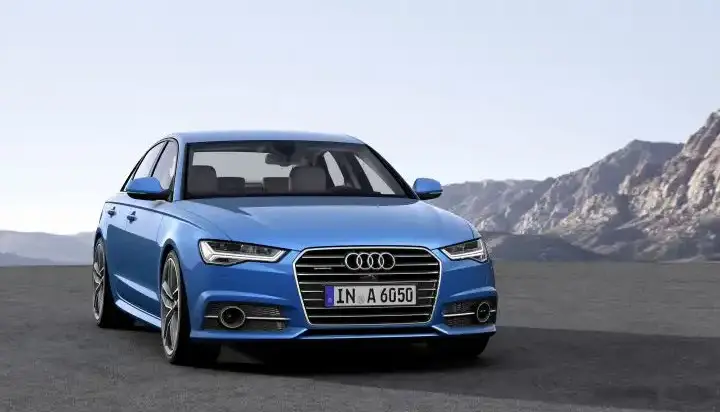
The Audi A6 Sedan (4G, C7 facelift) 2.0 TFSI quattro Tiptronic, produced from 2015 to 2016, represents a mid-cycle refresh of the fourth-generation A6. This variant occupied a significant position within the A6 lineup, offering a balance between performance, luxury, and all-weather capability. It catered to buyers seeking a sophisticated executive sedan with a potent engine and the added security of Audi’s quattro all-wheel-drive system. The “facelift” designation (C7) indicates cosmetic and technological updates applied to the original C7 platform (introduced in 2011), enhancing its appeal in a competitive segment.
Technical Specifications
| Brand | Audi |
| Model | A6 |
| Generation | A6 Sedan (4G, C7 facelift 2014) |
| Type (Engine) | 2.0 TFSI (252 Hp) quattro Tiptronic |
| Start of production | 2015 |
| End of production | 2016 |
| Powertrain Architecture | Internal Combustion engine |
| Body type | Sedan |
| Seats | 5 |
| Doors | 4 |
| Fuel consumption (economy) – urban (EPA) | 10.7 l/100 km (22 US mpg, 26.4 UK mpg, 9.3 km/l) |
| Fuel consumption (economy) – extra urban (EPA) | 7.4 l/100 km (31.8 US mpg, 38.2 UK mpg, 13.5 km/l) |
| Fuel consumption (economy) – combined (EPA) | 9 l/100 km (26.1 US mpg, 31.4 UK mpg, 11.1 km/l) |
| Fuel Type | Petrol (Gasoline) |
| Acceleration 0 – 60 mph | 5.8 sec |
| Maximum speed | 209 km/h (129.87 mph), Electronically limited |
| Emission standard | ULEV 125 |
| Weight-to-power ratio | 7.1 kg/Hp, 140.4 Hp/tonne |
| Weight-to-torque ratio | 4.9 kg/Nm, 206.1 Nm/tonne |
| Power | 252 Hp @ 5000-6000 rpm |
| Power per litre | 127 Hp/l |
| Torque | 370 Nm @ 1600-4500 rpm (272.9 lb.-ft. @ 1600-4500 rpm) |
| Engine layout | Front, Longitudinal |
| Engine Model/Code | EA888 / CYNB |
| Engine displacement | 1984 cm3 (121.07 cu. in.) |
| Number of cylinders | 4 |
| Engine configuration | Inline |
| Cylinder Bore | 82.5 mm (3.25 in.) |
| Piston Stroke | 92.8 mm (3.65 in.) |
| Compression ratio | 9.6:1 |
| Number of valves per cylinder | 4 |
| Fuel injection system | Direct injection |
| Engine aspiration | Turbocharger, Intercooler |
| Valvetrain | DOHC |
| Engine oil capacity | 4.6 l (4.86 US qt | 4.05 UK qt) |
| Coolant | 10 l (10.57 US qt | 8.8 UK qt) |
| Kerb Weight | 1795 kg (3957.3 lbs.) |
| Trunk (boot) space – minimum | 530 l (18.72 cu. ft.) |
| Trunk (boot) space – maximum | 995 l (35.14 cu. ft.) |
| Fuel tank capacity | 75 l (19.81 US gal | 16.5 UK gal) |
| Length | 4932 mm (194.17 in.) |
| Width | 1875 mm (73.82 in.) |
| Width including mirrors | 2086 mm (82.13 in.) |
| Height | 1468 mm (57.8 in.) |
| Wheelbase | 2912 mm (114.65 in.) |
| Front track | 1627 mm (64.06 in.) |
| Rear (Back) track | 1618 mm (63.7 in.) |
| Drag coefficient (Cd) | 0.28 |
| Minimum turning circle (turning diameter) | 11.9 m (39.04 ft.) |
| Drivetrain Architecture | The Internal combustion engine (ICE) drives permanently the four wheels of the vehicle. |
| Drive wheel | All wheel drive (4×4) |
| Number of gears and type of gearbox | 8 gears, automatic transmission Tiptronic |
| Front suspension | Coil spring, Independent multi-link suspension, Transverse stabilizer |
| Rear suspension | Independent on trapezoidal lever, Transverse stabilizer, Coil spring |
| Front brakes | Ventilated discs, 345 mm |
| Rear brakes | Ventilated discs, 330 mm |
| Assisting systems | ABS (Anti-lock braking system) |
| Steering type | Steering rack and pinion |
| Power steering | Electric Steering |
| Tires size | 245/45 R18; 255/40 R19; 255/35 R20 |
| Wheel rims size | 8J x 18; 8.5J x 19; 8.5J x 20 |
Powertrain & Engine Architecture
At the heart of the A6 2.0 TFSI quattro Tiptronic lies the EA888 engine, specifically the CYNB variant. This 1.984-liter inline-four cylinder engine utilizes direct fuel injection and a single turbocharger with an intercooler to produce 252 horsepower and 370 Nm (272.9 lb-ft) of torque. The direct injection system allows for precise fuel delivery, optimizing combustion efficiency and power output. The turbocharger provides a significant boost in power, particularly at lower engine speeds, mitigating turbo lag through careful design and implementation. The engine features a dual overhead camshaft (DOHC) valvetrain with four valves per cylinder, further enhancing its breathing and overall performance. The eight-speed Tiptronic automatic transmission is a torque-converter type, offering smooth and responsive gear changes. It allows for both fully automatic operation and manual gear selection via steering wheel-mounted paddles or the gear selector, providing the driver with greater control.
Driving Characteristics
The 2.0 TFSI engine, paired with the eight-speed Tiptronic transmission and quattro all-wheel drive, delivers a refined and capable driving experience. Acceleration from 0 to 60 mph takes a respectable 5.8 seconds. While not as overtly sporty as the A6’s higher-performance variants (like those with the 3.0-liter supercharged V6), this configuration provides ample power for everyday driving and confident highway passing. The Tiptronic transmission is well-tuned, offering seamless shifts and contributing to a comfortable ride. The quattro system provides excellent traction in all weather conditions, enhancing stability and control. Compared to the manual transmission versions of the 2.0 TFSI, the Tiptronic offers greater convenience, particularly in urban environments, but may sacrifice a small degree of driver engagement. The gear ratios are optimized for a balance of acceleration and fuel efficiency.
Equipment & Trim Levels
The 2.0 TFSI quattro Tiptronic typically came well-equipped, reflecting the A6’s positioning as a luxury sedan. Standard features often included leather upholstery, tri-zone automatic climate control, a multi-function steering wheel, and Audi’s MMI infotainment system with a central display screen. Optional extras were plentiful, including navigation, a premium sound system (Bang & Olufsen), adaptive cruise control, and various driver-assistance systems. Trim levels could vary slightly depending on the market, but generally offered packages that added features like upgraded interior trim, exterior styling enhancements, and advanced technology options.
Chassis & Braking
The A6 4G chassis utilizes a combination of high-strength steel and aluminum to achieve a balance of rigidity and weight savings. The front suspension features a multi-link design with coil springs and a transverse stabilizer bar, providing precise handling and a comfortable ride. The rear suspension employs an independent trapezoidal link setup, also with coil springs and a stabilizer bar. Braking duties are handled by ventilated disc brakes on all four wheels, with larger diameter discs at the front (345mm) compared to the rear (330mm). The anti-lock braking system (ABS) is standard, along with electronic stability control and traction control, enhancing safety and control in various driving conditions.
Market Reception & Comparison
The A6 2.0 TFSI quattro Tiptronic was generally well-received by automotive critics. It was praised for its refined engine, comfortable ride, and sophisticated interior. Fuel economy was considered reasonable for a vehicle of its size and performance, achieving around 26.1 US mpg in combined driving. Compared to the 3.0-liter V6 models, the 2.0 TFSI offered a more affordable entry point into the A6 range, albeit with slightly less power. The 2.0 TDI diesel variants were also popular, offering even better fuel economy but with a different driving character. Reliability was generally good, although some owners reported minor issues with the infotainment system and occasional oil consumption.
Legacy
The EA888 engine family, including the CYNB variant, has proven to be a robust and reliable powerplant. The eight-speed Tiptronic transmission has also demonstrated good durability. In the used car market, the A6 2.0 TFSI quattro Tiptronic remains a desirable option for buyers seeking a well-rounded luxury sedan. Regular maintenance, including oil changes and adherence to the manufacturer’s recommended service intervals, is crucial for ensuring long-term reliability. The combination of performance, luxury, and all-wheel-drive capability continues to make this variant a compelling choice for discerning drivers.