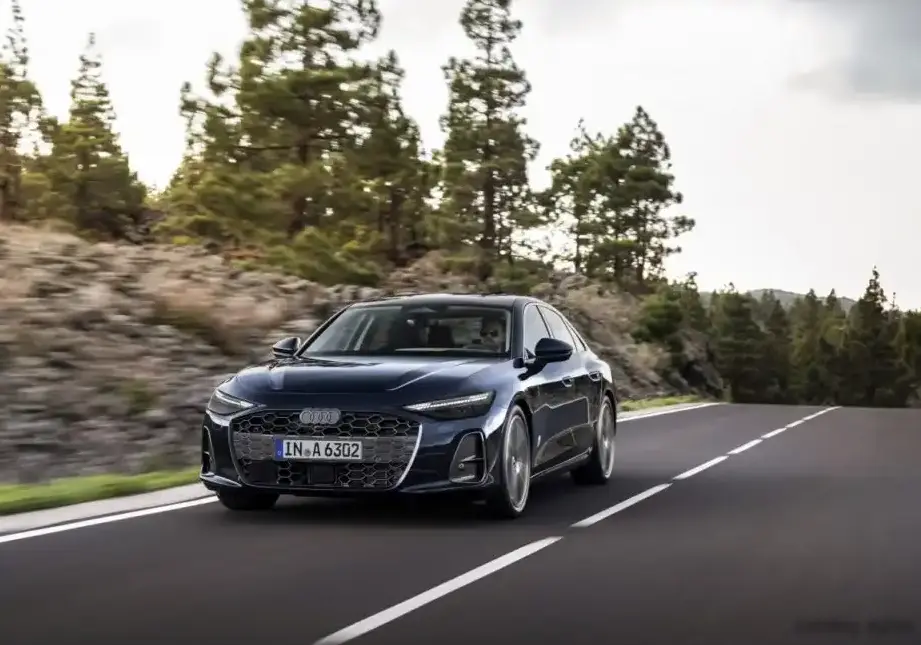
The Audi A6 Sedan (C9) 2.0 TDI, introduced in April 2025, represents a significant evolution in the mid-size luxury sedan segment. Positioned as a core offering within the C9 A6 lineup, this variant combines a 2.0-liter turbocharged diesel engine with a 48-volt mild hybrid system and Audi’s S tronic dual-clutch transmission. It’s designed to balance fuel efficiency, refined performance, and advanced technology, catering to buyers seeking a sophisticated and economical executive car. The C9 generation A6 builds upon the success of its predecessor, the C8, with a focus on digitalization and enhanced comfort features.
Technical Specifications
| Brand | Audi |
| Model | A6 |
| Generation | A6 Sedan (C9) |
| Type (Engine) | 2.0 TDI (204 Hp) Mild Hybrid plus S tronic |
| Start of production | April, 2025 |
| Powertrain Architecture | MHEV (Mild Hybrid Electric Vehicle) |
| Body type | Sedan |
| Seats | 5 |
| Doors | 4 |
| Fuel consumption at Low speed (WLTP) | 6.5 l/100 km (36.2 US mpg, 43.5 UK mpg, 15.4 km/l) |
| Fuel consumption at Medium speed (WLTP) | 4.5 l/100 km (52.3 US mpg, 62.8 UK mpg, 22.2 km/l) |
| Fuel consumption at high speed (WLTP) | 4.4 l/100 km (53.5 US mpg, 64.2 UK mpg, 22.7 km/l) |
| Fuel consumption at very high speed (WLTP) | 5.2 l/100 km (45.2 US mpg, 54.3 UK mpg, 19.2 km/l) |
| Combined fuel consumption (WLTP) | 4.8-5.6 l/100 km (49 – 42 US mpg, 58.9 – 50.4 UK mpg, 20.8 – 17.9 km/l) |
| CO2 emissions (WLTP) | 126-146 g/km |
| Fuel Type | Diesel |
| Acceleration 0 – 100 km/h | 7.8 sec |
| Acceleration 0 – 62 mph | 7.8 sec |
| Acceleration 0 – 60 mph | 7.4 sec |
| Maximum speed | 244 km/h (151.61 mph) |
| Emission standard | Euro 6e |
| Weight-to-power ratio | 9.4 kg/Hp, 106.8 Hp/tonne |
| Weight-to-torque ratio | 4.8 kg/Nm, 209.4 Nm/tonne |
| Gross battery capacity | 1.7 kWh |
| Battery voltage | 48 V |
| Battery technology | Lithium iron phosphate (LiFePO4) |
| Battery location | Under the trunk |
| Recuperation output | 25 kW |
| Electric motor power | 24 Hp |
| Electric motor Torque | 230 Nm (169.64 lb.-ft.) |
| Electric motor location | Middle, Longitudinal |
| Power | 204 Hp @ 3800-4200 rpm |
| Power per litre | 103.7 Hp/l |
| Torque | 400 Nm @ 1750-3250 rpm (295.02 lb.-ft. @ 1750-3250 rpm) |
| Engine layout | Front, Longitudinal |
| Engine displacement | 1968 cm3 (120.09 cu. in.) |
| Number of cylinders | 4 |
| Engine configuration | Inline |
| Cylinder Bore | 81 mm (3.19 in.) |
| Piston Stroke | 95.5 mm (3.76 in.) |
| Compression ratio | 15.5:1 |
| Number of valves per cylinder | 4 |
| Fuel injection system | Diesel Commonrail |
| Engine aspiration | Turbocharger, Intercooler |
| Valvetrain | DOHC |
| Engine oil capacity | 5.5 l (5.81 US qt | 4.84 UK qt) |
| Coolant | 17.1 l (18.07 US qt | 15.05 UK qt) |
| Kerb Weight | 1910 kg (4210.83 lbs.) |
| Max. weight | 2535 kg (5588.72 lbs.) |
| Max load | 625 kg (1377.89 lbs.) |
| Trunk (boot) space – minimum | 452 l (15.96 cu. ft.) |
| Fuel tank capacity | 60 l (15.85 US gal | 13.2 UK gal) |
| AdBlue tank | 20 l (5.28 US gal | 4.4 UK gal) |
| Max. roof load | 100 kg (220.46 lbs.) |
| Permitted trailer load with brakes (8%) | 2000 kg (4409.25 lbs.) |
| Permitted trailer load with brakes (12%) | 2000 kg (4409.25 lbs.) |
| Permitted trailer load without brakes | 750 kg (1653.47 lbs.) |
| Permitted towbar download | 95 kg (209.44 lbs.) |
| Length | 4999 mm (196.81 in.) |
| Width | 1875 mm (73.82 in.) |
| Width including mirrors | 2099 mm (82.64 in.) |
| Height | 1452 mm (57.17 in.) |
| Wheelbase | 2923 mm (115.08 in.) |
| Front track | 1626 mm (64.02 in.) |
| Rear (Back) track | 1610 mm (63.39 in.) |
| Front overhang | 938 mm (36.93 in.) |
| Rear overhang | 1138 mm (44.8 in.) |
| Drag coefficient (Cd) | 0.26 |
| Minimum turning circle (turning diameter) | 12.3 m (40.35 ft.) |
| Approach angle | 14.1° |
| Departure angle | 16.9° |
| Drivetrain Architecture | ICE and electric motor drive the front wheels |
| Drive wheel | Front wheel drive |
| Number of gears and type of gearbox | 7 gears, automatic transmission S tronic |
| Front suspension | Coil spring, Independent multi-link suspension, Transverse stabilizer, Air Suspension – Optional |
| Rear suspension | Independent multi-link spring suspension with stabilizer, Air Suspension – Optional |
| Front brakes | Ventilated discs, 338 mm |
| Rear brakes | Ventilated discs, 330 mm |
| Tires size | 225/60 R17; 225/55 R18; 245/45 R19; 255/40 R20; 255/35 R21 |
| Wheel rims size | 7.5J x 17; 8J x 18; 8.5J x 19; 8.5J x 20; 8.5J x 21 |
INTRODUCTION
The Audi A6 Sedan (C9) 2.0 TDI with the S tronic transmission represents a key variant in the ninth generation of Audi’s flagship executive sedan. Introduced in 2025, this model is designed to appeal to drivers prioritizing fuel economy and a comfortable driving experience without sacrificing the A6’s renowned refinement and technology. It slots into the A6 range as a more accessible entry point compared to the higher-powered petrol and diesel options, and the e-tron plug-in hybrid models. The C9 A6 is built on an evolution of the MLB Evo platform, shared with other Volkswagen Group vehicles, and emphasizes a more digital and connected driving experience.
Powertrain & Engine Architecture
At the heart of the A6 2.0 TDI is the Volkswagen Group’s EA288 evo diesel engine, specifically the version producing 204 horsepower. This engine utilizes a 2.0-liter inline-four cylinder configuration with common-rail direct injection and a turbocharger with an intercooler. The engine code is likely to fall within the current range, potentially a further refinement of existing codes. The mild hybrid system, operating at 48 volts, incorporates a belt starter generator (BSG) and a small lithium-ion battery. This system allows for extended start-stop functionality, regenerative braking, and a limited amount of electric assistance during acceleration. The S tronic 7-speed dual-clutch transmission provides quick and smooth gear changes, contributing to both performance and efficiency. The transmission is longitudinally mounted, driving the front wheels in this configuration.
Driving Characteristics
The 204 hp 2.0 TDI with the S tronic transmission delivers a balanced driving experience. While not as overtly sporty as the higher-output A6 variants, it provides ample power for everyday driving and highway cruising. Acceleration from 0-60 mph takes approximately 7.4 seconds. The S tronic transmission’s quick shifts and well-chosen gear ratios ensure responsive acceleration. The mild hybrid system subtly enhances the driving experience by smoothing out the start-stop transitions and providing a small boost during acceleration. Compared to a manual transmission version (if offered), the S tronic prioritizes convenience and ease of use, while potentially sacrificing a small degree of driver engagement. Compared to the more powerful 3.0 TDI, this variant offers significantly better fuel economy but less outright performance.
Equipment & Trim Levels
The A6 2.0 TDI typically comes well-equipped as standard. Expect features such as Audi’s Virtual Cockpit digital instrument cluster, a touchscreen infotainment system with Apple CarPlay and Android Auto integration, leather upholstery, automatic climate control, and a suite of driver-assistance systems including lane departure warning and automatic emergency braking. Optional extras often include a premium sound system, adaptive cruise control, a head-up display, and upgraded interior trim materials. Trim levels may vary by market, but generally offer increasing levels of luxury and technology. The base trim focuses on essential features, while higher trims add more comfort and convenience items.
Chassis & Braking
The A6 2.0 TDI utilizes a sophisticated suspension setup designed to provide a comfortable and controlled ride. Front suspension consists of a multi-link independent setup, while the rear features a similar multi-link design. Optional air suspension is available, offering adjustable ride height and damping for enhanced comfort and handling. Braking is handled by ventilated disc brakes on all four wheels, providing ample stopping power. ABS, electronic stability control, and traction control are standard features. The chassis is tuned to balance comfort and handling, offering a refined driving experience without feeling overly sporty.
Market Reception & Comparison
The Audi A6 2.0 TDI with S tronic has generally been well-received by automotive critics. It’s praised for its fuel efficiency, comfortable ride, and refined interior. Critics note that while it may not be the most exciting A6 variant to drive, it offers a compelling combination of practicality and luxury. Compared to rivals like the BMW 5 Series and Mercedes-Benz E-Class, the A6 2.0 TDI is often seen as a strong contender, particularly for buyers prioritizing fuel economy and technology. The mild hybrid system contributes to improved fuel economy compared to previous generation diesel A6 models.
Legacy
The EA288 diesel engine family has proven to be relatively reliable, although proper maintenance is crucial. The S tronic transmission, while generally robust, requires regular servicing to ensure smooth operation. The integration of the 48-volt mild hybrid system adds a layer of complexity, but early indications suggest it is a reliable component. In the used car market, the A6 2.0 TDI is expected to hold its value well, particularly models with a full service history and low mileage. Its combination of fuel efficiency, comfort, and technology makes it an attractive option for buyers seeking a premium executive sedan.