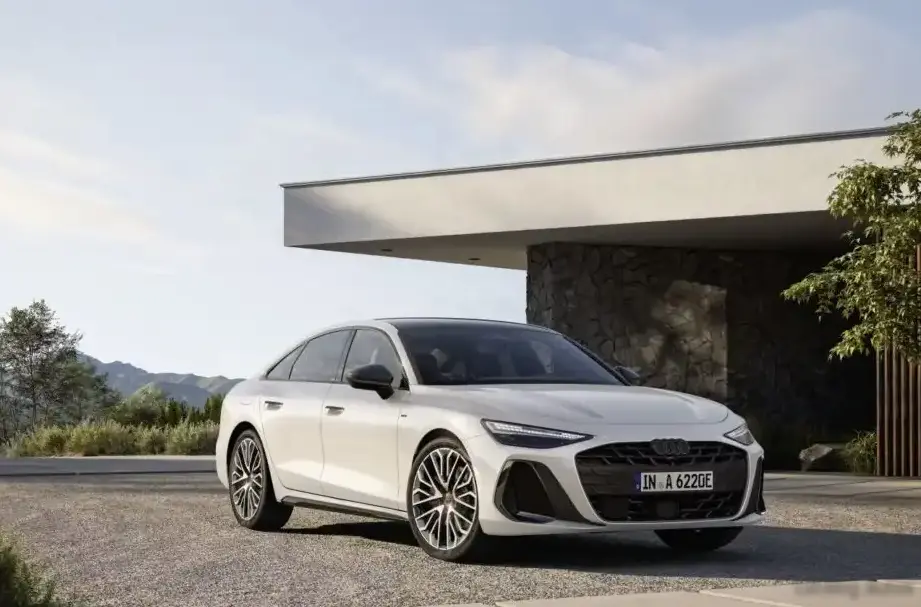
The Audi A6 Sedan (C9) 2.0 TFSI e-hybrid quattro ultra, launched in May 2025, represents Audi’s commitment to plug-in hybrid technology within its executive sedan lineup. This variant combines a 2.0-liter turbocharged four-cylinder gasoline engine with an electric motor and a substantial battery pack, offering both all-electric driving capability and the extended range of a traditional internal combustion engine. Positioned as a mid-range offering within the C9 A6 family, it caters to buyers seeking a balance between performance, efficiency, and environmental responsibility. The C9 generation A6 builds upon the success of its predecessors, incorporating advanced technology and a refined driving experience.
Technical Specifications
| Brand | Audi |
| Model | A6 |
| Generation | A6 Sedan (C9) |
| Type (Engine) | 2.0 TFSI (299 Hp) e-hybrid quattro ultra S tronic |
| Start of production | May, 2025 |
| Powertrain Architecture | PHEV (Plug-in Hybrid Electric Vehicle) |
| Body type | Sedan |
| Seats | 5 |
| Doors | 4 |
| Combined fuel consumption (WLTP) | 2.1-7.5 l/100 km (112 – 31.4 US mpg, 134.5 – 37.7 UK mpg, 47.6 – 13.3 km/l) |
| CO2 emissions (WLTP) | 48-63 g/km |
| Fuel Type | Petrol / electricity |
| Acceleration 0 – 100 km/h | 6 sec |
| Acceleration 0 – 62 mph | 6 sec |
| Acceleration 0 – 60 mph | 5.7 sec |
| Maximum speed | 250 km/h (155.34 mph) |
| Emission standard | Euro 6e |
| Weight-to-power ratio | 7.1 kg/Hp, 140.4 Hp/tonne |
| Weight-to-torque ratio | 4.7 kg/Nm, 211.3 Nm/tonne |
| Gross battery capacity | 25.9 kWh |
| Net (usable) battery capacity | 20.7 kWh |
| Battery voltage | 400 V |
| Battery technology | Lithium-ion (Li-Ion) |
| Battery location | Under the trunk |
| Recuperation output | 88 kW |
| All-electric range (WLTP) | 88-106 km (54.68 – 65.87 mi) |
| Average Energy consumption (WLTP) | 15-16.1 kWh/100 km (24.14 – 25.91 kWh/100 mi, 140 – 130 MPGe, 6.7 – 6.2 km/kWh, 4.1 – 3.9 mi/kWh) |
| Max speed (electric) | 140 km/h (86.99 mph) |
| Electric motor power | 143 Hp |
| Electric motor Torque | 350 Nm (258.15 lb.-ft.) |
| Electric motor location | Between the combustion engine and the transmission |
| Electric motor type | Synchronous |
| System power | 299 Hp |
| System torque | 450 Nm (331.9 lb.-ft.) |
| Power | 252 Hp @ 5000-6500 rpm |
| Torque | 380 Nm @ 1600-4500 rpm (280.27 lb.-ft. @ 1600-4500 rpm) |
| Engine layout | Front, Longitudinal |
| Engine displacement | 1984 cm3 (121.07 cu. in.) |
| Number of cylinders | 4 |
| Engine configuration | Inline |
| Cylinder Bore | 82.5 mm (3.25 in.) |
| Piston Stroke | 92.8 mm (3.65 in.) |
| Compression ratio | 10.5:1 |
| Number of valves per cylinder | 4 |
| Fuel injection system | Direct injection |
| Engine aspiration | Turbocharger, Intercooler |
| Valvetrain | DOHC |
| Engine oil capacity | 6 l (6.34 US qt | 5.28 UK qt) |
| Coolant | 20.1 l (21.24 US qt | 17.69 UK qt) |
| Kerb Weight | 2130 kg (4695.85 lbs.) |
| Max. weight | 2740 kg (6040.67 lbs.) |
| Max load | 610 kg (1344.82 lbs.) |
| Trunk (boot) space – minimum | 354 l (12.5 cu. ft.) |
| Fuel tank capacity | 46 l (12.15 US gal | 10.12 UK gal) |
| Max. roof load | 100 kg (220.46 lbs.) |
| Permitted trailer load with brakes (8%) | 2000 kg (4409.25 lbs.) |
| Permitted trailer load with brakes (12%) | 2000 kg (4409.25 lbs.) |
| Permitted trailer load without brakes | 750 kg (1653.47 lbs.) |
| Permitted towbar download | 95 kg (209.44 lbs.) |
| Length | 4999 mm (196.81 in.) |
| Width | 1875 mm (73.82 in.) |
| Width including mirrors | 2099 mm (82.64 in.) |
| Height | 1452 mm (57.17 in.) |
| Wheelbase | 2923 mm (115.08 in.) |
| Front track | 1626 mm (64.02 in.) |
| Rear (Back) track | 1610 mm (63.39 in.) |
| Front overhang | 938 mm (36.93 in.) |
| Rear overhang | 1138 mm (44.8 in.) |
| Drag coefficient (Cd) | 0.26 |
| Minimum turning circle (turning diameter) | 12.4 m (40.68 ft.) |
| Approach angle | 14.4° |
| Departure angle | 16.8° |
| Drivetrain Architecture | The Internal combustion engine (ICE) and the electric motor permanently drive the front wheels of the vehicle, capable of running in full electric or mixed mode, and if necessary through the electrically or mechanically controlled clutch, the rear wheels are driven. |
| Drive wheel | All wheel drive (4×4) |
| Number of gears and type of gearbox | 7 gears, automatic transmission S tronic |
| Front suspension | Coil spring, Independent multi-link suspension, Transverse stabilizer, Air Suspension – Optional |
| Rear suspension | Independent multi-link spring suspension with stabilizer, Air Suspension – Optional |
| Front brakes | Ventilated discs, 360 mm |
| Rear brakes | Ventilated discs, 350 mm |
| Assisting systems | ABS (Anti-lock braking system), 4-wheel steering (4WS, active rear steering) |
| Steering type | Steering rack and pinion |
| Power steering | Electric Steering |
| Tires size | 225/55 R18 |
| Wheel rims size | 8J x 18 |
INTRODUCTION
The Audi A6 Sedan (C9) 2.0 TFSI e-hybrid quattro ultra is a plug-in hybrid variant of the C9 generation A6, introduced in May 2025. It’s built on the modular longitudinal platform (MLB evo) shared with other Volkswagen Group vehicles. This model aims to provide a compelling alternative to traditional gasoline-powered vehicles, offering reduced emissions and the potential for significant fuel savings. The “ultra” designation signifies Audi’s focus on efficiency and lightweight construction. The combination of a turbocharged engine, electric motor, and quattro all-wheel drive delivers a sophisticated driving experience.
Powertrain & Engine Architecture
At the heart of the A6 2.0 TFSI e-hybrid is a 1984cc, inline-four cylinder engine utilizing direct fuel injection and a single turbocharger. This engine, identified by engine codes such as those within the EA888 family, produces 252 horsepower at 5000-6500 rpm and 380 Nm (280.27 lb-ft) of torque between 1600-4500 rpm. The turbocharger is an integral part of the engine’s design, providing increased power and torque output. The engine is paired with a 143 hp electric motor integrated between the engine and the seven-speed S tronic dual-clutch transmission. This transmission is known for its quick and smooth gear changes. The 25.9 kWh (gross) / 20.7 kWh (net) lithium-ion battery pack is located under the trunk floor, providing an all-electric range of 88-106 km (54.68 – 65.87 mi) according to WLTP standards. The system’s combined output reaches 299 hp and 450 Nm (331.9 lb.-ft.) of torque. The electric motor utilizes a synchronous design, known for its efficiency and power density.
Driving Characteristics
The A6 2.0 TFSI e-hybrid quattro ultra offers a refined and versatile driving experience. In all-electric mode, the vehicle provides near-silent operation and instant torque, resulting in brisk acceleration. When the battery is depleted or additional power is required, the gasoline engine seamlessly engages, providing a combined output that delivers a 0-100 km/h (0-62 mph) time of 6 seconds. The S tronic transmission contributes to smooth and responsive gear changes. The quattro all-wheel-drive system ensures excellent traction and stability in various driving conditions. The gear ratios are optimized for both efficiency and performance, providing a balance between fuel economy and responsiveness. Compared to higher-output A6 variants, such as those with the 3.0-liter V6 engine, this e-hybrid model prioritizes efficiency and offers a different driving character, focusing on smooth, linear power delivery rather than outright performance.
Equipment & Trim Levels
The A6 2.0 TFSI e-hybrid quattro ultra typically comes well-equipped as standard. Features include Audi’s virtual cockpit digital instrument cluster, a touchscreen infotainment system with navigation, leather upholstery, tri-zone automatic climate control, and a suite of advanced driver-assistance systems such as adaptive cruise control, lane-keeping assist, and automatic emergency braking. Optional extras may include a Bang & Olufsen premium sound system, massaging front seats, and a head-up display. Interior trim levels vary, offering choices in wood, aluminum, or carbon fiber accents. The exterior styling is consistent with other C9 A6 models, featuring Audi’s signature Singleframe grille and sleek LED headlights.
Chassis & Braking
The A6 2.0 TFSI e-hybrid utilizes a sophisticated chassis design. The front suspension features a five-link independent setup with coil springs, while the rear suspension employs a multi-link independent design. Optional air suspension is available, providing adjustable ride height and enhanced comfort. The braking system consists of ventilated discs on all four wheels, with front discs measuring 360mm and rear discs measuring 350mm. ABS (Anti-lock Braking System) and electronic stability control are standard features. The vehicle’s weight distribution is carefully optimized to enhance handling and stability. The quattro all-wheel-drive system actively distributes torque between the front and rear axles, maximizing traction in all conditions.
Market Reception & Comparison
The Audi A6 2.0 TFSI e-hybrid quattro ultra has been generally well-received by automotive critics. It’s praised for its fuel efficiency, smooth driving experience, and advanced technology. Compared to other A6 trims, the e-hybrid offers significantly improved fuel economy and reduced emissions, making it an attractive option for environmentally conscious buyers. However, the battery pack does reduce trunk space compared to non-hybrid models. The price point is typically higher than that of comparable gasoline-powered A6 variants, but government incentives and potential fuel savings can help offset the initial cost. Competitors include the BMW 530e and Mercedes-Benz E350e, both of which offer similar plug-in hybrid technology.
Legacy
The Audi A6 2.0 TFSI e-hybrid quattro ultra represents a significant step towards electrification in Audi’s lineup. The powertrain, while relatively new, benefits from Audi’s extensive experience in both gasoline engine technology and electric vehicle development. Long-term reliability is still being assessed, but the components used are generally known for their durability. In the used car market, these models are expected to hold their value well, particularly as demand for plug-in hybrid vehicles continues to grow. The integration of the electric motor and battery pack into the A6’s existing architecture demonstrates Audi’s ability to seamlessly blend traditional and alternative powertrain technologies.