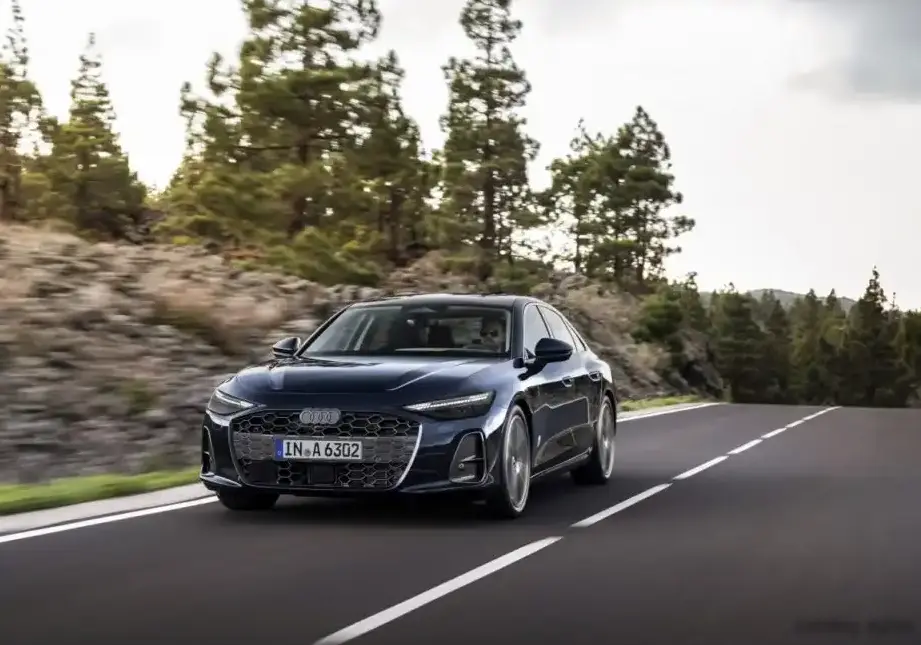
The Audi A6 Sedan (C9) 3.0 TFSI V6, producing 367 horsepower, represents a significant evolution in the luxury mid-size sedan segment. Introduced in April 2025, this variant sits at the upper echelon of the C9 A6 lineup, blending potent performance with advanced mild-hybrid technology and Audi’s renowned quattro all-wheel-drive system. It builds upon the foundation of the A6 Sedan (C9) generation, utilizing the MLB Evo platform, and aims to deliver a refined driving experience coupled with improved fuel efficiency. This model is primarily targeted towards buyers seeking a sophisticated and powerful executive sedan with cutting-edge technology.
Technical Specifications
| Brand | Audi |
| Model | A6 |
| Generation | A6 Sedan (C9) |
| Type (Engine) | 3.0 TFSI V6 (367 Hp) Mild Hybrid plus quattro ultra S tronic |
| Start of production | April, 2025 |
| Powertrain Architecture | MHEV (Mild Hybrid Electric Vehicle) |
| Body type | Sedan |
| Seats | 5 |
| Doors | 4 |
| Combined fuel consumption (WLTP) | 6.7-7.8 l/100 km (35.1 – 30.2 US mpg, 42.2 – 36.2 UK mpg, 14.9 – 12.8 km/l) |
| CO2 emissions (WLTP) | 153-173 g/km |
| Fuel Type | Petrol (Gasoline) |
| Acceleration 0 – 100 km/h | 4.7 sec |
| Acceleration 0 – 62 mph | 4.7 sec |
| Acceleration 0 – 60 mph | 4.5 sec |
| Maximum speed | 250 km/h (155.34 mph), Electronically limited |
| Emission standard | Euro 6e |
| Weight-to-power ratio | 5.4 kg/Hp, 185.4 Hp/tonne |
| Weight-to-torque ratio | 3.6 kg/Nm, 277.8 Nm/tonne |
| Gross battery capacity | 1.7 kWh |
| Battery voltage | 48 V |
| Battery technology | Lithium iron phosphate (LiFePO4) |
| Battery location | Under the trunk |
| Recuperation output | 25 kW |
| Electric motor power | 24 Hp |
| Electric motor Torque | 230 Nm (169.64 lb.-ft.) |
| Electric motor location | Middle, Longitudinal |
| Power | 367 Hp @ 5500-6300 rpm |
| Power per litre | 122.5 Hp/l |
| Torque | 550 Nm @ 1700-4000 rpm (405.66 lb.-ft. @ 1700-4000 rpm) |
| Engine layout | Front, Longitudinal |
| Engine displacement | 2995 cm3 (182.77 cu. in.) |
| Number of cylinders | 6 |
| Engine configuration | V-engine |
| Cylinder Bore | 84.5 mm (3.33 in.) |
| Piston Stroke | 89 mm (3.5 in.) |
| Compression ratio | 12:1 |
| Number of valves per cylinder | 4 |
| Fuel injection system | Direct injection |
| Engine aspiration | Turbocharger, Intercooler |
| Valvetrain | DOHC |
| Engine oil capacity | 7.5 l (7.93 US qt | 6.6 UK qt) |
| Coolant | 18 l (19.02 US qt | 15.84 UK qt) |
| Kerb Weight | 1980 kg (4365.15 lbs.) |
| Max. weight | 2625 kg (5787.13 lbs.) |
| Max load | 645 kg (1421.98 lbs.) |
| Trunk (boot) space – minimum | 452 l (15.96 cu. ft.) |
| Fuel tank capacity | 56 l (14.79 US gal | 12.32 UK gal) |
| Max. roof load | 100 kg (220.46 lbs.) |
| Permitted trailer load with brakes (8%) | 2100 kg (4629.71 lbs.) |
| Permitted trailer load with brakes (12%) | 2100 kg (4629.71 lbs.) |
| Permitted trailer load without brakes | 750 kg (1653.47 lbs.) |
| Permitted towbar download | 95 kg (209.44 lbs.) |
| Length | 4999 mm (196.81 in.) |
| Width | 1875 mm (73.82 in.) |
| Width including mirrors | 2099 mm (82.64 in.) |
| Height | 1452 mm (57.17 in.) |
| Wheelbase | 2923 mm (115.08 in.) |
| Front track | 1626 mm (64.02 in.) |
| Rear (Back) track | 1610 mm (63.39 in.) |
| Front overhang | 938 mm (36.93 in.) |
| Rear overhang | 1138 mm (44.8 in.) |
| Drag coefficient (Cd) | 0.27 |
| Minimum turning circle (turning diameter) | 12.3 m (40.35 ft.) |
| Approach angle | 14.1° |
| Departure angle | 16.9° |
| Drivetrain Architecture | ICE and electric motor drive front wheels, rear drive via clutch |
| Drive wheel | All wheel drive (4×4) |
| Number of gears and type of gearbox | 7 gears, automatic transmission S tronic |
| Front suspension | Coil spring, Independent multi-link suspension, Transverse stabilizer, Air Suspension – Optional |
| Rear suspension | Independent multi-link spring suspension with stabilizer, Air Suspension – Optional |
| Front brakes | Ventilated discs, 360 mm |
| Rear brakes | Ventilated discs, 350 mm |
| Steering type | Steering rack and pinion |
| Power steering | Electric Steering |
| Tires size | 225/55 R18; 245/45 R19; 255/40 R20; 255/35 R21 |
| Wheel rims size | 8J x 18; 8.5J x 19; 8.5J x 20; 8.5J x 21 |
Powertrain & Engine Architecture
At the heart of the A6 C9 3.0 TFSI lies the 2.995-liter V6 engine, designated as the 420 engine family within Audi’s portfolio. This engine utilizes a direct injection fuel system, delivering fuel directly into the combustion chambers for improved efficiency and power. The engine is turbocharged, employing a twin-scroll turbocharger with an intercooler to mitigate turbo lag and maximize boost pressure. The valvetrain features Dual Overhead Camshafts (DOHC) with four valves per cylinder, optimizing airflow for enhanced performance. The mild-hybrid system incorporates a 48V lithium-ion battery and a belt-driven starter-generator, enabling features like extended engine-off coasting, smoother start-stop operation, and a slight power boost during acceleration. The S tronic 7-speed dual-clutch transmission provides rapid and seamless gear changes, contributing to the car’s overall responsiveness. This transmission is known for its efficiency and ability to handle the engine’s substantial torque output.
Driving Characteristics
The 367 hp and 405.66 lb-ft of torque delivered by this powertrain configuration translate into brisk acceleration. The 0-60 mph sprint is achieved in approximately 4.5 seconds, making it one of the quicker variants in the A6 lineup. The S tronic transmission’s quick shifts and the mild-hybrid system’s torque fill contribute to a linear and engaging power delivery. Compared to lower-powered A6 models, such as the 2.0 TFSI, the 3.0 TFSI offers significantly more reserve power for overtaking and highway cruising. While not as overtly sporty as the S6, the 3.0 TFSI provides a compelling balance between performance and comfort. The quattro all-wheel-drive system ensures excellent traction in various weather conditions, enhancing stability and control.
Equipment & Trim Levels
The 3.0 TFSI variant typically comes standard with a high level of equipment. This includes Audi’s Virtual Cockpit digital instrument cluster, a premium sound system, leather upholstery, and a comprehensive suite of driver-assistance features such as adaptive cruise control, lane-keeping assist, and automatic emergency braking. Optional extras often include massaging front seats, a head-up display, and upgraded interior trim materials. The trim level often sits near the top of the A6 range, offering a luxurious and well-equipped experience. Specific packages, like the Prestige package, add even more premium features.
Chassis & Braking
The A6 C9 3.0 TFSI utilizes a sophisticated suspension system designed to balance comfort and handling. The standard suspension consists of coil springs and independent multi-link setups for both the front and rear axles. An optional air suspension system is available, providing adjustable ride height and damping for enhanced comfort and control. Braking duties are handled by ventilated discs on all four wheels, with larger discs at the front (360mm) compared to the rear (350mm). The anti-lock braking system (ABS) and electronic stability control (ESC) are standard features, ensuring safe and controlled braking performance.
Market Reception & Comparison
The Audi A6 3.0 TFSI has generally received positive reviews from automotive critics. It is praised for its powerful engine, refined ride quality, and advanced technology. Compared to its rivals, such as the BMW 540i and Mercedes-Benz E450, the A6 3.0 TFSI is often considered to offer a more balanced driving experience, with a focus on comfort and technology. Fuel economy is respectable for a V6 engine of this size, with combined WLTP figures ranging from 6.7 to 7.8 l/100 km. Reliability has been generally good, although some owners have reported minor issues with the mild-hybrid system.
Legacy
The 3.0 TFSI engine has proven to be a robust and reliable powerplant in various Audi models. The combination of direct injection, turbocharging, and mild-hybrid technology contributes to its efficiency and longevity. While long-term reliability data for the C9 generation is still emerging, the engine’s proven track record suggests it should provide years of dependable service. On the used car market, the A6 3.0 TFSI is expected to hold its value well due to its performance, luxury, and advanced features. Regular maintenance, including oil changes and adherence to the manufacturer’s recommended service intervals, will be crucial for ensuring the continued reliability of this powertrain.