
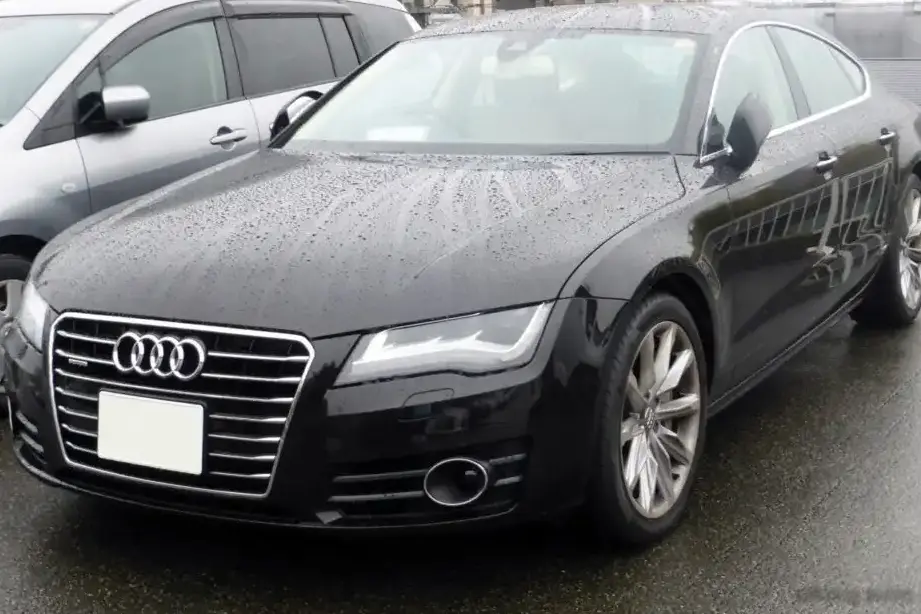
Technical Specifications
| Brand | Audi |
| Model | A7 |
| Generation | A7 Sportback (C7) |
| Type (Engine) | 3.0 TDI V6 (204 Hp) quattro S tronic |
| Start of production | 2010 |
| End of production | 2014 |
| Powertrain Architecture | Internal Combustion engine |
| Body type | Liftback |
| Seats | 5 |
| Doors | 5 |
| Fuel consumption (urban) | 6.8 l/100 km (34.6 US mpg, 41.5 UK mpg, 14.7 km/l) |
| Fuel consumption (extra urban) | 5.1 l/100 km (46.1 US mpg, 55.4 UK mpg, 19.6 km/l) |
| Fuel consumption (combined) | 5.8 l/100 km (40.6 US mpg, 48.7 UK mpg, 17.2 km/l) |
| CO2 emissions | 152 g/km |
| Fuel Type | Diesel |
| Acceleration 0 – 100 km/h | 7.2 sec |
| Acceleration 0 – 62 mph | 7.2 sec |
| Acceleration 0 – 60 mph | 6.8 sec |
| Maximum speed | 235 km/h (146.02 mph) |
| Emission standard | Euro 5 |
| Weight-to-power ratio | 8.8 kg/Hp, 114.3 Hp/tonne |
| Weight-to-torque ratio | 4 kg/Nm, 252.1 Nm/tonne |
| Power | 204 Hp @ 3250-4500 rpm |
| Power per litre | 68.8 Hp/l |
| Torque | 450 Nm @ 1250-3000 rpm (331.9 lb.-ft. @ 1250-3000 rpm) |
| Engine layout | Front, Longitudinal |
| Engine Model/Code | CLAA, CLAB |
| Engine displacement | 2967 cm3 (181.06 cu. in.) |
| Number of cylinders | 6 |
| Engine configuration | V-engine |
| Cylinder Bore | 83 mm (3.27 in.) |
| Piston Stroke | 91.4 mm (3.6 in.) |
| Compression ratio | 16.8:1 |
| Number of valves per cylinder | 4 |
| Fuel injection system | Diesel Commonrail |
| Engine aspiration | Turbocharger, Intercooler |
| Valvetrain | DOHC |
| Engine oil capacity | 6.4 l (6.76 US qt | 5.63 UK qt) |
| Kerb Weight | 1785 kg (3935.25 lbs.) |
| Max. weight | 2395 kg (5280.07 lbs.) |
| Max load | 610 kg (1344.82 lbs.) |
| Trunk (boot) space – minimum | 535 l (18.89 cu. ft.) |
| Trunk (boot) space – maximum | 1390 l (49.09 cu. ft.) |
| Fuel tank capacity | 65 l (17.17 US gal | 14.3 UK gal) |
| Max. roof load | 100 kg (220.46 lbs.) |
| Permitted trailer load with brakes (8%) | 1900 kg (4188.78 lbs.) |
| Permitted trailer load with brakes (12%) | 1800 kg (3968.32 lbs.) |
| Permitted trailer load without brakes | 750 kg (1653.47 lbs.) |
| Permitted towbar download | 85 kg (187.39 lbs.) |
| Length | 4969 mm (195.63 in.) |
| Width | 1911 mm (75.24 in.) |
| Height | 1420 mm (55.91 in.) |
| Wheelbase | 2914 mm (114.72 in.) |
| Front track | 1644 mm (64.72 in.) |
| Rear (Back) track | 1635 mm (64.37 in.) |
| Drag coefficient (Cd) | 0.29 |
| Minimum turning circle (turning diameter) | 11.9 m (39.04 ft.) |
| Drive wheel | All wheel drive (4×4) |
| Number of gears and type of gearbox | 7 gears, automatic transmission S tronic |
| Front suspension | Independent multi-link suspension |
| Rear suspension | Independent on trapezoidal lever |
| Front brakes | Ventilated discs |
| Rear brakes | Disc |
| Assisting systems | ABS (Anti-lock braking system) |
| Steering type | Steering rack and pinion |
| Power steering | Electric Steering |
| Tires size | 235/55 R17 |
| Wheel rims size | 8.0J x 17 |
The Audi A7 Sportback (C7) 3.0 TDI V6, producing 204 horsepower, was introduced in 2010 as a key component of the second-generation A7 lineup. This variant occupied a middle ground within the range, positioned between the entry-level 2.8-liter petrol engines and the more potent, higher-output 3.0 TDI models. The 204 hp version aimed to deliver a balance of fuel efficiency, comfortable performance, and the added security of Audi’s quattro all-wheel-drive system. Built on the Volkswagen Group’s MLB platform, the C7 A7 shared its architecture with the Porsche Panamera and other Audi models, emphasizing a commitment to sophisticated engineering and a premium driving experience.
Powertrain & Engine Architecture
The core of this A7 variant is the 3.0-liter V6 turbodiesel engine, identified by engine codes CLAA or CLAB depending on the specific production year and market. This engine utilizes a common rail direct injection system with piezo injectors, enabling precise fuel delivery and optimized combustion. A single turbocharger, coupled with an intercooler, boosts power and efficiency. The engine features a double overhead camshaft (DOHC) valvetrain with four valves per cylinder, maximizing airflow and contributing to its overall performance. The 204 horsepower output is achieved through careful engine management calibration, prioritizing fuel economy alongside adequate power delivery. This engine is mated to Audi’s 7-speed S tronic dual-clutch transmission. The S tronic provides rapid and seamless gear changes, enhancing both performance and fuel efficiency. Its ability to anticipate gear selection based on driving conditions contributes to a smooth and responsive driving experience.
Driving Characteristics
The 204 hp 3.0 TDI, paired with the S tronic transmission, delivers a refined and comfortable driving experience. While not as aggressively sporty as the higher-horsepower A7 variants, it provides ample torque – 450 Nm (331.9 lb-ft) – readily available from low engine speeds. This makes it well-suited for everyday driving and long-distance cruising. The S tronic transmission’s quick shifts contribute to a responsive feel, and the quattro all-wheel-drive system ensures excellent traction in various weather conditions. Compared to the manual transmission options, the S tronic offers greater convenience, especially in urban environments. However, some drivers may prefer the more engaging feel of a manual gearbox. In terms of acceleration, this 204 hp version achieves a 0-60 mph time of around 6.8 seconds, which is slower than the sub-6 second times of the more powerful TDI models.
Equipment & Trim Levels
The A7 Sportback 3.0 TDI 204 hp typically came generously equipped, reflecting Audi’s commitment to luxury and technology. Standard features commonly included leather upholstery, three-zone automatic climate control, a multi-function steering wheel, and Audi’s MMI infotainment system with a central display screen. A wide range of optional extras were available, such as adaptive cruise control, a premium Bang & Olufsen sound system, advanced parking assistance features, and various interior trim upgrades. The interior design emphasized a clean, modern aesthetic, utilizing high-quality materials and meticulous attention to detail. Trim levels varied by market, but this variant generally occupied a mid-range position, offering a good balance between features and price.
Chassis & Braking
The A7 Sportback’s chassis is engineered to provide a comfortable yet controlled ride. The front suspension utilizes an independent multi-link setup, while the rear features an independent trapezoidal link suspension. This configuration minimizes body roll and provides a stable platform for cornering. The braking system consists of ventilated discs at the front and solid discs at the rear, providing ample stopping power. ABS (Anti-lock Braking System) is standard, enhancing safety and control during emergency braking situations. The weight distribution, aided by the quattro all-wheel-drive system, contributes to balanced handling characteristics. Stabilizer bars are fitted to both the front and rear axles to further reduce body roll during cornering.
Market Reception & Comparison
The Audi A7 Sportback 3.0 TDI 204 hp received generally positive reviews from automotive critics. It was praised for its stylish design, comfortable ride quality, and efficient engine. Critics acknowledged that while it wasn’t the fastest A7 variant, it offered a compelling combination of performance and fuel economy. Compared to the 2.8-liter petrol models, the 3.0 TDI provided significantly more torque and superior fuel efficiency. Against the higher-powered TDI variants, it presented a more affordable option, albeit with a slight performance compromise. Fuel economy figures around 40.6 US mpg combined were considered excellent for a vehicle of its size and class. Reliability reports generally indicated good dependability, although, as with any complex vehicle, regular maintenance was essential for long-term reliability.
Legacy
The Audi A7 Sportback (C7) 3.0 TDI V6 204 hp has proven to be a relatively reliable and durable vehicle. The 3.0 TDI engine, in general, is known for its longevity when properly maintained with regular oil changes and servicing. On the used car market, these A7s remain desirable for their blend of style, comfort, and efficiency. The S tronic transmission, while generally reliable, may require servicing at higher mileages to ensure continued smooth operation. Overall, this variant represents a well-rounded and sophisticated grand tourer that continues to offer a compelling ownership experience for those seeking a blend of luxury, performance, and efficiency.
