
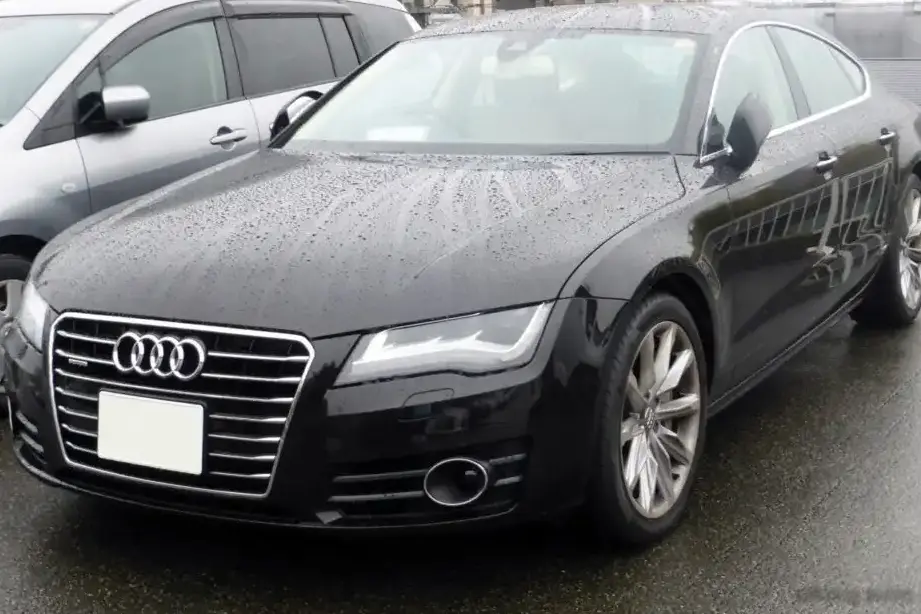
The Audi A7 Sportback (C7) 3.0 TFSI V6 quattro Tiptronic Start-Stop represents a compelling blend of luxury, performance, and technology within the Audi A7 range. Produced from July 2012 to 2015, this variant occupied a significant position in the lineup, offering a step up in power and refinement compared to the base 2.8-liter models, while remaining more accessible than the high-performance S7. Built on the Audi A6/A7 (4HX/C7) platform, the A7 Sportback aimed to redefine the four-door coupe segment with its elegant design and practical liftback configuration.
Technical Specifications
| Brand | Audi |
| Model | A7 |
| Generation | A7 Sportback (C7) |
| Type (Engine) | 3.0 TFSI V6 (310 Hp) quattro Tiptronic Start-Stop |
| Start of production | July, 2012 |
| End of production | 2015 |
| Powertrain Architecture | Internal Combustion engine |
| Body type | Liftback |
| Seats | 5 |
| Doors | 5 |
| Fuel consumption (economy) – urban (EPA) | 13.1 l/100 km (18 US mpg, 21.6 UK mpg, 7.6 km/l) |
| Fuel consumption (economy) – extra urban (EPA) | 8.4 l/100 km (28 US mpg, 33.6 UK mpg, 11.9 km/l) |
| Fuel consumption (economy) – combined (EPA) | 11.2 l/100 km (21 US mpg, 25.2 UK mpg, 8.9 km/l) |
| Fuel Type | Petrol (Gasoline) |
| Acceleration 0 – 60 mph | 5.4 sec |
| Maximum speed | 210 km/h (130.49 mph), Electronically limited |
| Emission standard | ULEV II |
| Weight-to-power ratio | 6.1 kg/Hp, 164 Hp/tonne |
| Weight-to-torque ratio | 4.3 kg/Nm, 232.8 Nm/tonne |
| Power | 310 Hp @ 5500 rpm |
| Power per litre | 103.5 Hp/l |
| Torque | 440 Nm @ 2900 rpm (324.53 lb.-ft. @ 2900 rpm) |
| Engine layout | Front, Longitudinal |
| Engine Model/Code | EA837 / CTUA |
| Engine displacement | 2995 cm3 (182.77 cu. in.) |
| Number of cylinders | 6 |
| Engine configuration | V-engine |
| Cylinder Bore | 84.5 mm (3.33 in.) |
| Piston Stroke | 89 mm (3.5 in.) |
| Compression ratio | 10.3:1 |
| Number of valves per cylinder | 4 |
| Fuel injection system | Direct injection |
| Engine aspiration | Supercharger, Intercooler |
| Valvetrain | DOHC |
| Engine oil capacity | 6.8 l (7.19 US qt | 5.98 UK qt) |
| Coolant | 12 l (12.68 US qt | 10.56 UK qt) |
| Kerb Weight | 1890-1905 kg (4166.74 – 4199.81 lbs.) |
| Trunk (boot) space – minimum | 535 l (18.89 cu. ft.) |
| Trunk (boot) space – maximum | 1390 l (49.09 cu. ft.) |
| Fuel tank capacity | 75 l (19.81 US gal | 16.5 UK gal) |
| Length | 4968 mm (195.59 in.) |
| Width | 1911 mm (75.24 in.) |
| Width including mirrors | 2139 mm (84.21 in.) |
| Height | 1420 mm (55.91 in.) |
| Wheelbase | 2912 mm (114.65 in.) |
| Front track | 1644 mm (64.72 in.) |
| Rear (Back) track | 1635 mm (64.37 in.) |
| Ride height (ground clearance) | 112 mm (4.41 in.) |
| Drag coefficient (Cd) | 0.30 |
| Minimum turning circle (turning diameter) | 11.9 m (39.04 ft.) |
| Drivetrain Architecture | The Internal combustion engine (ICE) drives permanently the four wheels of the vehicle. |
| Drive wheel | All wheel drive (4×4) |
| Number of gears and type of gearbox | 8 gears, automatic transmission Tiptronic |
| Front suspension | Coil spring, Independent multi-link suspension, Transverse stabilizer |
| Rear suspension | Independent on trapezoidal lever, Transverse stabilizer, Coil spring |
| Front brakes | Ventilated discs, 356 mm |
| Rear brakes | Ventilated discs, 330 mm |
INTRODUCTION
The Audi A7 Sportback (C7) 3.0 TFSI quattro Tiptronic Start-Stop, launched in 2012, was a key variant within the second generation of the A7. Positioned as a mid-range offering, it bridged the gap between the more economical 2.8-liter models and the performance-focused S7. This model combined a potent supercharged 3.0-liter V6 engine with Audi’s renowned quattro all-wheel-drive system and a smooth-shifting eight-speed Tiptronic automatic transmission. The inclusion of the Start-Stop system further enhanced its efficiency, aligning with growing environmental concerns. The A7 Sportback, with its distinctive coupe-like silhouette and practical liftback design, quickly gained popularity as a stylish and versatile grand tourer.
Powertrain & Engine Architecture
At the heart of the A7 3.0 TFSI lies the EA837 engine, a 2,995 cc (182.77 cu. in.) V6. This engine utilizes a mechanically driven supercharger, providing instant boost and eliminating turbo lag, coupled with direct fuel injection for precise fuel delivery. The engine code CTUA is specific to this configuration. The supercharger is intercooled to maintain intake air temperatures, maximizing efficiency. The engine produces 310 horsepower at 5,500 rpm and 440 Nm (324.53 lb.-ft.) of torque between 2,900 and 5,300 rpm. The eight-speed Tiptronic automatic transmission offers both fully automatic operation and manual gear selection via steering wheel-mounted paddles or the gear selector. This transmission is known for its smooth and responsive shifts, contributing to a refined driving experience. The transmission’s gear ratios are optimized for both performance and fuel economy, with a relatively tall final drive to aid highway cruising.
Driving Characteristics
The A7 3.0 TFSI delivers a refined and capable driving experience. The supercharged V6 provides ample power for effortless acceleration, achieving 0-60 mph in approximately 5.4 seconds. While not as overtly sporty as the S7, the 3.0 TFSI offers a satisfying balance between performance and comfort. The quattro all-wheel-drive system provides excellent traction in all weather conditions, enhancing stability and confidence. The Tiptronic transmission shifts smoothly and efficiently, although some drivers may prefer the more engaging experience of a manual gearbox. Compared to the 2.8-liter models, the 3.0 TFSI offers a noticeable increase in power and responsiveness. The weight distribution is well-balanced, contributing to neutral handling characteristics.
Equipment & Trim Levels
The A7 3.0 TFSI typically came well-equipped as standard. Features included leather upholstery, tri-zone automatic climate control, a premium sound system, and Audi’s Multi Media Interface (MMI) infotainment system with a central display screen. Optional extras included features like adaptive cruise control, a head-up display, ventilated front seats, and a panoramic sunroof. Interior trim options ranged from wood veneers to brushed aluminum accents, allowing buyers to personalize the cabin to their preferences. The standard seats provided excellent support and comfort, making long journeys enjoyable.
Chassis & Braking
The A7 Sportback features a sophisticated chassis design. The front suspension utilizes a multi-link setup with coil springs and a transverse stabilizer bar, while the rear suspension employs an independent trapezoidal link design with similar components. This configuration provides a comfortable ride while maintaining good handling characteristics. Braking duties are handled by ventilated discs on all four wheels, with larger discs at the front for increased stopping power. The A7 is equipped with ABS (Anti-lock braking system), electronic brake-force distribution, and brake assist. The steering is a speed-sensitive electric power steering system, providing precise and responsive control.
Market Reception & Comparison
The Audi A7 3.0 TFSI was generally well-received by automotive critics. It was praised for its stylish design, luxurious interior, and strong performance. The combination of the supercharged V6 and quattro all-wheel drive was particularly appreciated. Fuel economy was considered reasonable for a vehicle of its size and performance, averaging around 21 US mpg in combined driving. Compared to the 2.8-liter A7, the 3.0 TFSI offered a significant performance upgrade, justifying the higher price tag for many buyers. The S7, while offering even greater performance, came at a substantial premium. Reliability reports suggest that the EA837 engine is generally robust, although regular maintenance is essential.
Legacy
The Audi A7 Sportback (C7) 3.0 TFSI remains a desirable used car today. The EA837 engine, while requiring regular oil changes and attention to its timing chain, is generally considered reliable. The Tiptronic transmission is also known for its durability. The A7’s timeless design and luxurious interior continue to appeal to buyers seeking a stylish and capable grand tourer. Its blend of performance, comfort, and technology ensures its continued relevance in the used car market, offering a compelling alternative to more modern rivals.
