Technical Specifications
| Brand | Audi |
| Model | A7 |
| Generation | A7 Sportback (C8) |
| Type | 50 TFSI e (299 Hp) Plug-in Hybrid quattro ultra S tronic |
| Start of production | February, 2021 |
| End of production | May, 2023 |
| Powertrain Architecture | PHEV (Plug-in Hybrid Electric Vehicle) |
| Body type | Liftback |
| Seats | 5 |
| Doors | 5 |
| Combined fuel consumption (WLTP) | 1.4-1.6 l/100 km (168 – 147 US mpg, 201.8 – 176.6 UK mpg, 71.4 – 62.5 km/l) |
| CO2 emissions (WLTP) | 32-36 g/km |
| Fuel Type | Petrol / electricity |
| Acceleration 0 – 100 km/h | 6.3 sec |
| Acceleration 0 – 62 mph | 6.3 sec |
| Acceleration 0 – 60 mph | 6 sec |
| Maximum speed | 250 km/h (155.34 mph) |
| Emission standard | Euro 6d-ISC-FCM |
| Weight-to-power ratio | 6.9 kg/Hp, 144.8 Hp/tonne |
| Weight-to-torque ratio | 4.6 kg/Nm, 217.9 Nm/tonne |
| Gross battery capacity | 17.9 kWh |
| Net (usable) battery capacity | 14.4 kWh |
| Battery voltage | 381 V |
| Battery technology | Lithium-ion (Li-Ion) |
| Battery location | Under the trunk |
| All-electric range (WLTP) | 61-69 km (37.9 – 42.87 mi) |
| Average Energy consumption (WLTP) | 16.9-17.9 kWh/100 km (27.2 – 28.81 kWh/100 mi, 124 – 117 MPGe, 5.9 – 5.6 km/kWh, 3.7 – 3.5 mi/kWh) |
| Max speed (electric) | 135 km/h (83.89 mph) |
| Electric motor power | 143 Hp |
| Electric motor Torque | 350 Nm (258.15 lb.-ft.) |
| Electric motor location | Between the combustion engine and the transmission |
| System power | 299 Hp |
| System torque | 450 Nm (331.9 lb.-ft.) |
| Power | 265 Hp @ 5250-6500 rpm |
| Torque | 370 Nm @ 1600-4500 rpm (272.9 lb.-ft. @ 1600-4500 rpm) |
| Engine layout | Front, Longitudinal |
| Engine Model/Code | DRYA |
| Engine displacement | 1984 cm3 (121.07 cu. in.) |
| Number of cylinders | 4 |
| Engine configuration | Inline |
| Cylinder Bore | 82.5 mm (3.25 in.) |
| Piston Stroke | 92.8 mm (3.65 in.) |
| Compression ratio | 9.6:1 |
| Number of valves per cylinder | 4 |
| Fuel injection system | Direct injection |
| Engine aspiration | Turbocharger, Intercooler |
| Valvetrain | DOHC |
| Engine oil capacity | 5.2 l (5.49 US qt | 4.58 UK qt) |
| Coolant | 16.9 l (17.86 US qt | 14.87 UK qt) |
| Kerb Weight | 2065 kg (4552.55 lbs.) |
| Max. weight | 2650 kg (5842.25 lbs.) |
| Max load | 585 kg (1289.7 lbs.) |
| Trunk (boot) space – minimum | 380 l (13.42 cu. ft.) |
| Trunk (boot) space – maximum | 1235 l (43.61 cu. ft.) |
| Fuel tank capacity | 52 l (13.74 US gal | 11.44 UK gal) |
| Max. roof load | 90 kg (198.42 lbs.) |
| Permitted trailer load with brakes (8%) | 2000 kg (4409.25 lbs.) |
| Permitted trailer load with brakes (12%) | 2000 kg (4409.25 lbs.) |
| Permitted trailer load without brakes | 750 kg (1653.47 lbs.) |
| Permitted towbar download | 95 kg (209.44 lbs.) |
| Length | 4969 mm (195.63 in.) |
| Width | 1908 mm (75.12 in.) |
| Width including mirrors | 2118 mm (83.39 in.) |
| Height | 1421 mm (55.94 in.) |
| Wheelbase | 2926 mm (115.2 in.) |
| Front track | 1651 mm (65 in.) |
| Rear (Back) track | 1637 mm (64.45 in.) |
| Front overhang | 927 mm (36.5 in.) |
| Rear overhang | 1116 mm (43.94 in.) |
| Drag coefficient (Cd) | 0.27 |
| Minimum turning circle (turning diameter) | 12.2 m (40.03 ft.) |
| Drivetrain Architecture | The Internal combustion engine (ICE) and the electric motor permanently drive the front wheels of the vehicle, capable of running in full electric or mixed mode, and if necessary through the electrically or mechanically controlled clutch, the rear wheels are driven. |
| Drive wheel | All wheel drive (4×4) |
| Number of gears and type of gearbox | 7 gears, automatic transmission S tronic |
| Front suspension | Independent multi-link suspension, Transverse stabilizer |
| Rear suspension | Independent multi-link suspension, Transverse stabilizer |
| Front brakes | Ventilated discs |
| Rear brakes | Ventilated discs |
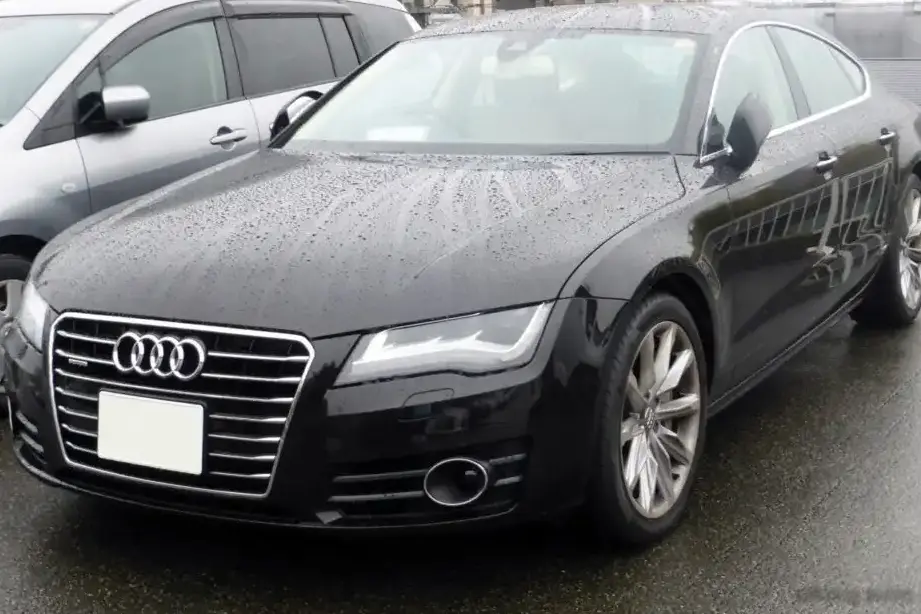
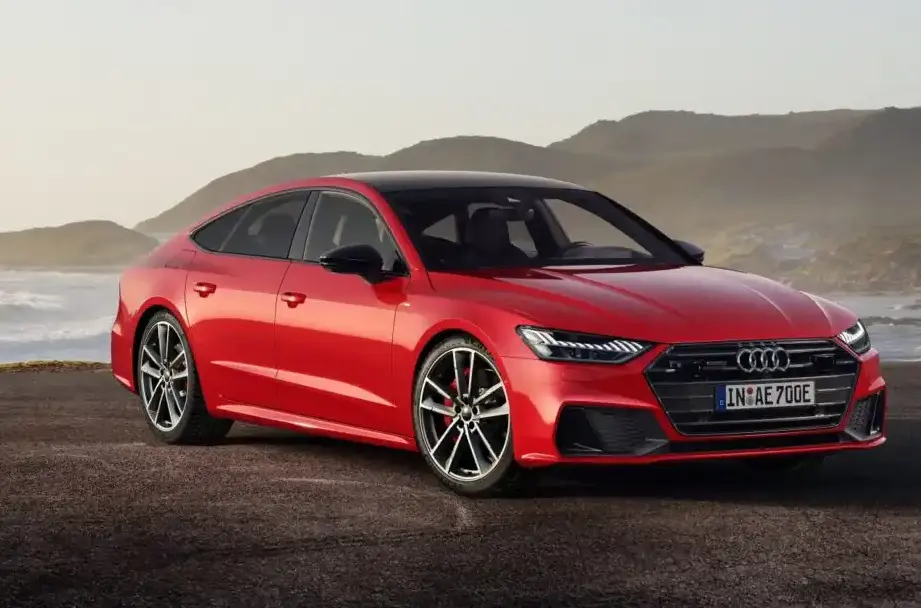
The Audi A7 Sportback (C8) 50 TFSI e, launched in February 2021 and produced through May 2023, is a plug-in hybrid variant of the C8 generation A7. The C8 A7, first introduced in 2018, marked a significant step forward in Audi’s four-door coupe design language, prioritizing both sophisticated aesthetics and cutting-edge technology. The “50 TFSI e” designation identifies a mid-range powertrain option, blending a 2.0-liter turbocharged engine with an electric motor and a substantial battery pack to deliver a considerable all-electric driving range. This model was designed to attract buyers who desired a premium, efficient, and technologically advanced grand touring vehicle.
Powertrain & Engine Architecture
The Audi A7 50 TFSI e is powered by the DRYA engine, a 2.0-liter inline-four cylinder gasoline engine with turbocharging. This engine generates 265 horsepower and 370 Nm (272.9 lb-ft) of torque. It features direct fuel injection and a single twin-scroll turbocharger, enhancing both responsiveness and fuel efficiency. This engine is coupled with a 143 horsepower electric motor integrated directly between the engine and the seven-speed S tronic dual-clutch transmission. The electric motor receives its energy from a 17.9 kWh (gross) / 14.4 kWh (net) lithium-ion battery pack positioned under the trunk floor. The combined system output reaches 299 horsepower and 450 Nm (331.9 lb-ft) of torque. The S tronic transmission provides rapid and seamless gear changes, contributing to the vehicle’s overall performance characteristics. The hybrid system intelligently manages power distribution between the engine and electric motor, optimizing for either efficiency or performance based on driving conditions.
Driving Characteristics
The A7 50 TFSI e delivers a refined and comfortable driving experience. In electric-only mode, the car operates almost silently and offers brisk acceleration, making it well-suited for urban driving and shorter commutes. The all-electric range of 61-69 km (37.9 – 42.87 mi) allows for significant emissions-free travel. When the battery is depleted or when increased power is needed, the gasoline engine seamlessly engages, providing a combined output that achieves a 0-60 mph time of approximately 6 seconds. The S tronic transmission ensures quick and responsive shifts, and the quattro all-wheel-drive system provides excellent traction in various weather conditions. Compared to the higher-performance A7 variants, such as the S7, the 50 TFSI e prioritizes fuel efficiency and comfort over outright speed, yet still offers a respectable level of performance for everyday driving. The transmission gear ratios are carefully tuned to strike a balance between acceleration and fuel economy.
Equipment & Trim Levels
The A7 50 TFSI e typically came generously equipped as standard. Features included Audi’s Virtual Cockpit digital instrument cluster, a large touchscreen infotainment system with navigation, leather upholstery, three-zone automatic climate control, and a comprehensive suite of advanced driver-assistance systems, such as adaptive cruise control, lane-keeping assist, and automatic emergency braking. Optional extras included a Bang & Olufsen premium sound system, massaging seats, and a head-up display. Interior trim options were available, allowing buyers to personalize the cabin with different wood or aluminum accents. The exterior styling remained consistent with other C8 A7 models, with subtle “TFSI e” badging to indicate the plug-in hybrid powertrain.
Chassis & Braking
The A7 50 TFSI e features an independent multi-link suspension system at both the front and rear axles, providing a comfortable ride and precise handling. The suspension is tuned to balance comfort and control, delivering a composed ride even on uneven road surfaces. Ventilated disc brakes are fitted on all four wheels, ensuring ample stopping power. The electronic stability control (ESC) system is integrated with the quattro all-wheel-drive system to enhance stability and traction. The car’s weight, at 2065 kg (4552.55 lbs), is higher than non-hybrid A7 models due to the added weight of the battery pack and electric motor, but the quattro system effectively mitigates the impact on handling.
Market Reception & Comparison
The Audi A7 50 TFSI e received generally positive reviews from automotive critics. It was praised for its refined driving experience, efficient powertrain, and luxurious interior. Some reviewers noted that the battery pack reduced trunk space compared to non-hybrid A7 models. Compared to the A7 45 TFSI (with a non-hybrid 2.0-liter engine), the 50 TFSI e offered significantly improved fuel economy and the ability to operate in electric-only mode. In comparison to the higher-performance A7 55 TFSI (equipped with a 3.0-liter V6 engine), the 50 TFSI e provided less outright power but a more environmentally friendly driving experience. The plug-in hybrid powertrain positioned it as a competitor to other premium plug-in hybrid vehicles, such as the BMW 745e and Mercedes-Benz E350e.
Legacy
The Audi A7 Sportback (C8) 50 TFSI e represents a significant milestone in Audi’s commitment to electrification. Although production concluded in 2023, these models are now appearing in the used car market. The powertrain has demonstrated a generally reliable performance, with routine maintenance requirements similar to those of conventional Audi vehicles – regular servicing of the engine, transmission, and brakes. The longevity of the battery pack is a key consideration for prospective buyers, but Audi’s battery technology has generally proven to be durable. The A7 50 TFSI e remains an attractive option for buyers seeking a luxurious, efficient, and technologically advanced grand tourer.