
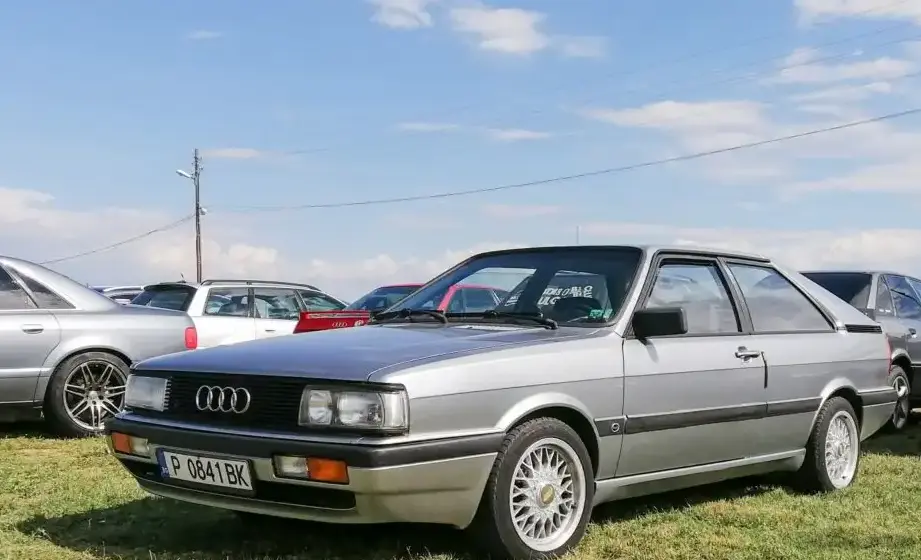
The Audi Coupe GT 1.8 (110 hp) CAT, produced between August 1986 and July 1988, represents a key iteration of the B2 Coupe generation (internal codes 81 and 85, with a significant facelift in 1984). Positioned as a mid-range offering within the Coupe lineup, it aimed to provide a balance between performance and affordability, appealing to buyers seeking a stylish and relatively economical grand tourer. This variant was primarily sold in European markets, where the Coupe enjoyed considerable success as a sporty alternative to more mainstream sedans.
Technical Specifications
| Brand | Audi |
| Model | Coupe |
| Generation | Coupe (B2 81, 85, facelift 1984) |
| Type (Engine) | GT 1.8 (110 Hp) CAT |
| Start of production | August, 1986 |
| End of production | July, 1988 |
| Powertrain Architecture | Internal Combustion engine |
| Body type | Coupe |
| Seats | 5 |
| Doors | 2 |
| Fuel Type | Petrol (Gasoline) |
| Acceleration 0 – 100 km/h | 9.5 sec |
| Acceleration 0 – 62 mph | 9.5 sec |
| Acceleration 0 – 60 mph | 9 sec |
| Maximum speed | 186 km/h (115.58 mph) |
| Weight-to-power ratio | 8.9 kg/Hp, 112.2 Hp/tonne |
| Weight-to-torque ratio | 6.3 kg/Nm, 158.2 Nm/tonne |
| Power | 110 Hp @ 5800 rpm |
| Power per litre | 61.8 Hp/l |
| Torque | 155 Nm @ 3250 rpm (114.32 lb.-ft. @ 3250 rpm) |
| Engine layout | Front, Longitudinal |
| Engine Model/Code | PV |
| Engine displacement | 1781 cm3 (108.68 cu. in.) |
| Number of cylinders | 4 |
| Engine configuration | Inline |
| Cylinder Bore | 81 mm (3.19 in.) |
| Piston Stroke | 86.4 mm (3.4 in.) |
| Compression ratio | 10:1 |
| Number of valves per cylinder | 2 |
| Fuel injection system | Multi-port manifold injection |
| Engine aspiration | Naturally aspirated engine |
| Engine oil capacity | 3 l (3.17 US qt | 2.64 UK qt) |
| Coolant | 6.5 l (6.87 US qt | 5.72 UK qt) |
| Kerb Weight | 980 kg (2160.53 lbs.) |
| Max. weight | 1440 kg (3174.66 lbs.) |
| Max load | 460 kg (1014.13 lbs.) |
| Trunk (boot) space – minimum | 443 l (15.64 cu. ft.) |
| Fuel tank capacity | 68 l (17.96 US gal | 14.96 UK gal) |
| Length | 4421 mm (174.06 in.) |
| Width | 1682 mm (66.22 in.) |
| Height | 1350 mm (53.15 in.) |
| Wheelbase | 2538 mm (99.92 in.) |
| Front track | 1400 mm (55.12 in.) |
| Rear (Back) track | 1420 mm (55.91 in.) |
| Ride height (ground clearance) | 110 mm (4.33 in.) |
| Drag coefficient (Cd) | 0.36 |
| Minimum turning circle (turning diameter) | 11 m (36.09 ft.) |
| Drivetrain Architecture | The Internal combustion engine (ICE) drives the front wheels of the vehicle. |
| Drive wheel | Front wheel drive |
| Number of gears and type of gearbox | 5 gears, manual transmission |
| Front brakes | Disc |
| Rear brakes | Drum |
| Tires size | 175/70 R13 |
| Wheel rims size | 13 |
Powertrain & Engine Architecture
The heart of the GT 1.8 was the Audi PV engine, an inline four-cylinder unit displacing 1781 cc. This engine belonged to Audi’s earlier generation of gasoline engines, utilizing a two-valve per cylinder configuration and multi-port fuel injection. The ‘CAT’ designation indicates the presence of a catalytic converter, a feature increasingly common in European vehicles during this period to meet tightening emissions regulations. The engine produced 110 horsepower at 5800 rpm and 155 Nm (114 lb-ft) of torque at 3250 rpm. The engine’s longitudinal mounting and front-wheel drive configuration were typical for Audi at the time, contributing to a balanced weight distribution. The five-speed manual transmission was the standard offering, providing drivers with a reasonable degree of control over the engine’s power band.
Driving Characteristics
The 1.8-liter engine, coupled with the five-speed manual gearbox, delivered a respectable, though not exhilarating, driving experience. Acceleration from 0 to 60 mph took approximately 9 seconds, and the car could reach a top speed of 115.58 mph. Compared to the more potent 1.8-liter versions with higher outputs or the larger-displacement engines (like the 2.0 or 2.3 liter options), the GT 1.8 felt less urgent in its acceleration. However, it offered a more relaxed and fuel-efficient driving experience. The gear ratios were well-chosen for everyday driving, providing adequate power for overtaking and maintaining highway speeds. The front-wheel drive setup, while offering good traction in most conditions, could exhibit some understeer when pushed hard through corners.
Equipment & Trim Levels
The GT 1.8 occupied a middle ground in the Coupe’s trim hierarchy. Standard equipment typically included cloth upholstery, a basic stereo system, and power steering. Optional extras, which could significantly enhance the car’s appeal, included alloy wheels, a sunroof, upgraded audio systems, and central locking. The interior design was functional and typically German in its simplicity, prioritizing ergonomics over lavish ornamentation. The dashboard layout was straightforward, with clearly marked gauges and controls. The GT trim generally offered a step up in interior appointments compared to the base models, but fell short of the luxury features found in the higher-spec versions.
Chassis & Braking
The B2 Audi Coupe utilized a MacPherson strut front suspension and a torsion beam rear suspension. This setup provided a good balance between ride comfort and handling. The GT 1.8 typically featured disc brakes on the front wheels and drum brakes on the rear. While adequate for normal driving, the rear drum brakes were a point of criticism, particularly when compared to the all-disc brake setups found on higher-performance models. The car’s curb weight of 980 kg (2160 lbs) contributed to its relatively nimble handling characteristics. A stabilizer bar was fitted to both the front and rear axles to reduce body roll during cornering.
Market Reception & Comparison
The Audi Coupe GT 1.8 was generally well-received by automotive critics as a stylish and practical coupe. It was praised for its comfortable ride, decent performance, and relatively affordable price. However, some reviewers noted that the engine lacked the punch of its larger-displacement counterparts. Compared to the more powerful versions of the Coupe, the GT 1.8 offered better fuel economy, making it a more attractive option for drivers who prioritized efficiency. Against competitors like the Opel Manta or Ford Capri, the Audi Coupe offered a more sophisticated driving experience and a higher level of build quality.
Legacy
The Audi Coupe B2, including the GT 1.8 variant, has gained a following among classic car enthusiasts. The PV engine, while not known for being particularly high-strung, is generally considered reliable if properly maintained. Common issues include oil leaks and wear in the timing belt. The availability of spare parts is generally good, although some specific trim pieces can be difficult to find. Today, the GT 1.8 represents an affordable entry point into Audi ownership, offering a taste of 1980s German engineering and styling. Well-maintained examples are increasingly sought after by collectors and enthusiasts who appreciate the Coupe’s timeless design and understated elegance.
