Technical Specifications
| Brand | Audi |
| Model | Q3 |
| Generation | Q3 II (F3) |
| Type (Engine) | 35 TDI (150 Hp) quattro |
| Start of production | 2018 |
| End of production | 2020 |
| Powertrain Architecture | Internal Combustion engine |
| Body type | SUV |
| Seats | 5 |
| Doors | 5 |
| Combined fuel consumption (WLTP) | 6.6-7.1 l/100 km (35.6 – 33.1 US mpg, 42.8 – 39.8 UK mpg, 15.2 – 14.1 km/l) |
| CO2 emissions (WLTP) | 174-187 g/km |
| Fuel consumption (urban) | 6.5-6.6 l/100 km (36.2 – 35.6 US mpg, 43.5 – 42.8 UK mpg, 15.4 – 15.2 km/l) |
| Fuel consumption (extra urban) | 4.9-5.2 l/100 km (48 – 45.2 US mpg, 57.6 – 54.3 UK mpg, 20.4 – 19.2 km/l) |
| Fuel consumption (combined) | 5.5-5.7 l/100 km (42.8 – 41.3 US mpg, 51.4 – 49.6 UK mpg, 18.2 – 17.5 km/l) |
| CO2 emissions | 145-150 g/km |
| Fuel Type | Diesel |
| Acceleration 0 – 100 km/h | 9.3 sec |
| Acceleration 0 – 62 mph | 9.3 sec |
| Acceleration 0 – 60 mph | 8.8 sec |
| Maximum speed | 211 km/h (131.11 mph) |
| Emission standard | Euro 6d – TEMP |
| Weight-to-power ratio | 10.8 kg/Hp, 92.3 Hp/tonne |
| Weight-to-torque ratio | 4.8 kg/Nm, 209.2 Nm/tonne |
| Power | 150 Hp @ 3500-4000 rpm |
| Power per litre | 76.2 Hp/l |
| Torque | 340 Nm @ 1750-3000 rpm (250.77 lb.-ft. @ 1750-3000 rpm) |
| Engine layout | Front, Transverse |
| Engine Model/Code | DFGA |
| Engine displacement | 1968 cm3 (120.09 cu. in.) |
| Number of cylinders | 4 |
| Engine configuration | Inline |
| Cylinder Bore | 81 mm (3.19 in.) |
| Piston Stroke | 95.5 mm (3.76 in.) |
| Compression ratio | 16.2:1 |
| Number of valves per cylinder | 4 |
| Fuel injection system | Diesel Commonrail |
| Engine aspiration | Turbocharger, Intercooler |
| Engine oil capacity | 4.7 l (4.97 US qt | 4.14 UK qt) |
| Coolant | 8 l (8.45 US qt | 7.04 UK qt) |
| Kerb Weight | 1625 kg (3582.51 lbs.) |
| Max. weight | 2175 kg (4795.05 lbs.) |
| Max load | 550 kg (1212.54 lbs.) |
| Trunk (boot) space – minimum | 530 l (18.72 cu. ft.) |
| Trunk (boot) space – maximum | 1525 l (53.85 cu. ft.) |
| Fuel tank capacity | 60 l (15.85 US gal | 13.2 UK gal) |
| AdBlue tank | 18 l (4.76 US gal | 3.96 UK gal) |
| Max. roof load | 75 kg (165.35 lbs.) |
| Permitted trailer load with brakes (8%) | 2000 kg (4409.25 lbs.) |
| Permitted trailer load with brakes (12%) | 2000 kg (4409.25 lbs.) |
| Permitted trailer load without brakes | 750 kg (1653.47 lbs.) |
| Permitted towbar download | 90 kg (198.42 lbs.) |
| Length | 4484 mm (176.54 in.) |
| Width | 1856 mm (73.07 in.) |
| Width including mirrors | 2024 mm (79.69 in.) |
| Height | 1616 mm (63.62 in.) |
| Wheelbase | 2680 mm (105.51 in.) |
| Front track | 1584 mm (62.36 in.) |
| Rear track | 1576 mm (62.05 in.) |
| Front overhang | 896 mm (35.28 in.) |
| Rear overhang | 908 mm (35.75 in.) |
| Drag coefficient (Cd) | 0.32 |
| Minimum turning circle | 11.8 m (38.71 ft.) |
| Drive wheel | All wheel drive (4×4) |
| Number of gears | 6 |
| Gearbox type | Manual transmission |
| Front suspension | Independent type McPherson |
| Rear suspension | Independent multi-link suspension |
| Front brakes | Ventilated discs |
| Rear brakes | Disc |
| Assisting systems | ABS (Anti-lock braking system) |
| Steering type | Steering rack and pinion |
| Power steering | Electric Steering |
| Tires size | 215/65 R17 |
| Wheel rims size | 6.5J x 17 |
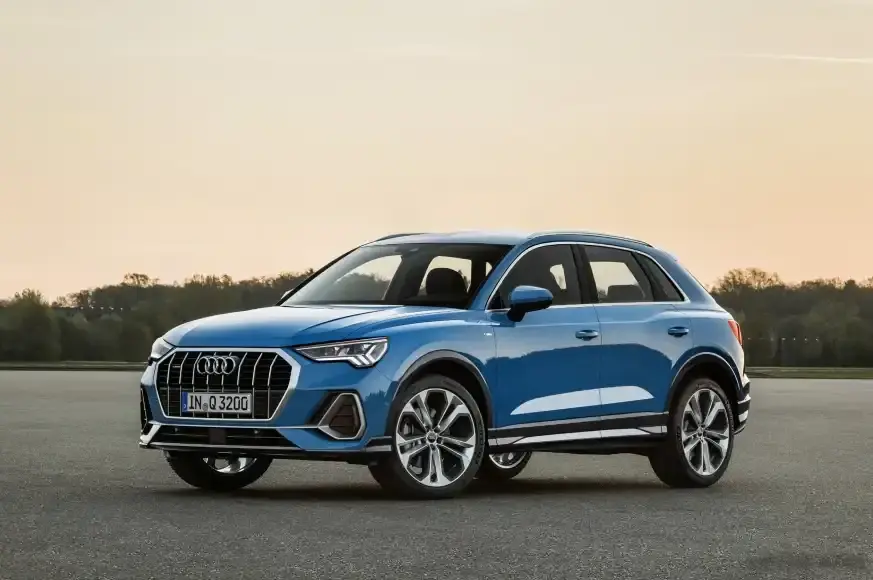
The Audi Q3 II (F3) 35 TDI quattro, produced from 2018 to 2020, represents an accessible entry point into the second generation of Audi’s compact luxury SUV. Positioned within the broader F3 Q3 range, which included various engine and drivetrain configurations, the 35 TDI quattro offered a blend of fuel efficiency, respectable performance, and Audi’s renowned all-wheel-drive capability. This variant was primarily targeted towards European markets where diesel engines remained popular, providing a practical and refined option for both daily commutes and longer journeys. It occupied a mid-range position in the lineup, situated below the more powerful 40 TDI and 45 TFSI models.
Powertrain & Engine Architecture
The Q3 35 TDI quattro’s powertrain centers around the DFGA engine, a 2.0-liter inline-four cylinder diesel. This engine is part of the Volkswagen Group’s modular engine family, widely utilized across numerous brands and models. It employs a common rail direct injection system, delivering fuel at exceptionally high pressures for optimized combustion efficiency. A turbocharger, coupled with an intercooler, enhances power and torque output, generating 150 horsepower at 3500-4000 rpm and 340 Nm (250.77 lb-ft) of torque between 1750 and 3000 rpm. The engine also incorporates four valves per cylinder and a compression ratio of 16.2:1. A 6-speed manual transmission was standard, providing precise gear changes and contributing to the vehicle’s overall fuel economy.
Driving Characteristics
The 35 TDI quattro, equipped with its 150 hp engine and manual transmission, delivered a well-balanced driving experience. Acceleration from 0 to 100 km/h (0-62 mph) took around 9.3 seconds, making it adequately responsive for everyday driving situations. The quattro all-wheel-drive system provided excellent traction in diverse conditions, enhancing stability and driver confidence, especially on wet or slippery surfaces. While not as dynamically focused as the higher-powered variants, the 35 TDI offered sufficient power for overtaking and maintaining comfortable cruising speeds on the highway. The manual gearbox allowed for greater driver engagement, although the gear ratios were optimized for fuel efficiency rather than outright performance.
Equipment & Trim Levels
The Q3 35 TDI quattro typically came standard with a comprehensive set of features. These included Audi’s MMI infotainment system with a 7-inch display, automatic climate control, cloth upholstery, and a leather-wrapped steering wheel. Safety features such as ABS, electronic stability control, and multiple airbags were also standard equipment. A range of optional extras were available, including larger alloy wheels, a panoramic sunroof, upgraded infotainment systems with navigation, and various driver-assistance systems like adaptive cruise control and park assist. Interior trim levels varied, with options for leather upholstery and decorative interior inserts.
Chassis & Braking
The Q3 35 TDI quattro utilized an independent McPherson strut front suspension and an independent multi-link rear suspension, providing a comfortable and controlled ride quality. The suspension tuning prioritized comfort over sporty handling characteristics. The braking system consisted of ventilated discs at the front and solid discs at the rear, offering sufficient stopping power for the vehicle’s weight and performance capabilities. The quattro all-wheel-drive system intelligently distributed power between the front and rear axles as needed, maximizing traction and stability.
Market Reception & Comparison
The Q3 35 TDI quattro was generally well-received by automotive critics as a practical and refined compact SUV. It was praised for its fuel efficiency, comfortable ride, and the added security of the quattro all-wheel-drive system. Compared to the more powerful 40 TDI and 45 TFSI variants, the 35 TDI offered a more affordable entry point into the Q3 range, albeit at the expense of some performance. The 35 TDI also demonstrated better fuel economy than the gasoline-powered 45 TFSI. Reliability was generally considered good, consistent with Audi’s reputation, although potential issues with the diesel particulate filter (DPF) could arise with frequent short trips.
Legacy
The Audi Q3 II (F3) 35 TDI quattro continues to be a popular choice in the used car market, particularly in Europe. Its combination of fuel efficiency, practicality, and Audi’s established reputation for quality makes it an appealing option for buyers seeking a compact luxury SUV. The DFGA engine, while not known for being particularly exhilarating, is generally reliable when properly maintained. Regular servicing, including DPF regeneration and oil changes, is essential for ensuring the long-term health of the powertrain. The quattro all-wheel-drive system remains a valuable asset, providing enhanced traction and safety in challenging driving conditions.