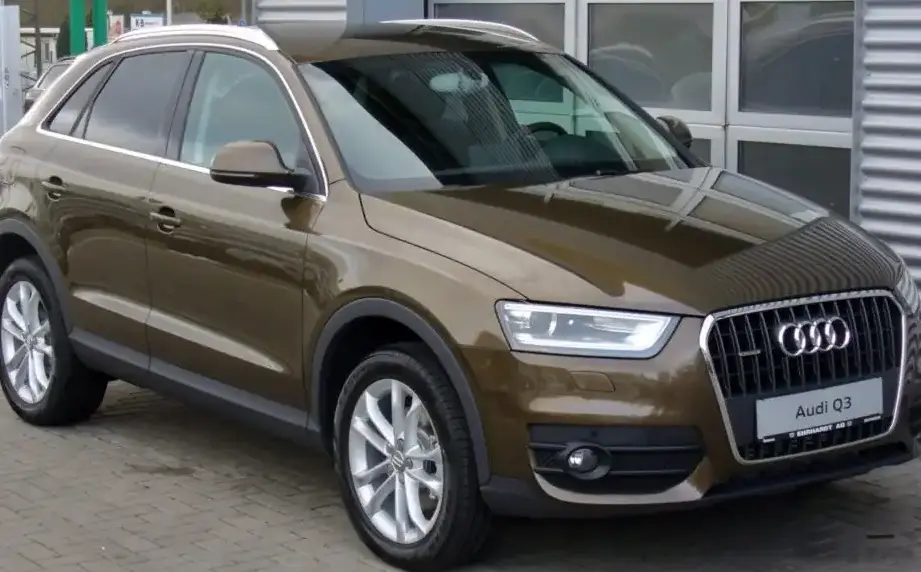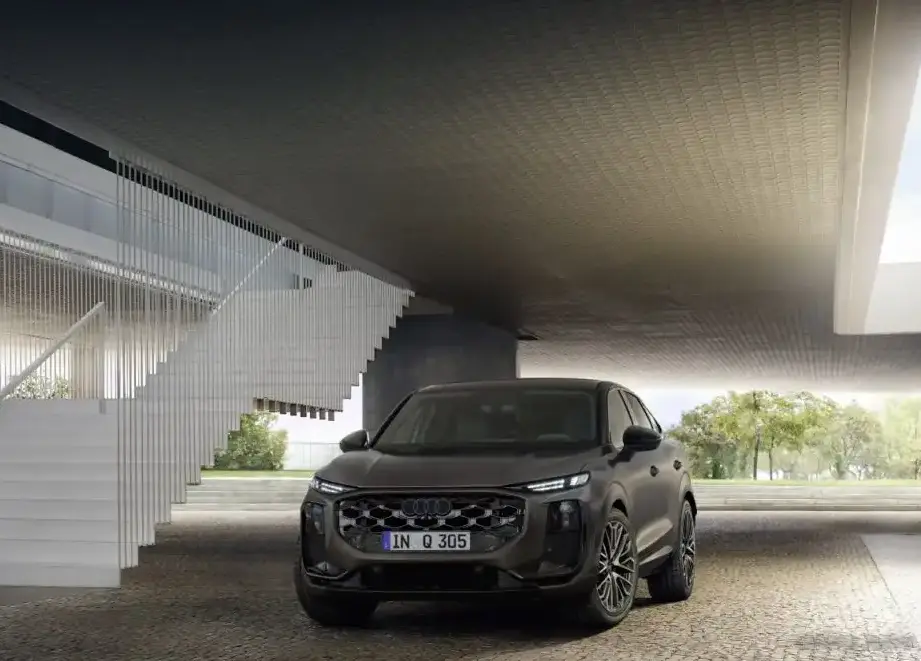
The Audi Q3 III Sportback 2.0 TFSI quattro S tronic, launched in August 2025, represents the performance-oriented variant within the third generation (FJ) of Audi’s compact luxury crossover coupe. Positioned as a premium offering, it slots above the base Q3 Sportback trims and below potential future RS models. This model combines a potent 2.0-liter turbocharged four-cylinder engine with Audi’s quattro all-wheel-drive system and a seven-speed S tronic dual-clutch transmission, targeting drivers seeking a blend of sporty handling and everyday practicality. The Sportback body style distinguishes it from the standard Q3 with a sloping roofline, emphasizing a more dynamic aesthetic.
Technical Specifications
| Brand | Audi |
| Model | Q3 |
| Generation | Q3 III Sportback (FJ) |
| Type (Engine) | 2.0 TFSI (265 Hp) quattro S tronic |
| Start of production | August, 2025 |
| Powertrain Architecture | Internal Combustion engine |
| Body type | Coupe, SUV |
| Seats | 5 |
| Doors | 5 |
| Combined fuel consumption (WLTP) | 8.5-9 l/100 km (27.7 – 26.1 US mpg, 33.2 – 31.4 UK mpg, 11.8 – 11.1 km/l) |
| CO2 emissions (WLTP) | 193-205 g/km |
| Fuel Type | Petrol (Gasoline) |
| Acceleration 0 – 100 km/h | 5.7 sec |
| Acceleration 0 – 62 mph | 5.7 sec |
| Acceleration 0 – 60 mph | 5.4 sec |
| Maximum speed | 240 km/h (149.13 mph) |
| Emission standard | Euro 6e |
| Weight-to-power ratio | 6.3 kg/Hp, 158.2 Hp/tonne |
| Weight-to-torque ratio | 4.2 kg/Nm, 238.8 Nm/tonne |
| Power | 265 Hp @ 5000-6500 rpm |
| Power per litre | 133.6 Hp/l |
| Torque | 400 Nm @ 1650-4350 rpm (295.02 lb.-ft. @ 1650-4350 rpm) |
| Engine layout | Front, Transverse |
| Engine displacement | 1984 cm3 (121.07 cu. in.) |
| Number of cylinders | 4 |
| Engine configuration | Inline |
| Cylinder Bore | 82.5 mm (3.25 in.) |
| Piston Stroke | 92.8 mm (3.65 in.) |
| Compression ratio | 9.6:1 |
| Number of valves per cylinder | 4 |
| Fuel injection system | Direct injection |
| Engine aspiration | Turbocharger, Intercooler |
| Valvetrain | DOHC |
| Engine oil capacity | 5.7 l (6.02 US qt | 5.02 UK qt) |
| Coolant | 9.2 l (9.72 US qt | 8.09 UK qt) |
| Kerb Weight | 1675 kg (3692.74 lbs.) |
| Max. weight | 2260 kg (4982.45 lbs.) |
| Max load | 585 kg (1289.7 lbs.) |
| Trunk (boot) space – minimum | 488 l (17.23 cu. ft.) |
| Trunk (boot) space – maximum | 1289 l (45.52 cu. ft.) |
| Fuel tank capacity | 60 l (15.85 US gal | 13.2 UK gal) |
| Max. roof load | 75 kg (165.35 lbs.) |
| Permitted trailer load with brakes (8%) | 2100 kg (4629.71 lbs.) |
| Permitted trailer load with brakes (12%) | 2100 kg (4629.71 lbs.) |
| Permitted trailer load without brakes | 750 kg (1653.47 lbs.) |
| Permitted towbar download | 90 kg (198.42 lbs.) |
| Length | 4531 mm (178.39 in.) |
| Width | 1859 mm (73.19 in.) |
| Width including mirrors | 2087 mm (82.17 in.) |
| Height | 1559 mm (61.38 in.) |
| Wheelbase | 2681 mm (105.55 in.) |
| Front track | 1588 mm (62.52 in.) |
| Rear (Back) track | 1581 mm (62.24 in.) |
| Front overhang | 940 mm (37.01 in.) |
| Rear overhang | 910 mm (35.83 in.) |
| Drag coefficient (Cd) | 0.34 |
| Minimum turning circle (turning diameter) | 11.8 m (38.71 ft.) |
| Approach angle | 17° |
| Departure angle | 25° |
| Drivetrain Architecture | The Internal combustion engine (ICE) drives the front wheels permanently, and the rear wheels are driven through an electrically or mechanically operated clutch if necessary. |
| Drive wheel | All wheel drive (4×4) |
| Number of gears and type of gearbox | 7 gears, automatic transmission S tronic |
| Front suspension | Independent, type McPherson with coil spring and anti-roll bar |
| Rear suspension | Independent multi-link spring suspension with stabilizer |
| Front brakes | Ventilated discs |
| Assisting systems | ABS (Anti-lock braking system) |
| Steering type | Steering rack and pinion |
| Power steering | Electric Steering |
| Tires size | 235/55 R8 |
| Wheel rims size | 8J x 18 |
Powertrain & Engine Architecture
At the heart of the Q3 Sportback 2.0 TFSI quattro lies the EA888 2.0-liter inline-four cylinder gasoline engine. This engine, a staple in the Volkswagen Group’s portfolio, utilizes direct fuel injection and a single twin-scroll turbocharger with intercooling. The engine’s output of 265 horsepower at 5000-6500 rpm and 295 lb-ft of torque between 1650-4350 rpm is achieved through careful tuning of the engine management system. The S tronic seven-speed dual-clutch transmission provides rapid and seamless gear changes, contributing to the vehicle’s brisk acceleration. The quattro all-wheel-drive system employs a multi-plate clutch to distribute torque between the front and rear axles as needed, enhancing traction and stability, particularly in adverse weather conditions. A start/stop system is included as standard to improve fuel efficiency.
Driving Characteristics
The 2.0 TFSI engine paired with the S tronic transmission delivers a responsive and engaging driving experience. Acceleration from 0-60 mph is achieved in approximately 5.4 seconds. The S tronic transmission’s quick shifts and the quattro system’s intelligent torque distribution contribute to confident handling and cornering ability. Compared to lower-powered Q3 variants, the 2.0 TFSI offers significantly more punch, making overtaking maneuvers effortless. While not as raw or focused as a dedicated sports car, the Q3 Sportback 2.0 TFSI provides a satisfying balance between performance and comfort. The gear ratios are tuned for a blend of acceleration and fuel economy, with taller gears for relaxed cruising on the highway.
Equipment & Trim Levels
The 2.0 TFSI quattro S tronic trim typically includes a generous array of standard features. These commonly include Audi’s Virtual Cockpit digital instrument cluster, a touchscreen infotainment system with navigation, leather upholstery, heated front seats, and a panoramic sunroof. Exterior features often include LED headlights, a power tailgate, and 18-inch alloy wheels. Optional extras can include a premium sound system, adaptive cruise control, and advanced driver-assistance systems such as lane keeping assist and blind-spot monitoring. Interior trim options allow for personalization, with choices in wood, aluminum, or carbon fiber accents.
Chassis & Braking
The Q3 Sportback 2.0 TFSI utilizes a McPherson strut front suspension and a multi-link rear suspension, providing a comfortable yet controlled ride. Stabilizer bars are fitted to both axles to reduce body roll during cornering. The braking system consists of ventilated disc brakes at all four corners, providing ample stopping power. ABS (Anti-lock Braking System) is standard, along with electronic stability control and traction control. The steering is an electric power-assisted rack and pinion system, offering precise and responsive steering feel.
Market Reception & Comparison
The Audi Q3 Sportback 2.0 TFSI quattro S tronic has generally been well-received by automotive critics. Reviewers praise its stylish design, refined interior, and engaging driving dynamics. Fuel economy is respectable for its class, averaging around 27-31 mpg in mixed driving. Compared to the base Q3 models with smaller engines, the 2.0 TFSI offers a substantial performance upgrade, justifying the higher price point. Compared to rivals like the BMW X2 and Mercedes-Benz GLA, the Q3 Sportback is often noted for its spacious interior and user-friendly technology. Reliability has been generally good, although some owners have reported minor issues with the infotainment system.
Legacy
The EA888 engine family, including the 2.0 TFSI variant found in the Q3 Sportback, has a proven track record for reliability when properly maintained. Regular oil changes and adherence to the manufacturer’s recommended service intervals are crucial for long-term durability. The S tronic transmission is also generally reliable, but requires periodic servicing, including fluid changes. As the Q3 Sportback 2.0 TFSI enters the used car market, it is expected to hold its value well due to its desirable combination of performance, luxury, and practicality. Its quattro all-wheel-drive system will likely make it a popular choice in regions with inclement weather.