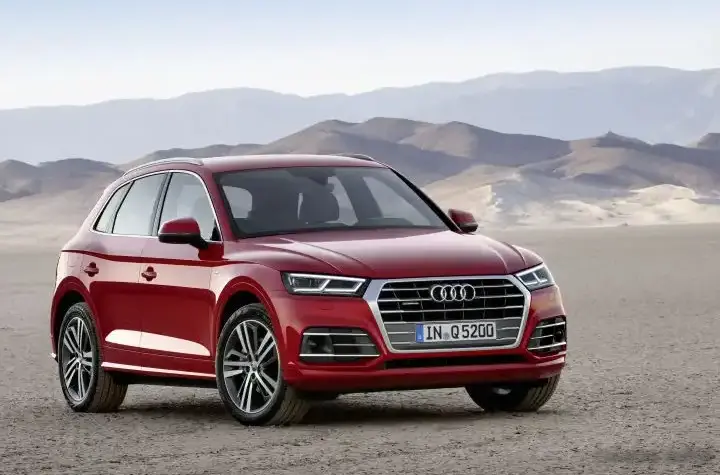
The Audi Q5 II (FY) 2.0 TFSI quattro ultra S tronic represents a significant iteration in Audi’s popular compact luxury SUV lineup. Produced from 2016 to 2018, this variant occupied a key position within the second-generation Q5 (FY) range, offering a balance of performance, efficiency, and all-weather capability. It was designed to appeal to buyers seeking a premium SUV experience without the higher price tag and performance focus of the SQ5 or the diesel-oriented TDI models. The Q5 FY series, built on the MLB Evo platform, aimed to improve upon the original Q5 in terms of interior space, technology, and driving dynamics.
Technical Specifications
| Brand | Audi |
| Model | Q5 |
| Generation | Q5 II (FY) |
| Type (Engine) | 2.0 TFSI (252 Hp) quattro ultra S tronic |
| Start of production | 2016 |
| End of production | 2018 |
| Powertrain Architecture | Internal Combustion engine |
| Body type | SUV |
| Seats | 5 |
| Doors | 5 |
| Fuel consumption (urban) | 8.3-8.6 l/100 km (28.3 – 27.4 US mpg, 34 – 32.8 UK mpg, 12 – 11.6 km/l) |
| Fuel consumption (extra urban) | 5.9-6.4 l/100 km (39.9 – 36.8 US mpg, 47.9 – 44.1 UK mpg, 16.9 – 15.6 km/l) |
| Fuel consumption (combined) | 6.8-7.2 l/100 km (34.6 – 32.7 US mpg, 41.5 – 39.2 UK mpg, 14.7 – 13.9 km/l) |
| CO2 emissions | 154-164 g/km |
| Fuel Type | Petrol (Gasoline) |
| Acceleration 0 – 100 km/h | 6.3 sec |
| Acceleration 0 – 62 mph | 6.3 sec |
| Acceleration 0 – 60 mph | 6 sec |
| Maximum speed | 237 km/h (147.26 mph) |
| Emission standard | Euro 6 |
| Weight-to-power ratio | 6.8 kg/Hp, 146.5 Hp/tonne |
| Weight-to-torque ratio | 4.6 kg/Nm, 215.1 Nm/tonne |
| Power | 252 Hp @ 5000-6000 rpm |
| Power per litre | 127 Hp/l |
| Torque | 370 Nm @ 1600-4500 rpm (272.9 lb.-ft. @ 1600-4500 rpm) |
| Engine layout | Front, Longitudinal |
| Engine Model/Code | EA888 / DAXB |
| Engine displacement | 1984 cm3 (121.07 cu. in.) |
| Number of cylinders | 4 |
| Engine configuration | Inline |
| Cylinder Bore | 82.5 mm (3.25 in.) |
| Piston Stroke | 92.8 mm (3.65 in.) |
| Compression ratio | 9.6:1 |
| Number of valves per cylinder | 4 |
| Fuel injection system | Direct injection and Multi-port manifold injection |
| Engine aspiration | Turbocharger, Intercooler |
| Valvetrain | DOHC |
| Engine oil capacity | 5.2 l (5.49 US qt | 4.58 UK qt) |
| Coolant | 8.65 l (9.14 US qt | 7.61 UK qt) |
| Kerb Weight | 1720 kg (3791.95 lbs.) |
| Max. weight | 2400 kg (5291.09 lbs.) |
| Max load | 680 kg (1499.14 lbs.) |
| Trunk (boot) space – minimum | 550 l (19.42 cu. ft.) |
| Trunk (boot) space – maximum | 1510 l (53.33 cu. ft.) |
| Fuel tank capacity | 70 l (18.49 US gal | 15.4 UK gal) |
| Max. roof load | 75 kg (165.35 lbs.) |
| Permitted trailer load with brakes (8%) | 2400 kg (5291.09 lbs.) |
| Permitted trailer load with brakes (12%) | 2400 kg (5291.09 lbs.) |
| Permitted trailer load without brakes | 750 kg (1653.47 lbs.) |
| Permitted towbar download | 100 kg (220.46 lbs.) |
| Length | 4663 mm (183.58 in.) |
| Width | 1893 mm (74.53 in.) |
| Width including mirrors | 2140 mm (84.25 in.) |
| Height | 1659 mm (65.31 in.) |
| Wheelbase | 2819 mm (110.98 in.) |
| Front track | 1616 mm (63.62 in.) |
| Rear (Back) track | 1609 mm (63.35 in.) |
| Front overhang | 899 mm (35.39 in.) |
| Rear overhang | 945 mm (37.2 in.) |
| Drag coefficient (Cd) | 0.30 |
| Minimum turning circle (turning diameter) | 11.7 m (38.39 ft.) |
| Drivetrain Architecture | The Internal combustion engine (ICE) drives the front wheels permanently, and the rear wheels are driven through an electrically or mechanically operated clutch if necessary. |
| Drive wheel | All wheel drive (4×4) |
| Number of gears and type of gearbox | 7 gears, automatic transmission S tronic |
| Front suspension | Independent multi-link suspension, Transverse stabilizer |
| Rear suspension | Independent multi-link spring suspension with stabilizer |
| Front brakes | Ventilated discs |
| Rear brakes | Ventilated discs |
| Assisting systems | ABS (Anti-lock braking system) |
| Steering type | Steering rack and pinion |
| Power steering | Electric Steering |
| Tires size | 235/65 R17; 235/60 R18; 235/55 R19; 255/45 R20 |
| Wheel rims size | 8J x 17; 8J x 18; 8J x 19; 8J x 20 |
Powertrain & Engine Architecture
At the heart of the Q5 2.0 TFSI quattro ultra S tronic lies the EA888 2.0-liter turbocharged four-cylinder engine, specifically the DAXB variant. This engine is a staple in the Volkswagen Group’s product lineup, known for its blend of power and efficiency. The DAXB features direct fuel injection combined with multi-point injection, optimizing combustion under various load conditions. The engine utilizes a single-scroll turbocharger with an intercooler to minimize turbo lag and maximize boost pressure. The engine produces 252 horsepower at 5000-6000 rpm and 370 Nm (272.9 lb-ft) of torque between 1600 and 4500 rpm. The S tronic 7-speed dual-clutch transmission (DCT) is a key component, offering rapid and smooth gear changes. The ‘ultra’ designation in ‘quattro ultra’ indicates an on-demand all-wheel-drive system, which primarily drives the front wheels and engages the rear axle electronically when traction demands it, improving fuel economy.
Driving Characteristics
The 2.0 TFSI with the S tronic transmission delivers a responsive and refined driving experience. Acceleration from 0 to 60 mph takes approximately 6 seconds, making it adequately quick for most driving situations. The S tronic transmission provides quick shifts, enhancing the feeling of performance. Compared to the higher-output SQ5, the 2.0 TFSI offers less outright acceleration, but it compensates with better fuel economy and a more comfortable ride. The ‘quattro ultra’ system generally operates seamlessly, providing enhanced traction in adverse weather conditions. The gear ratios are tuned for a balance between acceleration and fuel efficiency, with a relatively tall seventh gear for highway cruising.
Equipment & Trim Levels
The Q5 2.0 TFSI quattro ultra S tronic typically came well-equipped, even in base trim. Standard features included Audi’s MMI infotainment system with a 7-inch display, tri-zone automatic climate control, leather upholstery, and power-adjustable front seats. Optional extras included a larger MMI display with navigation, a Bang & Olufsen sound system, a panoramic sunroof, and various driver-assistance features like adaptive cruise control and blind-spot monitoring. Trim levels varied by market, but generally offered packages that added cosmetic enhancements, upgraded interior materials, and additional technology features.
Chassis & Braking
The Q5 FY features a sophisticated chassis design with independent multi-link suspension at all four corners. This setup provides a comfortable ride while maintaining good handling characteristics. The suspension is tuned to balance comfort and control, offering a stable and predictable driving experience. Braking duties are handled by ventilated discs on all four wheels, providing ample stopping power. The ABS system and electronic stability control further enhance safety. The steering is precise and well-weighted, providing good feedback to the driver.
Market Reception & Comparison
The Audi Q5 2.0 TFSI quattro ultra S tronic was generally well-received by automotive critics. It was praised for its refined interior, comfortable ride, and efficient powertrain. Compared to competitors like the BMW X3 and Mercedes-Benz GLC, the Q5 offered a compelling combination of features and value. The ‘quattro ultra’ system was noted for its ability to improve fuel economy without significantly compromising all-weather capability. However, some critics found the engine to be slightly less powerful than those offered by its rivals. Fuel economy figures typically ranged from 32.7 to 39.2 US mpg, depending on driving conditions.
Legacy
The EA888 2.0 TFSI engine, in its various iterations, has proven to be a reliable and durable powertrain. While some early versions of the EA888 experienced carbon buildup issues, the DAXB variant generally exhibits good long-term reliability with proper maintenance. The S tronic transmission is also generally reliable, but requires regular fluid changes to ensure optimal performance. Today, the Q5 2.0 TFSI quattro ultra S tronic remains a popular choice in the used car market, offering a blend of luxury, performance, and practicality. Its relatively strong resale value reflects its reputation for quality and durability.