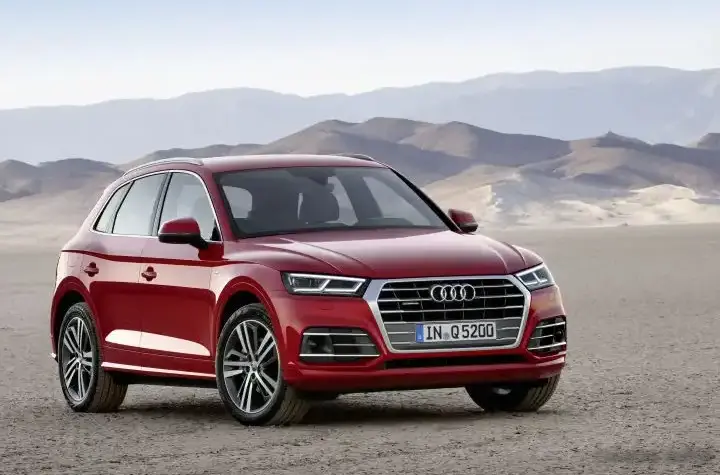
The Audi Q5 II (FY) 3.0 TDI quattro tiptronic represents a significant iteration in Audi’s popular luxury compact SUV lineup. Produced from 2017 to 2018, this variant combined a potent diesel engine with Audi’s renowned quattro all-wheel-drive system and a smooth-shifting eight-speed tiptronic automatic transmission. It occupied a premium position within the Q5 range, offering a balance of performance, refinement, and practicality aimed at buyers seeking a sophisticated and capable SUV. The Q5 II (FY) built upon the success of the first-generation Q5, utilizing a revised MLB Evo platform to deliver improved space, technology, and driving dynamics.
Technical Specifications
| Brand | Audi |
| Model | Q5 |
| Generation | Q5 II (FY) |
| Type (Engine) | 3.0 TDI (286 Hp) quattro tiptronic |
| Start of production | 2017 |
| End of production | 2018 |
| Powertrain Architecture | Internal Combustion engine |
| Body type | SUV |
| Seats | 5 |
| Doors | 5 |
| Fuel consumption (urban) | 6.4-6.9 l/100 km (36.8 – 34.1 US mpg, 44.1 – 40.9 UK mpg, 15.6 – 14.5 km/l) |
| Fuel consumption (extra urban) | 5.3-5.8 l/100 km (44.4 – 40.6 US mpg, 53.3 – 48.7 UK mpg, 18.9 – 17.2 km/l) |
| Fuel consumption (combined) | 5.7-6.2 l/100 km (41.3 – 37.9 US mpg, 49.6 – 45.6 UK mpg, 17.5 – 16.1 km/l) |
| CO2 emissions | 149-162 g/km |
| Fuel Type | Diesel |
| Acceleration 0 – 100 km/h | 5.8 sec |
| Acceleration 0 – 62 mph | 5.8 sec |
| Acceleration 0 – 60 mph | 5.5 sec |
| Maximum speed | 237 km/h (147.26 mph) |
| Emission standard | Euro 6 |
| Weight-to-power ratio | 6.5 kg/Hp, 152.9 Hp/tonne |
| Weight-to-torque ratio | 3 kg/Nm, 331.6 Nm/tonne |
| Power | 286 Hp @ 3750-4000 rpm |
| Power per litre | 96.4 Hp/l |
| Torque | 620 Nm @ 1500-3000 rpm (457.29 lb.-ft. @ 1500-3000 rpm) |
| Engine layout | Front, Longitudinal |
| Engine Model/Code | DCPC |
| Engine displacement | 2967 cm3 (181.06 cu. in.) |
| Number of cylinders | 6 |
| Engine configuration | V-engine |
| Cylinder Bore | 83 mm (3.27 in.) |
| Piston Stroke | 91.4 mm (3.6 in.) |
| Compression ratio | 16:1 |
| Number of valves per cylinder | 4 |
| Fuel injection system | Diesel Commonrail |
| Engine aspiration | Turbocharger, Intercooler |
| Valvetrain | DOHC |
| Engine oil capacity | 6.1 l (6.45 US qt | 5.37 UK qt) |
| Coolant | 12.5 l (13.21 US qt | 11 UK qt) |
| Kerb Weight | 1870 kg (4122.64 lbs.) |
| Max. weight | 2550 kg (5621.79 lbs.) |
| Max load | 680 kg (1499.14 lbs.) |
| Trunk (boot) space – minimum | 550 l (19.42 cu. ft.) |
| Trunk (boot) space – maximum | 1510 l (53.33 cu. ft.) |
| Fuel tank capacity | 65 l (17.17 US gal | 14.3 UK gal) |
| AdBlue tank | 12 l (3.17 US gal | 2.64 UK gal) |
| Max. roof load | 75 kg (165.35 lbs.) |
| Permitted trailer load with brakes (8%) | 2400 kg (5291.09 lbs.) |
| Permitted trailer load with brakes (12%) | 2400 kg (5291.09 lbs.) |
| Permitted trailer load without brakes | 750 kg (1653.47 lbs.) |
| Permitted towbar download | 100 kg (220.46 lbs.) |
| Length | 4663 mm (183.58 in.) |
| Width | 1893 mm (74.53 in.) |
| Width including mirrors | 2140 mm (84.25 in.) |
| Height | 1659 mm (65.31 in.) |
| Wheelbase | 2819 mm (110.98 in.) |
| Front track | 1616 mm (63.62 in.) |
| Rear (Back) track | 1609 mm (63.35 in.) |
| Front overhang | 899 mm (35.39 in.) |
| Rear overhang | 945 mm (37.2 in.) |
| Minimum turning circle (turning diameter) | 11.7 m (38.39 ft.) |
| Drive wheel | All wheel drive (4×4) |
| Number of gears and type of gearbox | 8 gears, automatic transmission tiptronic |
| Front suspension | Independent multi-link suspension |
| Rear suspension | Independent multi-link suspension |
| Front brakes | Ventilated discs |
| Rear brakes | Ventilated discs |
INTRODUCTION
The Audi Q5 II (FY) 3.0 TDI quattro tiptronic, launched in 2017, represented a significant upgrade over its predecessor. Built on the MLB Evo platform, it offered increased interior space, a more refined driving experience, and a host of advanced technologies. This particular variant, powered by the 3.0-liter TDI engine and paired with the eight-speed tiptronic transmission, was positioned as a premium offering within the Q5 lineup, appealing to buyers who prioritized performance and all-weather capability. It served as a key model in Audi’s strategy to maintain its position in the competitive luxury SUV segment, particularly in European markets where diesel engines remained popular.
Powertrain & Engine Architecture
At the heart of the Q5 3.0 TDI lies the DCPC engine, a 3.0-liter V6 turbocharged diesel engine. This engine is a member of Audi’s modular engine family, known for its robust construction and efficiency. The engine utilizes a common rail direct injection system, delivering fuel at extremely high pressures for optimized combustion. The turbocharger, coupled with an intercooler, provides increased air density for enhanced power output. The engine produces 286 horsepower at 3750-4000 rpm and a substantial 620 Nm (457.29 lb.-ft.) of torque between 1500-3000 rpm. The eight-speed tiptronic automatic transmission is a torque-converter type, offering smooth and responsive gear changes. It features adaptive shift programs that adjust to the driver’s style and driving conditions. The transmission’s wide gear ratio spread contributes to both fuel efficiency and strong acceleration.
Driving Characteristics
The Q5 3.0 TDI quattro tiptronic delivers a refined and capable driving experience. The abundant torque from the diesel engine provides strong acceleration, with a 0-60 mph time of around 5.5 seconds. The quattro all-wheel-drive system ensures excellent traction in all weather conditions, distributing power between the front and rear axles as needed. The tiptronic transmission shifts smoothly and efficiently, contributing to a comfortable ride. Compared to the lower-powered 2.0-liter TFSI variants, the 3.0 TDI offers significantly more performance and a more relaxed driving experience, particularly when fully loaded or towing. While not as sporty as some competitors, the Q5 3.0 TDI provides a balanced blend of comfort and performance.
Equipment & Trim Levels
The Q5 3.0 TDI quattro tiptronic typically came well-equipped as standard. Features included leather upholstery, tri-zone automatic climate control, a power liftgate, and Audi’s MMI infotainment system with a 7-inch display. Optional extras included a larger 8.3-inch MMI display with navigation, a Bang & Olufsen sound system, adaptive cruise control, a panoramic sunroof, and various driver-assistance systems. Interior trim options ranged from wood veneers to brushed aluminum, allowing buyers to personalize the cabin to their preferences. The overall interior design emphasized quality materials and a user-friendly layout.
Chassis & Braking
The Q5 II (FY) features an independent multi-link suspension at both the front and rear axles, providing a comfortable and controlled ride. The suspension is tuned to balance handling and comfort, offering a stable and predictable driving experience. Ventilated disc brakes are fitted on all four wheels, providing ample stopping power. The electronic stability control (ESC) system works in conjunction with the quattro all-wheel-drive system to enhance stability and prevent skidding. The steering is a speed-sensitive electric power steering system, offering precise and responsive control.
Market Reception & Comparison
The Audi Q5 3.0 TDI quattro tiptronic was generally well-received by automotive critics. It was praised for its refined engine, comfortable ride, and sophisticated interior. Compared to competitors like the BMW X3 and Mercedes-Benz GLC, the Q5 offered a compelling combination of performance, luxury, and practicality. Fuel economy was a strong point, with combined figures ranging from 37.9 to 41.3 US mpg. Reliability was generally good, although some owners reported minor issues with the infotainment system. The 3.0 TDI variant was often seen as a more desirable alternative to the 2.0-liter TFSI models, offering a more powerful and refined driving experience.
Legacy
The Audi Q5 II (FY) 3.0 TDI quattro tiptronic remains a popular choice in the used car market. The 3.0-liter TDI engine is known for its durability and longevity, provided it has been properly maintained. Regular servicing, including oil changes and filter replacements, is crucial for ensuring long-term reliability. While diesel engines have faced increased scrutiny in recent years, the Q5 3.0 TDI continues to appeal to buyers who value fuel efficiency and strong performance. Its combination of luxury, capability, and refinement ensures its continued relevance in the premium SUV segment.