Technical Specifications
| Brand | Audi |
| Model | Q5 |
| Generation | Q5 II (FY, facelift 2020) |
| Type (Engine) | 35 TDI (163 Hp) Mild Hybrid S tronic |
| Start of production | September, 2020 |
| End of production | September, 2024 |
| Powertrain Architecture | MHEV (Mild Hybrid Electric Vehicle) |
| Body type | SUV |
| Seats | 5 |
| Doors | 5 |
| Combined fuel consumption (WLTP) | 5.6-6.1 l/100 km (42 – 38.6 US mpg) |
| CO2 emissions (WLTP) | 146-161 g/km |
| Fuel consumption (urban) | 5.4-5.5 l/100 km (43.6 – 42.8 US mpg) |
| Fuel consumption (extra urban) | 4.2-4.4 l/100 km (56 – 53.5 US mpg) |
| Fuel consumption (combined) | 4.7-4.8 l/100 km (50 – 49 US mpg) |
| CO2 emissions (NEDC) | 123-125 g/km |
| Fuel Type | Diesel |
| Acceleration 0 – 100 km/h | 9 sec |
| Acceleration 0 – 62 mph | 9 sec |
| Acceleration 0 – 60 mph | 8.6 sec |
| Maximum speed | 213 km/h (132.35 mph) |
| Emission standard | Euro 6d-ISC-FCM |
| Weight-to-power ratio | 10.7 kg/Hp |
| Weight-to-torque ratio | 4.7 kg/Nm |
| Battery voltage | 12 V |
| Battery technology | Lithium-ion (Li-Ion) |
| Electric motor power | 3 Hp |
| Electric motor Torque | 60 Nm (44.25 lb.-ft.) |
| Power | 163 Hp @ 3250-4200 rpm |
| Torque | 370 Nm @ 1500-3000 rpm (272.9 lb.-ft.) |
| Engine displacement | 1968 cm3 (120.09 cu. in.) |
| Number of cylinders | 4 |
| Engine layout | Front, Longitudinal |
| Engine Model/Code | EA288 evo / DEZE, DTNA |
| Cylinder Bore | 81 mm (3.19 in.) |
| Piston Stroke | 95.5 mm (3.76 in.) |
| Compression ratio | 16:1 |
| Fuel injection system | Diesel Commonrail |
| Engine aspiration | Turbocharger, Intercooler |
| Valvetrain | DOHC |
| Engine oil capacity | 5.5 l (5.81 US qt | 4.84 UK qt) |
| Coolant capacity | 11.5 l (12.15 US qt | 10.12 UK qt) |
| Kerb Weight | 1740 kg (3836.04 lbs.) |
| Max. weight | 2420 kg (5335.19 lbs.) |
| Max load | 680 kg (1499.14 lbs.) |
| Trunk (boot) space – minimum | 520 l (18.36 cu. ft.) |
| Trunk (boot) space – maximum | 1520 l (53.68 cu. ft.) |
| Fuel tank capacity | 65 l (17.17 US gal | 14.3 UK gal) |
| AdBlue tank | 12 l (3.17 US gal | 2.64 UK gal) |
| Max. roof load | 75 kg (165.35 lbs.) |
| Permitted trailer load (8%) | 2000 kg (4409.25 lbs.) |
| Permitted trailer load (12%) | 2000 kg (4409.25 lbs.) |
| Permitted trailer load (unbraked) | 750 kg (1653.47 lbs.) |
| Permitted towbar download | 100 kg (220.46 lbs.) |
| Length | 4682 mm (184.33 in.) |
| Width | 1893 mm (74.53 in.) |
| Width including mirrors | 2140 mm (84.25 in.) |
| Height | 1637 mm (64.45 in.) |
| Wheelbase | 2819 mm (110.98 in.) |
| Front track | 1616-1623 mm (63.62 – 63.9 in.) |
| Rear track | 1609-1611 mm (63.35 – 63.43 in.) |
| Front overhang | 910 mm (35.83 in.) |
| Rear overhang | 953 mm (37.52 in.) |
| Drag coefficient (Cd) | 0.30 |
| Minimum turning circle | 11.8 m (38.71 ft.) |
| Drivetrain | Front wheel drive, MHEV |
| Gearbox | 7-speed automatic S tronic |
| Front suspension | Coil spring, Independent multi-link, Transverse stabilizer |
| Rear suspension | Independent multi-link with stabilizer |
| Front brakes | Ventilated discs, 338 mm |
| Rear brakes | Ventilated discs, 330 mm |
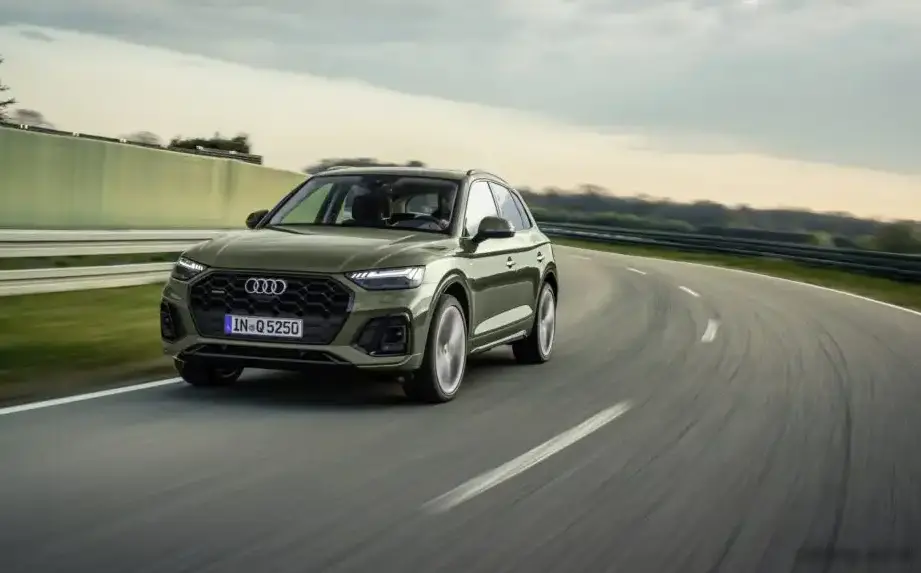
The Audi Q5 II 35 TDI (163 hp) Mild Hybrid S tronic, produced from September 2020 to September 2024, was a significant variant within the second-generation Q5 (FY) lineup, particularly following the 2020 facelift. Positioned as an entry-level diesel option in many European markets, it aimed to deliver a blend of fuel efficiency and the practicality expected of a compact luxury SUV. This model sought to balance affordability with the premium Audi experience, appealing to buyers who prioritized economy and comfort over outright performance. It existed within a broader Q5 range that included more powerful gasoline and diesel engines, as well as plug-in hybrid alternatives.
Powertrain & Engine Architecture
The Q5 35 TDI utilizes the Volkswagen Group’s EA288 evo series of diesel engines, specifically the DEZE or DTNA engine code depending on the production date and market. This 2.0-liter inline-four cylinder engine employs a turbocharger and intercooler to generate 163 horsepower at 3250-4200 rpm and 370 Nm (272.9 lb-ft) of torque between 1500-3000 rpm. The engine features a diesel common rail fuel injection system for precise fuel delivery and optimized combustion. The valvetrain is a Dual Overhead Camshaft (DOHC) configuration with four valves per cylinder. A key feature of this variant is its 48V mild hybrid system. This system incorporates a belt starter generator (BSG) and a small lithium-ion battery to enable features like extended start-stop operation, regenerative braking, and a modest power boost during acceleration. The standard transmission is a 7-speed S tronic dual-clutch transmission, offering quick and smooth gear changes.
Driving Characteristics
The 163 hp output and S tronic transmission provide adequate, though not particularly sporty, performance. Acceleration from 0-60 mph takes approximately 8.6 seconds, and the top speed is electronically limited to 132.35 mph. The engine delivers a useful amount of torque at low engine speeds, making it well-suited for everyday driving and overtaking. Compared to the more powerful Q5 variants (such as the 40 TDI or 45 TFSI), the 35 TDI feels less responsive, especially at higher speeds. The S tronic transmission is well-calibrated, providing seamless shifts and contributing to a comfortable driving experience. The mild hybrid system is largely unnoticeable during normal driving, but it does contribute to improved fuel economy and reduced emissions. The gear ratios are tuned for efficiency, prioritizing fuel savings over rapid acceleration.
Equipment & Trim Levels
The Q5 35 TDI typically came equipped with a comprehensive set of standard features, including Audi’s MMI infotainment system with a touchscreen display, automatic climate control, leather upholstery, and a suite of driver-assistance systems such as lane departure warning and automatic emergency braking. Optional extras included a panoramic sunroof, an upgraded sound system, adaptive cruise control, and various interior trim packages. Trim levels varied depending on the market, but generally offered increasing levels of luxury and technology. The base trim focused on essential features, while higher trims added more premium materials and advanced driver aids. Features like heated seats and parking sensors were often available as options or included in higher trim packages.
Chassis & Braking
The Q5 35 TDI utilizes a MacPherson strut front suspension and a multi-link rear suspension, providing a comfortable and controlled ride. Stabilizer bars are fitted to both axles to minimize body roll during cornering. The braking system consists of ventilated discs on all four wheels, with diameters of 338mm at the front and 330mm at the rear. ABS (Anti-lock Braking System) is standard. The suspension setup is tuned to prioritize comfort over sporty handling, making it well-suited for long-distance travel. The steering is precise and well-weighted, providing a confident feel on the road.
Market Reception & Comparison
The Q5 35 TDI was generally well-received by automotive critics as a practical and efficient option within the luxury SUV segment. It was praised for its comfortable ride, refined interior, and fuel economy. However, some reviewers noted that the engine lacked the performance of its more powerful counterparts. Compared to the Q5 40 TDI, the 35 TDI offered lower running costs but sacrificed acceleration. Against competitors like the BMW X3 and Mercedes-Benz GLC, the Q5 35 TDI held its own in terms of quality and features, but often came at a slightly higher price point. Its fuel efficiency was a key selling point, particularly in markets with high fuel taxes.
Legacy
The EA288 engine family, including the variants used in the Q5 35 TDI, has proven to be relatively reliable, although diesel particulate filter (DPF) issues can occur with vehicles primarily used for short trips. The mild hybrid technology introduced in this model paved the way for more advanced hybrid systems in later Audi models. On the used car market, the Q5 35 TDI represents a good value proposition for buyers seeking a comfortable, well-equipped, and fuel-efficient luxury SUV. Its longevity and relatively low maintenance costs contribute to its continued appeal. The combination of Audi’s build quality and the efficient diesel engine makes it a popular choice for those seeking a practical and reliable vehicle.