Technical Specifications
| Brand | Audi |
| Model | Q5 |
| Generation | Q5 II (FY, facelift 2020) |
| Type (Engine) | 50 TDI V6 (286 Hp) Mild Hybrid quattro tiptronic |
| Start of production | 2020 |
| End of production | September, 2024 |
| Powertrain Architecture | MHEV (Mild Hybrid Electric Vehicle) |
| Body type | SUV |
| Seats | 5 |
| Doors | 5 |
| Combined fuel consumption (WLTP) | 8.1-8.8 l/100 km (29 – 26.7 US mpg) |
| CO2 emissions (WLTP) | 211-231 g/km |
| Fuel consumption (urban) | 8.4-8.5 l/100 km (28 – 27.7 US mpg) |
| Fuel consumption (extra urban) | 5.7-5.9 l/100 km (41.3 – 39.9 US mpg) |
| Fuel consumption (combined) | 6.7-6.9 l/100 km (35.1 – 34.1 US mpg) |
| CO2 emissions (NEDC) | 176-181 g/km |
| Fuel Type | Diesel |
| Acceleration 0 – 100 km/h | 5.7 sec |
| Acceleration 0 – 62 mph | 5.7 sec |
| Acceleration 0 – 60 mph | 5.4 sec |
| Maximum speed | 240 km/h (149.13 mph) |
| Emission standard | Euro 6d-ISC-FCM |
| Weight-to-power ratio | 6.8 kg/Hp |
| Weight-to-torque ratio | 3.1 kg/Nm |
| Power | 286 Hp @ 3500-4000 rpm |
| Torque | 620 Nm @ 1750-3000 rpm (457.29 lb.-ft.) |
| Engine layout | Front, Longitudinal |
| Engine Model/Code | EA897evo3 / DMGA |
| Engine displacement | 2967 cm3 (181.06 cu. in.) |
| Number of cylinders | 6 |
| Engine configuration | V-engine |
| Number of valves per cylinder | 4 |
| Fuel injection system | Diesel Commonrail |
| Engine aspiration | Turbocharger, Intercooler |
| Engine oil capacity | 6.1 l (6.45 US qt | 5.37 UK qt) |
| Kerb Weight | 1935 kg (4265.94 lbs.) |
| Max. weight | 2645 kg (5831.23 lbs.) |
| Max load | 710 kg (1565.28 lbs.) |
| Trunk (boot) space – minimum | 520 l (18.36 cu. ft.) |
| Trunk (boot) space – maximum | 1520 l (53.68 cu. ft.) |
| Fuel tank capacity | 70 l (18.49 US gal | 15.4 UK gal) |
| Max. roof load | 75 kg (165.35 lbs.) |
| Permitted trailer load (brakes) | 2400 kg (5291.09 lbs.) |
| Permitted trailer load (no brakes) | 750 kg (1653.47 lbs.) |
| Permitted towbar download | 100 kg (220.46 lbs.) |
| Length | 4682 mm (184.33 in.) |
| Width | 1893 mm (74.53 in.) |
| Width including mirrors | 2140 mm (84.25 in.) |
| Height | 1662 mm (65.43 in.) |
| Wheelbase | 2819 mm (110.98 in.) |
| Front track | 1616 mm (63.62 in.) |
| Rear track | 1609 mm (63.35 in.) |
| Minimum turning circle | 11.8 m (38.71 ft.) |
| Drivetrain Architecture | All wheel drive (4×4) MHEV |
| Number of gears | 8 |
| Gearbox type | Automatic transmission tiptronic |
| Front suspension | Independent multi-link suspension |
| Rear suspension | Independent multi-link suspension |
| Front brakes | Ventilated discs |
| Rear brakes | Ventilated discs |
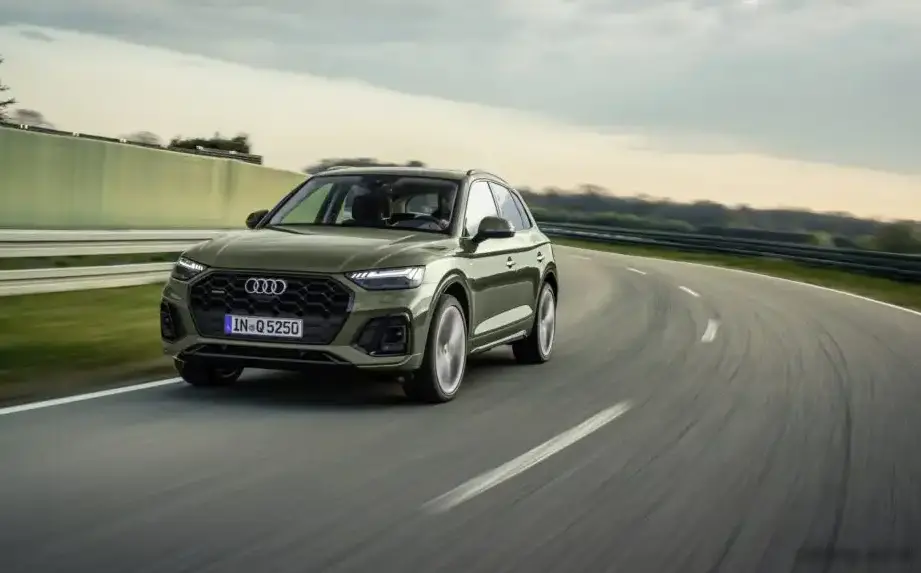
The 2020-2024 Audi Q5 II facelift 50 TDI V6 represents a sophisticated blend of performance and efficiency within the Q5 range. Positioned as a mid-to-high trim level, it offered a step up from the base 40 TDI models, providing significantly more power and torque. This variant was primarily marketed in Europe and other regions where diesel engines remain popular, offering a compelling alternative to gasoline-powered SUVs. The facelift brought updated styling cues, a more modern interior with the MMI touch response system, and enhanced driver-assistance features, solidifying the Q5’s position as a leading contender in the luxury compact SUV segment.
Powertrain & Engine Architecture
At the heart of the Q5 50 TDI lies the EA897evo3 3.0-liter V6 diesel engine, designated with the engine code DMGA. This engine is a turbocharged common-rail direct injection diesel, known for its robust construction and refined power delivery. The engine utilizes a single turbocharger with variable geometry turbine (VGT) technology, coupled with an intercooler, to maximize efficiency and minimize turbo lag. The common-rail system operates at extremely high pressures, ensuring fine atomization of the fuel for cleaner combustion and improved performance. The mild hybrid system (MHEV) incorporates a 48-volt electrical system and a belt-driven starter-generator (BSG). This system allows for extended engine-off coasting, regenerative braking to recapture energy, and smoother start-stop operation, contributing to improved fuel economy. The engine is paired with Audi’s eight-speed tiptronic automatic transmission, known for its smooth and responsive shifts. This transmission is designed to handle the high torque output of the V6 diesel and offers both automatic and manual shift modes.
Driving Characteristics
The Q5 50 TDI V6 Automatic delivers a refined and confident driving experience. The 620 Nm (457.29 lb.-ft.) of torque, available from a low 1750 rpm, provides strong acceleration in all situations. The 0-60 mph sprint is dispatched in approximately 5.4 seconds, making it a genuinely quick SUV. The eight-speed tiptronic transmission is well-matched to the engine, providing seamless gear changes and contributing to a relaxed cruising experience. Compared to the lower-powered 40 TDI variants, the 50 TDI offers a noticeable improvement in responsiveness and effortless overtaking capability. While not as overtly sporty as some competitors, the Q5 50 TDI prioritizes comfort and refinement, making it an excellent choice for long-distance journeys. The quattro all-wheel-drive system provides excellent traction and stability in all weather conditions.
Equipment & Trim Levels
The Q5 50 TDI V6 typically came well-equipped as standard. Features included Audi’s Virtual Cockpit digital instrument cluster, a touchscreen MMI infotainment system with navigation, leather upholstery, tri-zone automatic climate control, and a suite of driver-assistance systems such as adaptive cruise control, lane departure warning, and automatic emergency braking. Optional extras included a panoramic sunroof, a Bang & Olufsen premium sound system, ventilated front seats, and a head-up display. Trim levels varied by market, but generally offered options for upgraded interior finishes, exterior styling packages, and additional driver-assistance features.
Chassis & Braking
The Q5 50 TDI V6 utilizes an independent multi-link suspension setup at both the front and rear axles. This configuration provides a comfortable ride quality while maintaining good handling characteristics. The suspension is tuned to prioritize comfort, but still offers a reasonable degree of body control. Braking duties are handled by ventilated discs on all four wheels, providing ample stopping power. The electronic stability control (ESC) system is integrated with the quattro all-wheel-drive system to enhance stability and prevent wheelspin. The steering is an electromechanical power steering system, offering precise and responsive steering feel.
Market Reception & Comparison
The Audi Q5 50 TDI V6 was generally well-received by automotive critics. It was praised for its powerful and refined engine, comfortable ride, and high-quality interior. Compared to the 40 TDI models, the 50 TDI offered a significant performance upgrade, justifying the higher price tag for buyers prioritizing power and responsiveness. Against competitors such as the BMW X3 30d and the Mercedes-Benz GLC 300d, the Q5 50 TDI held its own, offering a compelling combination of performance, luxury, and technology. Fuel economy was generally considered good for a vehicle of its size and performance, although real-world figures could vary depending on driving style and conditions.
Legacy
The EA897evo3 engine family, including the 3.0-liter V6 diesel used in the Q5 50 TDI, has proven to be relatively reliable. However, like all modern diesel engines, it is susceptible to issues related to the diesel particulate filter (DPF) and emissions control systems, particularly if driven primarily on short journeys. On the used car market, the Q5 50 TDI V6 commands a premium over the lower-powered variants, reflecting its superior performance and desirable features. Well-maintained examples continue to be sought after by buyers looking for a refined and capable luxury SUV.