Technical Specifications
| Brand | Audi |
| Model | Q5 |
| Generation | Q5 II (FY, facelift 2020) |
| Type (Engine) | 55 TFSI e (367 Hp) Plug-in Hybrid quattro S tronic |
| Start of production | February, 2021 |
| End of production | November, 2024 |
| Powertrain Architecture | PHEV (Plug-in Hybrid Electric Vehicle) |
| Body type | SUV |
| Seats | 5 |
| Doors | 5 |
| Combined fuel consumption (WLTP) | 1.5-1.8 l/100 km (156.8 – 130.7 US mpg, 188.3 – 156.9 UK mpg, 66.7 – 55.6 km/l) |
| CO2 emissions (WLTP) | 35-42 g/km |
| Fuel consumption (economy) – combined (NEDC) | 1.8-1.9 l/100 km (130.7 – 123.8 US mpg, 156.9 – 148.7 UK mpg, 55.6 – 52.6 km/l) |
| CO2 emissions (NEDC) | 41-44 g/km |
| Fuel Type | Petrol / electricity |
| Acceleration 0 – 100 km/h | 5.3 sec |
| Acceleration 0 – 62 mph | 5.3 sec |
| Acceleration 0 – 60 mph | 5 sec (Calculated) |
| Maximum speed | 239 km/h (148.51 mph), Electronically limited |
| Emission standard | Euro 6d-ISC-FCM |
| Weight-to-power ratio | 5.7 kg/Hp, 176.9 Hp/tonne |
| Weight-to-torque ratio | 4.2 kg/Nm, 241 Nm/tonne |
| Gross battery capacity | 17.9 kWh |
| Net (usable) battery capacity | 14.4 kWh |
| Battery voltage | 381 V |
| Battery technology | Lithium-ion (Li-Ion) |
| Battery location | Under the trunk |
| Recuperation output | 80 kW |
| All-electric range (WLTP) | 56-62 km (34.8 – 38.53 mi) |
| Average Energy consumption (NEDC) | 19.3-19.5 kWh/100 km (31.06 – 31.38 kWh/100 mi, 108 – 107 MPGe, 5.2 – 5.1 km/kWh, 3.2 – 3.2 mi/kWh) |
| Max speed (electric) | 135 km/h (83.89 mph) |
| Electric motor power | 143 Hp |
| Electric motor Torque | 350 Nm (258.15 lb.-ft.) |
| Electric motor location | Between the combustion engine and the transmission |
| System power | 367 Hp |
| System torque | 500 Nm (368.78 lb.-ft.) |
| Power | 265 Hp @ 5250-6500 rpm |
| Torque | 370 Nm @ 1600-4500 rpm (272.9 lb.-ft. @ 1600-4500 rpm) |
| Engine layout | Front, Longitudinal |
| Engine Model/Code | DRYA |
| Engine displacement | 1984 cm3 (121.07 cu. in.) |
| Number of cylinders | 4 |
| Engine configuration | Inline |
| Cylinder Bore | 82.5 mm (3.25 in.) |
| Piston Stroke | 92.8 mm (3.65 in.) |
| Compression ratio | 9.6:1 |
| Number of valves per cylinder | 4 |
| Fuel injection system | Direct injection |
| Engine aspiration | Turbocharger, Intercooler |
| Valvetrain | DOHC |
| Engine oil capacity | 5.2 l (5.49 US qt | 4.58 UK qt) |
| Coolant | 17.7 l (18.7 US qt | 15.57 UK qt) |
| Kerb Weight | 2075 kg (4574.59 lbs.) |
| Max. weight | 2660 kg (5864.3 lbs.) |
| Max load | 585 kg (1289.7 lbs.) |
| Trunk (boot) space – minimum | 465 l (16.42 cu. ft.) |
| Trunk (boot) space – maximum | 1405 l (49.62 cu. ft.) |
| Fuel tank capacity | 54 l (14.27 US gal | 11.88 UK gal) |
| Max. roof load | 75 kg (165.35 lbs.) |
| Permitted trailer load with brakes (8%) | 2000 kg (4409.25 lbs.) |
| Permitted trailer load with brakes (12%) | 2000 kg (4409.25 lbs.) |
| Permitted trailer load without brakes | 750 kg (1653.47 lbs.) |
| Permitted towbar download | 100 kg (220.46 lbs.) |
| Length | 4682 mm (184.33 in.) |
| Width | 1893 mm (74.53 in.) |
| Width including mirrors | 2140 mm (84.25 in.) |
| Height | 1659 mm (65.31 in.) |
| Wheelbase | 2819 mm (110.98 in.) |
| Front track | 1616 mm (63.62 in.) |
| Rear (Back) track | 1609 mm (63.35 in.) |
| Front overhang | 910 mm (35.83 in.) |
| Rear overhang | 953 mm (37.52 in.) |
| Drag coefficient (Cd) | 0.31 |
| Minimum turning circle (turning diameter) | 11.8 m (38.71 ft.) |
| Approach angle | 20° |
| Departure angle | 21.1° |
| Drivetrain Architecture | The Internal combustion engine (ICE) and the electric motor permanently drive the front wheels of the vehicle, capable of running in full electric or mixed mode, and if necessary through the electrically or mechanically controlled clutch, the rear wheels are driven. |
| Drive wheel | All wheel drive (4×4) |
| Number of gears and type of gearbox | 7 gears, automatic transmission S tronic |
| Front suspension | Independent multi-link suspension, Transverse stabilizer |
| Rear suspension | Independent multi-link suspension, Transverse stabilizer |
| Front brakes | Ventilated discs |
| Rear brakes | Ventilated discs |
| Assisting systems | ABS (Anti-lock braking system) |
| Steering type | Steering rack and pinion |
| Power steering | Electric Steering |
| Tires size | 235/60 R18 |
| Wheel rims size | 8J x 18 |
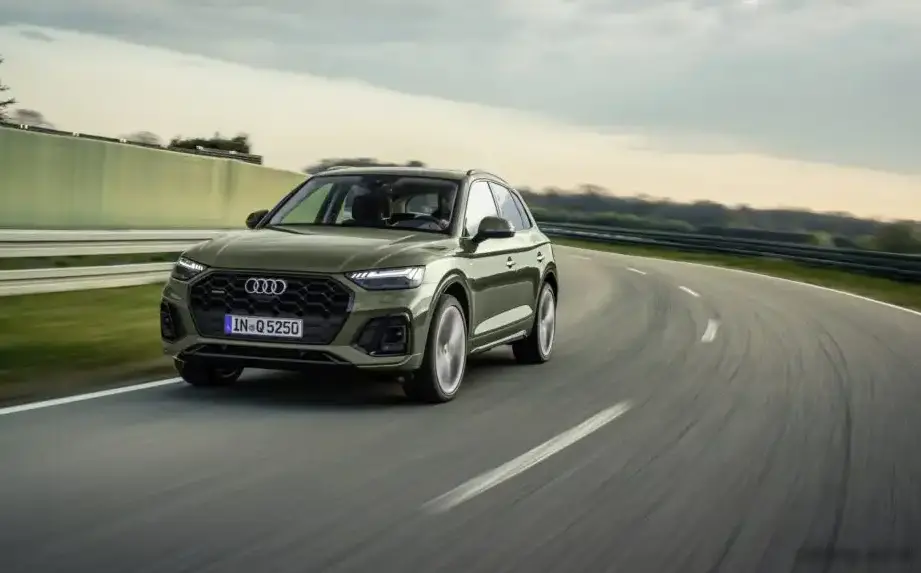
The Audi Q5 II 55 TFSI e, launched in early 2021, represents a significant step in Audi’s electrification strategy. Built on the MLB Evo platform (specifically the 1HX0/A3 variant for the Q5), this plug-in hybrid model aimed to provide a compelling alternative to traditional gasoline-powered SUVs. It offered a combination of all-wheel drive (quattro), a respectable electric range, and the premium features expected from the Audi brand. The “55 TFSI e” designation indicates a specific power output level within Audi’s naming convention, signifying a combined system output of 367 horsepower. This variant was available throughout the 2021-2024 model years, serving as a bridge between conventional combustion engines and fully electric vehicles.
Powertrain & Engine Architecture
At the heart of the Q5 55 TFSI e lies a 2.0-liter, inline-four cylinder gasoline engine, internally designated as the DRYA. This engine utilizes direct fuel injection and is coupled with a single turbocharger and intercooler, producing 265 horsepower at 5250-6500 rpm and 370 Nm (272.9 lb-ft) of torque between 1600-4500 rpm. The engine’s design incorporates Audi’s Valvelift system, which allows for variable valve lift to optimize efficiency and performance. Integrated with the engine is a 143 horsepower electric motor, powered by a 17.9 kWh (gross) / 14.4 kWh (net) lithium-ion battery pack located under the trunk floor. The electric motor delivers 350 Nm (258.15 lb-ft) of torque. The combined system output is 367 horsepower and 500 Nm (368.78 lb-ft) of torque. Power is transmitted to all four wheels via Audi’s seven-speed S tronic dual-clutch automatic transmission. This transmission is known for its quick and smooth shifts, contributing to the vehicle’s responsive driving experience. The electric motor is positioned between the engine and the transmission, allowing for seamless integration of electric and gasoline power.
Driving Characteristics
The Q5 55 TFSI e offers a distinct driving experience compared to its gasoline-only counterparts. In electric-only mode, the vehicle provides near-silent operation and instant torque, resulting in brisk acceleration. The usable electric range of 56-62 km (34.8-38.53 miles) allows for daily commutes and short trips to be completed without using any gasoline. When the battery is depleted or when more power is demanded, the gasoline engine seamlessly kicks in, providing a combined 0-60 mph acceleration time of approximately 5 seconds. The S tronic transmission’s gear ratios are optimized for both efficiency and performance, providing quick responses during acceleration and comfortable cruising at highway speeds. Compared to the Q5 2.0T models, the 55 TFSI e offers a noticeable boost in overall power and torque. While the added weight of the battery pack slightly impacts handling, the quattro all-wheel-drive system maintains excellent grip and stability in various driving conditions. The hybrid system’s regenerative braking feature also contributes to improved efficiency and reduces wear on the conventional brakes.
Equipment & Trim Levels
The Q5 55 TFSI e typically came well-equipped, reflecting its position as a mid-to-premium trim level. Standard features included Audi’s virtual cockpit digital instrument cluster, a touchscreen infotainment system with navigation, Apple CarPlay and Android Auto compatibility, leather upholstery, heated front seats, and a panoramic sunroof. Safety features such as automatic emergency braking, lane departure warning, and blind-spot monitoring were also standard. Optional extras included adaptive cruise control, a premium sound system, and various interior trim upgrades. The interior design mirrored that of other Q5 models, with a focus on quality materials and a user-friendly layout. The battery pack’s placement under the trunk floor does reduce cargo space compared to non-hybrid Q5 models, but the available space remains practical for everyday use.
Chassis & Braking
The Q5 55 TFSI e utilizes an independent multi-link suspension system for both the front and rear axles, providing a comfortable and controlled ride. A transverse stabilizer bar is included on both axles to minimize body roll during cornering. The braking system consists of ventilated discs on all four wheels, providing ample stopping power. The ABS (Anti-lock Braking System) and electronic stability control systems work in conjunction to enhance safety and stability. Due to the added weight of the hybrid components, the suspension was slightly tuned to provide optimal handling and ride comfort. The steering system is an electric power-assisted rack and pinion system, offering precise and responsive steering feel.
Market Reception & Comparison
The Audi Q5 55 TFSI e was generally well-received by automotive critics, who praised its blend of performance, efficiency, and luxury. The plug-in hybrid powertrain was seen as a significant step forward in terms of reducing emissions and fuel consumption. Compared to the Q5 2.0T models, the 55 TFSI e offered superior acceleration and a more refined driving experience. However, the higher price tag and reduced cargo space were noted as potential drawbacks. Compared to other plug-in hybrid SUVs in its class, the Q5 55 TFSI e stood out for its premium interior, sophisticated technology, and engaging driving dynamics. Fuel economy figures were impressive, with combined WLTP figures ranging from 1.5-1.8 l/100 km, and a significant portion of daily driving achievable on electric power alone.
Legacy
The Audi Q5 II 55 TFSI e represents an important milestone in Audi’s transition towards electric mobility. While the model has been superseded by newer plug-in hybrid and fully electric Q5 variants, the 55 TFSI e remains a desirable option in the used car market. The powertrain has proven to be relatively reliable, with few widespread issues reported. The combination of a well-engineered gasoline engine, a capable electric motor, and Audi’s renowned build quality ensures that these vehicles continue to provide a premium driving experience for years to come. As demand for electric and hybrid vehicles continues to grow, the Q5 55 TFSI e is likely to maintain its appeal as a practical and environmentally conscious SUV.