
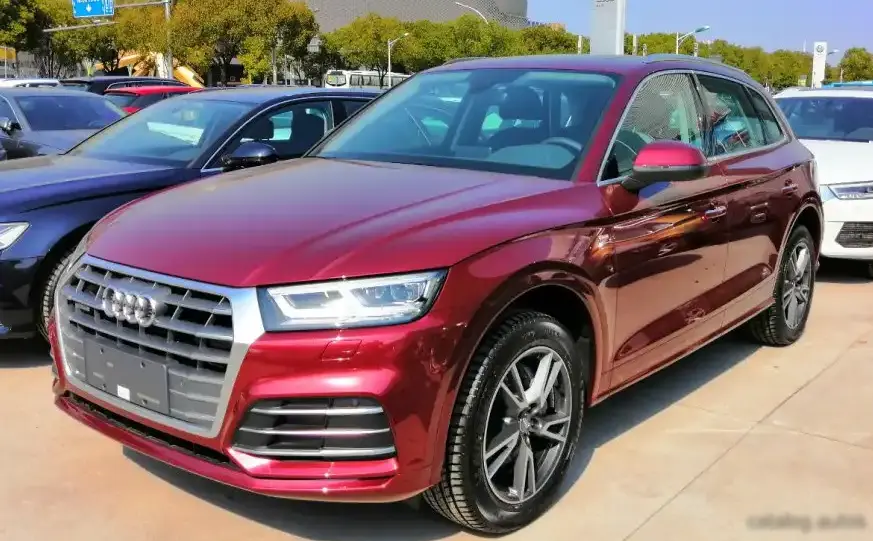
The Audi Q5L II 2.0 TFSI quattro ultra S tronic, produced from April 2018 to 2020, represents a significant iteration of Audi’s popular Q5 SUV, specifically tailored for the Chinese market. The “L” designation indicates a long-wheelbase version, offering increased rear passenger space – a key preference for buyers in that region. This variant, powered by a 2.0-liter turbocharged four-cylinder engine producing 190 horsepower, occupied a mid-range position within the Q5L II lineup, balancing performance with fuel efficiency and a more accessible price point compared to higher-output models. It utilized Audi’s quattro ultra all-wheel-drive system and a seven-speed S tronic dual-clutch transmission.
Technical Specifications
| Brand | Audi |
| Model | Q5 |
| Generation | Q5L II (FY) |
| Type (Engine) | 2.0 TFSI (190 Hp) quattro ultra S tronic |
| Start of production | April, 2018 |
| End of production | 2020 |
| Powertrain Architecture | Internal Combustion engine |
| Body type | SUV |
| Seats | 5 |
| Doors | 5 |
| Fuel consumption (urban) | 8.6 l/100 km (27.4 US mpg, 32.8 UK mpg, 11.6 km/l) |
| Fuel consumption (extra urban) | 5.9 l/100 km (39.9 US mpg, 47.9 UK mpg, 16.9 km/l) |
| Fuel consumption (combined) | 6.9 l/100 km (34.1 US mpg, 40.9 UK mpg, 14.5 km/l) |
| CO2 emissions | 164 g/km |
| Fuel Type | Petrol (Gasoline) |
| Acceleration 0 – 100 km/h | 8.6 sec |
| Acceleration 0 – 62 mph | 8.6 sec |
| Acceleration 0 – 60 mph | 8.2 sec |
| Maximum speed | 210 km/h (130.49 mph) |
| Weight-to-power ratio | 9.7 kg/Hp, 103.3 Hp/tonne |
| Weight-to-torque ratio | 5.8 kg/Nm, 173.9 Nm/tonne |
| Power | 190 Hp @ 4500-6000 rpm |
| Power per litre | 95.8 Hp/l |
| Torque | 320 Nm @ 1450-4200 rpm (236.02 lb.-ft. @ 1450-4200 rpm) |
| Engine layout | Front, Longitudinal |
| Engine Model/Code | EA888 / DTA |
| Engine displacement | 1984 cm3 (121.07 cu. in.) |
| Number of cylinders | 4 |
| Engine configuration | Inline |
| Cylinder Bore | 82.5 mm (3.25 in.) |
| Piston Stroke | 92.8 mm (3.65 in.) |
| Compression ratio | 11.7:1 |
| Number of valves per cylinder | 4 |
| Fuel injection system | Direct injection and Multi-port manifold injection |
| Engine aspiration | Turbocharger, Intercooler |
| Valvetrain | DOHC |
| Engine oil capacity | 4.7 l (4.97 US qt | 4.14 UK qt) |
| Kerb Weight | 1840 kg (4056.51 lbs.) |
| Max. weight | 2325 kg (5125.75 lbs.) |
| Max load | 485 kg (1069.24 lbs.) |
| Trunk (boot) space – minimum | 550 l (19.42 cu. ft.) |
| Trunk (boot) space – maximum | 1550 l (54.74 cu. ft.) |
| Fuel tank capacity | 73 l (19.28 US gal | 16.06 UK gal) |
| Length | 4753 mm (187.13 in.) |
| Width | 1893 mm (74.53 in.) |
| Width including mirrors | 2140 mm (84.25 in.) |
| Height | 1659 mm (65.31 in.) |
| Wheelbase | 2908 mm (114.49 in.) |
| Front track | 1616 mm (63.62 in.) |
| Rear (Back) track | 1610 mm (63.39 in.) |
| Front overhang | 905 mm (35.63 in.) |
| Rear overhang | 940 mm (37.01 in.) |
| Ride height (ground clearance) | 179 mm (7.05 in.) |
| Minimum turning circle | 12.2 m (40.03 ft.) |
| Drivetrain Architecture | The Internal combustion engine (ICE) drives the front wheels permanently, and the rear wheels are driven through an electrically or mechanically operated clutch if necessary. |
| Drive wheel | All wheel drive (4×4) |
| Number of gears and type of gearbox | 7 gears, automatic transmission S tronic |
| Front suspension | Independent multi-link suspension, Transverse stabilizer |
| Rear suspension | Independent multi-link spring suspension with stabilizer |
| Assisting systems | ABS (Anti-lock braking system) |
| Steering type | Steering rack and pinion |
| Power steering | Electric Steering |
| Tires size | 235/60 R18; 235/55 R19; 255/45 R20 |
| Wheel rims size | 8J x 18; 8J x 19; 8J x 20 |
INTRODUCTION
The Audi Q5L II 2.0 TFSI quattro ultra S tronic, launched in April 2018, is a long-wheelbase variant of the second-generation Q5 (FY series). Specifically designed for the Chinese market, the Q5L offers extended rear legroom, catering to the preference for chauffeur-driven or family-oriented transportation common in that region. This particular variant, equipped with the 2.0-liter turbocharged engine and the S tronic transmission, served as a popular choice for buyers seeking a balance between performance, efficiency, and luxury within the Q5L range. It builds upon the foundation of the standard Q5, incorporating Audi’s latest technology and design cues.
Powertrain & Engine Architecture
At the heart of the Q5L II 2.0 TFSI lies the EA888 engine, specifically the DTA code variant. This is a 2.0-liter inline-four cylinder engine utilizing direct injection and multi-port fuel injection for optimized combustion. The engine benefits from a single turbocharger with an intercooler, boosting power output to 190 horsepower and 320 Nm (236 lb-ft) of torque. The turbocharger provides a broad torque curve, peaking between 1450 and 4200 rpm. The engine features a dual overhead camshaft (DOHC) valvetrain with four valves per cylinder. The S tronic seven-speed dual-clutch transmission delivers rapid and smooth gear changes. The quattro ultra system is an on-demand all-wheel-drive system. It primarily operates in front-wheel drive to maximize fuel efficiency, engaging the rear axle via a multi-plate clutch when traction demands it.
Driving Characteristics
The 190 hp 2.0 TFSI engine, coupled with the seven-speed S tronic transmission, provides adequate performance for everyday driving. Acceleration from 0 to 100 km/h (0-62 mph) takes approximately 8.6 seconds. While not as sporty as the higher-output Q5L variants, this configuration offers a comfortable and refined driving experience. The S tronic transmission contributes to quick shifts and responsive acceleration. The quattro ultra system provides enhanced stability and traction, particularly in adverse weather conditions. Compared to the manual transmission options (not widely available on the Q5L), the S tronic prioritizes convenience and ease of use. The gear ratios are tuned for a balance between fuel economy and responsiveness, with a relatively tall final drive to aid efficiency.
Equipment & Trim Levels
The Q5L II 2.0 TFSI quattro ultra S tronic typically came equipped with a comprehensive suite of standard features. These included Audi’s MMI infotainment system with a central touchscreen display, leather upholstery, automatic climate control, and a suite of driver-assistance systems such as lane departure warning and automatic emergency braking. Optional extras included a panoramic sunroof, upgraded sound system, and adaptive cruise control. Interior trim levels varied, with options for different wood or aluminum inlays. The long wheelbase translates to generous rear passenger space, with comfortable seating and ample legroom. The dashboard layout is typical of Audi’s design language, emphasizing a clean and modern aesthetic.
Chassis & Braking
The Q5L II utilizes an independent multi-link suspension setup for both the front and rear axles, providing a comfortable ride and good handling characteristics. A transverse stabilizer bar is fitted at both ends to reduce body roll during cornering. The braking system consists of ventilated disc brakes at the front and solid disc brakes at the rear. ABS (Anti-lock Braking System) is standard. The suspension is tuned to prioritize comfort, reflecting the Q5L’s positioning as a luxury SUV. The long wheelbase contributes to improved stability, particularly at highway speeds.
Market Reception & Comparison
The Audi Q5L II 2.0 TFSI quattro ultra S tronic was well-received in the Chinese market, where its spacious interior and comfortable ride were highly valued. Critics praised the engine’s balance of power and efficiency, as well as the smooth operation of the S tronic transmission. Compared to the higher-output 2.0 TFSI variants, this version offered a more affordable entry point into the Q5L range. Fuel economy figures of around 6.9 l/100 km (34.1 US mpg) were competitive within its segment. Reliability reports have generally been positive, with the EA888 engine proving to be a durable and dependable unit.
Legacy
The Audi Q5L II 2.0 TFSI quattro ultra S tronic remains a popular choice in the used car market in China. The EA888 engine, in this configuration, has proven to be relatively reliable, although regular maintenance is crucial. The S tronic transmission, while generally robust, may require servicing at higher mileages. The Q5L’s long wheelbase and spacious interior continue to appeal to buyers seeking a comfortable and practical luxury SUV. Its blend of German engineering, advanced technology, and market-specific adaptations solidified its position as a key player in the premium SUV segment in China.
