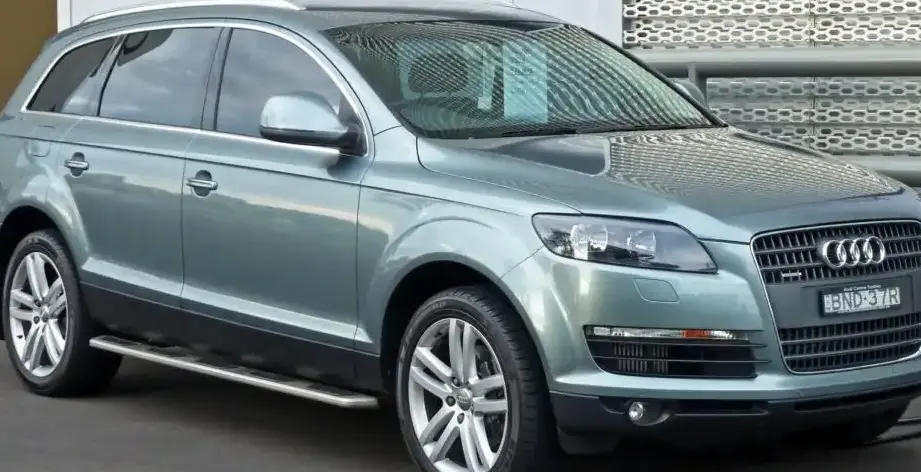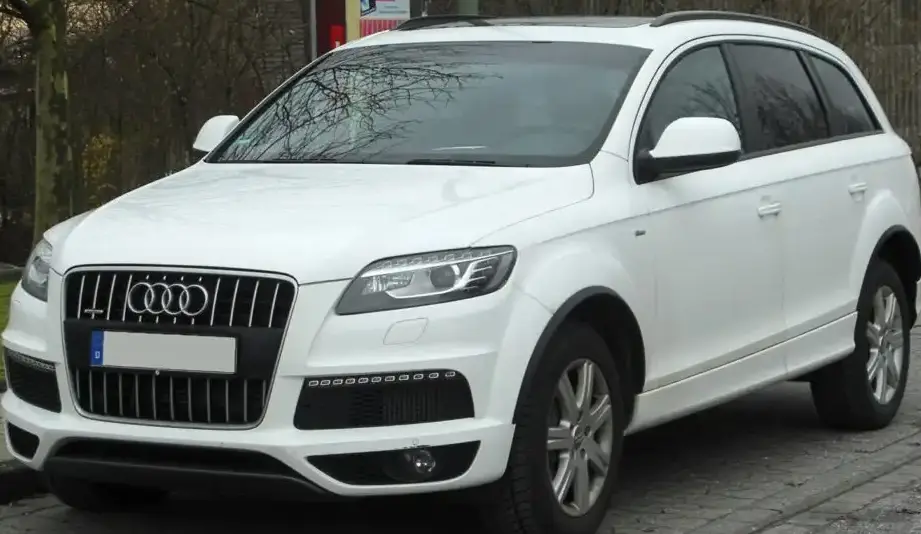
The Audi Q7 3.0 TFSI quattro tiptronic, produced from 2011 to 2015, represents a significant iteration of the Typ 4L Q7 generation, following the 2009 facelift. This variant positioned itself as a mid-to-upper range offering within the Q7 lineup, blending performance, luxury, and practicality for families. It catered to buyers seeking a capable SUV with a more powerful engine than the base options, but without the outright performance focus of the supercharged 3.0 TFSI variants. The Q7, as a whole, aimed to provide Audi’s signature quality and technology in a larger, seven-seat package, competing with vehicles like the BMW X5, Mercedes-Benz GL-Class, and Acura MDX in the North American market.
Technical Specifications
| Brand | Audi |
| Model | Q7 |
| Generation | Q7 (Typ 4L, facelift 2009) |
| Type (Engine) | 3.0 TFSI V6 (280 Hp) quattro tiptronic 7 Seat |
| Start of production | 2011 |
| End of production | 2015 |
| Powertrain Architecture | Internal Combustion engine |
| Body type | SUV |
| Seats | 7 |
| Doors | 5 |
| Fuel consumption (urban) | 14.7 l/100 km (16 US mpg, 19.2 UK mpg, 6.8 km/l) |
| Fuel consumption (extra urban) | 10.7 l/100 km (22 US mpg, 26.4 UK mpg, 9.3 km/l) |
| Fuel consumption (combined) | 13.1 l/100 km (18 US mpg, 21.6 UK mpg, 7.6 km/l) |
| Fuel Type | Petrol (Gasoline) |
| Acceleration 0 – 60 mph | 7.7 sec |
| Maximum speed | 209 km/h (129.87 mph) |
| Emission standard | LEV II |
| Weight-to-power ratio | 8.4 kg/Hp, 118.9 Hp/tonne |
| Weight-to-torque ratio | 5.9 kg/Nm, 169.9 Nm/tonne |
| Power | 280 Hp @ 4920 rpm |
| Power per litre | 93.5 Hp/l |
| Torque | 400 Nm @ 2250 rpm (295.02 lb.-ft. @ 2250 rpm) |
| Engine layout | Front, Longitudinal |
| Engine Model/Code | CJWE, CTWB |
| Engine displacement | 2995 cm3 (182.77 cu. in.) |
| Number of cylinders | 6 |
| Engine configuration | V-engine |
| Cylinder Bore | 84.5 mm (3.33 in.) |
| Piston Stroke | 89 mm (3.5 in.) |
| Compression ratio | 10.5:1 |
| Number of valves per cylinder | 4 |
| Fuel injection system | Direct injection |
| Engine aspiration | Supercharger, Intercooler |
| Valvetrain | DOHC |
| Engine oil capacity | 6.8 l (7.19 US qt | 5.98 UK qt) |
| Coolant | 15 l (15.85 US qt | 13.2 UK qt) |
| Kerb Weight | 2355-2400 kg (5191.89 – 5291.09 lbs.) |
| Trunk (boot) space – minimum | 330 l (11.65 cu. ft.) |
| Trunk (boot) space – maximum | 2035 l (71.87 cu. ft.) |
| Fuel tank capacity | 100 l (26.42 US gal | 22 UK gal) |
| Permitted trailer load with brakes (12%) | 2495 kg (5500.53 lbs.) |
| Length | 5089 mm (200.35 in.) |
| Width | 1983 mm (78.07 in.) |
| Width including mirrors | 2177 mm (85.71 in.) |
| Height | 1737 mm (68.39 in.) |
| Wheelbase | 3002 mm (118.19 in.) |
| Front track | 1651 mm (65 in.) |
| Rear (Back) track | 1681 mm (66.18 in.) |
| Front overhang | 962 mm (37.87 in.) |
| Rear overhang | 1125 mm (44.29 in.) |
| Ride height (ground clearance) | 205 mm (8.07 in.) |
| Drag coefficient (Cd) | 0.37 |
| Minimum turning circle (turning diameter) | 12 m (39.37 ft.) |
| Drivetrain Architecture | ICE drives permanently the four wheels |
| Drive wheel | All wheel drive (4×4) |
| Number of gears and type of gearbox | 8 gears, automatic transmission Tiptronic |
| Front suspension | Coil spring, Double wishbone, Transverse stabilizer |
| Rear suspension | Independent multi-link spring suspension with stabilizer |
| Front brakes | Ventilated discs, 350×34 mm |
| Rear brakes | Ventilated discs, 330×28 mm |
| Assisting systems | ABS (Anti-lock braking system) |
| Steering type | Steering rack and pinion |
| Power steering | Electric Steering |
| Tires size | 255/55 R18; 265/50 R19; 275/45 R20 |
| Wheel rims size | 8J x 18; 8.5J x 19; 9J x 20 |
Powertrain & Engine Architecture
The heart of this Q7 variant is the 3.0 TFSI V6 engine, specifically the CJWE or CTWB engine codes depending on the market and specific production year. This engine is a 2,995 cc (182.77 cu. in.) naturally aspirated V6 featuring direct fuel injection and an intercooled supercharger. The supercharger provides immediate boost at lower RPMs, mitigating turbo lag and delivering a more responsive driving experience. The engine utilizes a double overhead camshaft (DOHC) valvetrain with four valves per cylinder. The 8-speed tiptronic automatic transmission, a staple of Audi’s quattro drivetrain, efficiently manages power delivery. This transmission offers both automatic shifting and manual control via steering wheel-mounted paddles, allowing drivers to tailor the driving experience. The quattro all-wheel-drive system distributes power between the front and rear axles as needed, enhancing traction and stability in various driving conditions.
Driving Characteristics
The 280 horsepower and 295 lb-ft of torque produced by the 3.0 TFSI engine provide adequate performance for the Q7’s substantial weight. Acceleration from 0 to 60 mph takes approximately 7.7 seconds, and the electronically limited top speed is 129.87 mph. While not as quick as the supercharged 3.0 TFSI variants, this engine offers a smoother, more linear power delivery. The 8-speed tiptronic transmission contributes to this smoothness, providing well-spaced gear ratios. Compared to the diesel-powered Q7 models (like the 3.0 TDI), the 3.0 TFSI offers a more spirited driving experience, albeit with slightly lower fuel economy. The automatic transmission, while convenient, can sometimes feel less engaging than the available manual transmission options.
Equipment & Trim Levels
The 3.0 TFSI quattro tiptronic typically came well-equipped, positioning it as a premium offering. Standard features often included leather upholstery, tri-zone automatic climate control, a premium sound system, and Audi’s Multi Media Interface (MMI) infotainment system. Optional extras included features like adaptive cruise control, a panoramic sunroof, heated and ventilated front seats, and advanced driver-assistance systems. Trim levels varied by market, but generally offered packages that added cosmetic enhancements, upgraded interior materials, and additional technology features. The seven-seat configuration was standard, providing flexibility for families.
Chassis & Braking
The Q7’s chassis features a double wishbone front suspension and an independent multi-link rear suspension, both incorporating stabilizer bars to minimize body roll. The suspension is tuned for a balance between comfort and handling, providing a relatively smooth ride while maintaining good control in corners. Braking duties are handled by ventilated discs on all four wheels, providing ample stopping power. The ABS (Anti-lock braking system) is standard, enhancing safety during emergency braking situations. The steering is electric power-assisted, offering a precise and responsive feel.
Market Reception & Comparison
The Audi Q7 3.0 TFSI quattro tiptronic was generally well-received by automotive critics. It was praised for its comfortable ride, spacious interior, and refined powertrain. However, some reviewers noted that its fuel economy was relatively poor compared to its competitors, and its size could make it challenging to maneuver in tight spaces. Compared to the 3.0 TDI models, the 3.0 TFSI offered a more engaging driving experience but lacked the diesel’s fuel efficiency. Against rivals like the BMW X5 and Mercedes-Benz GL-Class, the Q7 was often seen as offering a more technologically advanced and stylish package.
Legacy
The 3.0 TFSI engine, in its various iterations, has proven to be a relatively reliable powertrain. However, like any complex engine, it is not without its potential issues. Common concerns include carbon buildup on the intake valves (a characteristic of direct-injection engines) and potential oil leaks. The 8-speed tiptronic transmission is generally robust, but regular maintenance is crucial to ensure its longevity. Today, the 2011-2015 Q7 3.0 TFSI quattro tiptronic represents a compelling value in the used car market, offering a blend of luxury, practicality, and performance at a relatively affordable price point. Properly maintained examples continue to provide years of reliable service.