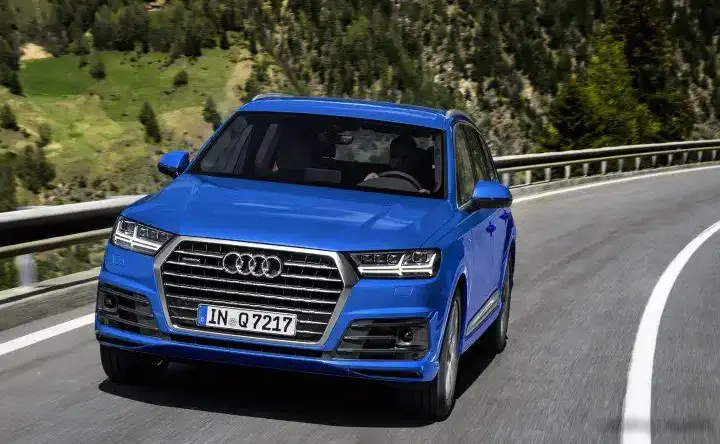
The Audi Q7 (Typ 4M) 3.0 ultra TDI V6 (218 hp) quattro tiptronic 7-seat variant was a key model in Audi’s second-generation Q7 lineup, produced from August 2015 to 2018. Representing a balance between performance, efficiency, and practicality, this version occupied a mid-range position within the 4M series, slotting below the more powerful 3.0 TDI variants and above the entry-level 2.0 TDI models. The Typ 4M Q7 marked a significant shift for the Q7, moving to the MLB Evo platform, resulting in substantial weight reduction and improved driving dynamics compared to its predecessor.
Technical Specifications
| Brand | Audi |
| Model | Q7 |
| Generation | Q7 (Typ 4M) |
| Type (Engine) | 3.0 ultra TDI V6 (218 Hp) quattro tiptronic 7 Seat |
| Start of production | August, 2015 |
| End of production | 2018 |
| Powertrain Architecture | Internal Combustion engine |
| Body type | SUV |
| Seats | 7 |
| Doors | 5 |
| Fuel consumption (urban) | 6.3 l/100 km (37.3 US mpg, 44.8 UK mpg, 15.9 km/l) |
| Fuel consumption (extra urban) | 5.3 l/100 km (44.4 US mpg, 53.3 UK mpg, 18.9 km/l) |
| Fuel consumption (combined) | 5.7 l/100 km (41.3 US mpg, 49.6 UK mpg, 17.5 km/l) |
| CO2 emissions | 148 g/km |
| Fuel Type | Diesel |
| Acceleration 0 – 100 km/h | 7.3 sec |
| Acceleration 0 – 62 mph | 7.3 sec |
| Acceleration 0 – 60 mph | 6.9 sec |
| Maximum speed | 216 km/h (134.22 mph) |
| Emission standard | Euro 6 |
| Weight-to-power ratio | 9.4 kg/Hp, 105.8 Hp/tonne |
| Weight-to-torque ratio | 4.1 kg/Nm, 242.7 Nm/tonne |
| Power | 218 Hp @ 3250-4750 rpm |
| Power per litre | 73.5 Hp/l |
| Torque | 500 Nm @ 1250-3000 rpm (368.78 lb.-ft. @ 1250-3000 rpm) |
| Engine layout | Front, Longitudinal |
| Engine Model/Code | CZZA, CZZB |
| Engine displacement | 2967 cm3 (181.06 cu. in.) |
| Number of cylinders | 6 |
| Engine configuration | V-engine |
| Cylinder Bore | 83 mm (3.27 in.) |
| Piston Stroke | 91.4 mm (3.6 in.) |
| Compression ratio | 16:1 |
| Number of valves per cylinder | 4 |
| Fuel injection system | Diesel Commonrail |
| Engine aspiration | Turbocharger, Intercooler |
| Engine oil capacity | 6.1 l (6.45 US qt | 5.37 UK qt) |
| Coolant | 13 l (13.74 US qt | 11.44 UK qt) |
| Kerb Weight | 2060 kg (4541.52 lbs.) |
| Max. weight | 2940 kg (6481.59 lbs.) |
| Max load | 880 kg (1940.07 lbs.) |
| Trunk (boot) space – minimum | 770 l (27.19 cu. ft.) |
| Trunk (boot) space – maximum | 1955 l (69.04 cu. ft.) |
| Fuel tank capacity | 75 l (19.81 US gal | 16.5 UK gal) |
| Max. roof load | 100 kg (220.46 lbs.) |
| Permitted trailer load with brakes (8%) | 2800 kg (6172.94 lbs.) |
| Permitted trailer load with brakes (12%) | 2700 kg (5952.48 lbs.) |
| Permitted trailer load without brakes | 750 kg (1653.47 lbs.) |
| Permitted towbar download | 115 kg (253.53 lbs.) |
| Length | 5052 mm (198.9 in.) |
| Width | 1968 mm (77.48 in.) |
| Width including mirrors | 2212 mm (87.09 in.) |
| Height | 1741 mm (68.54 in.) |
| Wheelbase | 2994 mm (117.87 in.) |
| Front track | 1679 mm (66.1 in.) |
| Rear (Back) track | 1691 mm (66.5 in.) |
| Front overhang | 978 mm (38.5 in.) |
| Rear overhang | 1080 mm (42.52 in.) |
| Minimum turning circle (turning diameter) | 12.4 m (40.68 ft.) |
| Drive wheel | All wheel drive (4×4) |
| Number of gears and type of gearbox | 8 gears, automatic transmission tiptronic |
| Front suspension | Independent multi-link suspension |
| Rear suspension | Independent multi-link suspension |
| Front brakes | Ventilated discs |
| Rear brakes | Ventilated discs |
| Assisting systems | ABS (Anti-lock braking system) |
| Steering type | Steering rack and pinion |
| Power steering | Electric Steering |
| Tires size | 235/65 R18 |
| Wheel rims size | 8.0J x 18 |
Powertrain & Engine Architecture
The heart of the Q7 3.0 ultra TDI is the 3.0-liter V6 diesel engine, specifically utilizing the CZZA or CZZB engine codes. This engine is a turbocharged common rail direct injection diesel, designed for a balance of power and fuel economy. The ‘ultra’ designation signifies a focus on efficiency, achieved through modifications to the engine management system and reduced internal friction. The engine produces 218 horsepower at 3250-4750 rpm and a substantial 500 Nm (368 lb-ft) of torque between 1250-3000 rpm. This torque output, available from low engine speeds, is a hallmark of modern diesel engines and contributes to the Q7’s effortless cruising ability. The engine features a single turbocharger with an intercooler to enhance performance. The transmission is an 8-speed tiptronic automatic, known for its smooth shifts and responsiveness. This transmission allows for both fully automatic operation and manual gear selection via steering wheel-mounted paddles or the gear selector.
Driving Characteristics
The 218 hp/automatic combination in the Q7 delivers a comfortable and refined driving experience. While not as overtly sporty as the higher-powered variants, the 3.0 TDI ultra offers ample power for everyday driving and highway cruising. Acceleration from 0-60 mph takes around 6.9 seconds, which is respectable for a large, seven-seat SUV. The tiptronic transmission is well-matched to the engine, providing smooth and timely gear changes. The quattro all-wheel-drive system ensures excellent traction in all weather conditions. The gear ratios are tuned for fuel efficiency, meaning the engine doesn’t rev as high as in the more performance-oriented models. This results in a more relaxed driving experience, but may require more deliberate throttle input for quicker acceleration.
Equipment & Trim Levels
The Q7 3.0 ultra TDI typically came well-equipped as standard. Common features included leather upholstery, three-zone automatic climate control, a 7-inch infotainment screen with Audi’s MMI system, parking sensors, and a power tailgate. Optional extras included a larger infotainment screen, a panoramic sunroof, adaptive cruise control, a premium sound system, and various driver assistance features. Trim levels varied by market, but generally offered packages that added features like upgraded interior trim, exterior styling enhancements, and advanced safety technologies.
Chassis & Braking
The Typ 4M Q7 features an independent multi-link suspension on both the front and rear axles, providing a comfortable ride and good handling characteristics. The suspension is tuned to prioritize comfort, but still offers a reasonable level of body control. The Q7 3.0 ultra TDI is equipped with ventilated disc brakes on all four wheels, providing ample stopping power. Anti-lock braking system (ABS) and electronic stability control (ESC) are standard safety features. The weight distribution is well-balanced, contributing to the Q7’s stable and predictable handling.
Market Reception & Comparison
The Q7 3.0 ultra TDI was generally well-received by automotive critics. It was praised for its fuel efficiency, comfortable ride, spacious interior, and refined driving experience. Compared to the more powerful 3.0 TDI variants, the ‘ultra’ model offered a more affordable entry point into the Q7 range, while still providing a good level of performance. Fuel economy was a key selling point, with the Q7 3.0 ultra TDI achieving around 41.3 US mpg in combined driving. Reliability was generally good, although, like all modern diesel vehicles, it was susceptible to issues with the diesel particulate filter (DPF) if not driven on longer journeys regularly.
Legacy
The Audi Q7 (Typ 4M) 3.0 ultra TDI V6 remains a popular choice in the used car market. Its combination of practicality, comfort, and fuel efficiency makes it a compelling option for families and those who need a versatile SUV. The 3.0 TDI engine, while complex, is generally considered to be durable if properly maintained. Regular servicing, including oil changes and DPF maintenance, is crucial to ensure long-term reliability. The Typ 4M Q7 represented a significant step forward for Audi’s SUV lineup, and the 3.0 ultra TDI variant continues to offer a compelling blend of performance and efficiency.