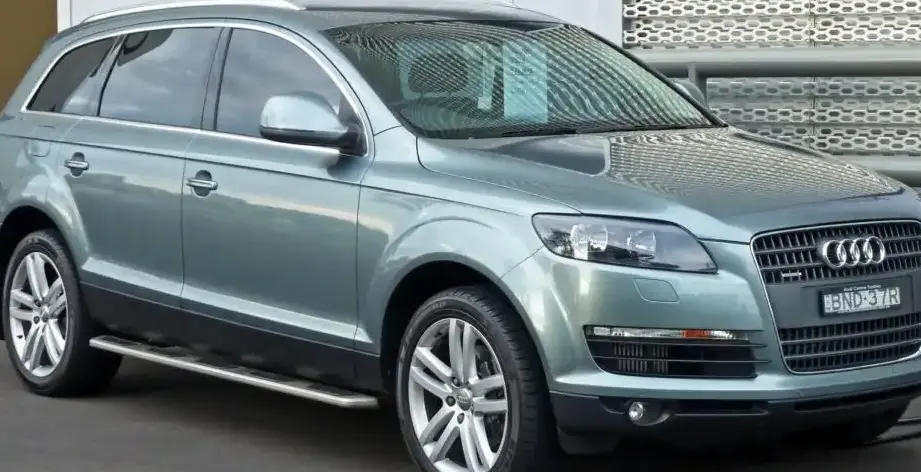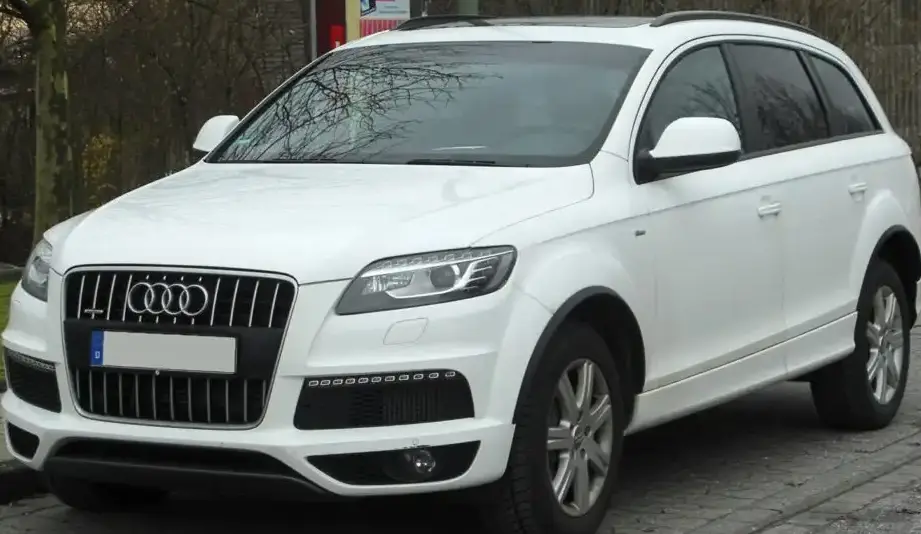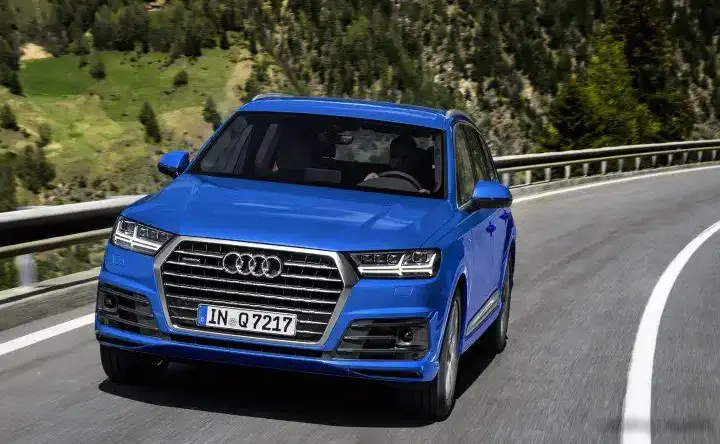
The Audi Q7 (Typ 4M) 45 TDI V6 quattro tiptronic, produced from 2018 to 2019, represents a significant iteration of Audi’s popular luxury SUV. Positioned as a mid-range offering within the Typ 4M generation, which ran from 2015-2024, this variant combined a potent diesel engine with a sophisticated mild-hybrid system and Audi’s renowned quattro all-wheel drive. It was designed to appeal to buyers seeking a balance of performance, efficiency, and practicality, particularly in European markets where diesel engines remained highly favored. The seven-seat configuration further broadened its appeal to families.
Technical Specifications
| Brand | Audi |
| Model | Q7 |
| Generation | Q7 (Typ 4M) |
| Type (Engine) | 45 TDI V6 (231 Hp) quattro Mild Hybrid tiptronic 7 Seat |
| Start of production | 2018 |
| End of production | 2019 |
| Powertrain Architecture | MHEV (Mild Hybrid Electric Vehicle) |
| Body type | SUV |
| Seats | 7 |
| Doors | 5 |
| Fuel consumption (urban) | 7.5-7.6 l/100 km (31.4 – 30.9 US mpg) |
| Fuel consumption (extra urban) | 6.4-6.6 l/100 km (36.8 – 35.6 US mpg) |
| Fuel consumption (combined) | 6.8-7.0 l/100 km (34.6 – 33.6 US mpg) |
| CO2 emissions | 196-181 g/km |
| Fuel Type | Diesel |
| Acceleration 0 – 100 km/h | 7.3 sec |
| Acceleration 0 – 62 mph | 7.3 sec |
| Acceleration 0 – 60 mph | 6.9 sec |
| Maximum speed | 229 km/h (142.29 mph) |
| Emission standard | Euro 6d-Temp |
| Weight-to-power ratio | 9.2 kg/Hp |
| Weight-to-torque ratio | 4.3 kg/Nm |
| Power | 231 Hp @ 3250-4750 rpm |
| Torque | 500 Nm @ 1750-3250 rpm (368.78 lb.-ft.) |
| Engine layout | Front, Longitudinal |
| Engine Model/Code | DHXC |
| Engine displacement | 2967 cm3 (181.06 cu. in.) |
| Number of cylinders | 6 |
| Engine configuration | V-engine |
| Cylinder Bore | 83 mm (3.27 in.) |
| Piston Stroke | 91.4 mm (3.6 in.) |
| Compression ratio | 16:1 |
| Number of valves per cylinder | 4 |
| Fuel injection system | Diesel Commonrail |
| Engine aspiration | Turbocharger, Intercooler |
| Engine oil capacity | 6.1 l (6.45 US qt | 5.37 UK qt) |
| Coolant capacity | 12.3 l (13 US qt | 10.82 UK qt) |
| Kerb Weight | 2135 kg (4706.87 lbs.) |
| Max. weight | 2990 kg (6591.82 lbs.) |
| Max load | 855 kg (1884.95 lbs.) |
| Trunk (boot) space – minimum | 890 l (31.43 cu. ft.) |
| Trunk (boot) space – maximum | 2075 l (73.28 cu. ft.) |
| Fuel tank capacity | 75 l (19.81 US gal | 16.5 UK gal) |
| AdBlue tank capacity | 24 l (6.34 US gal | 5.28 UK gal) |
| Max. roof load | 100 kg (220.46 lbs.) |
| Permitted trailer load with brakes (8%) | 2800 kg (6172.94 lbs.) |
| Permitted trailer load without brakes | 750 kg (1653.47 lbs.) |
| Length | 5052 mm (198.9 in.) |
| Width | 1968 mm (77.48 in.) |
| Height | 1740 mm (68.5 in.) |
| Wheelbase | 2994 mm (117.87 in.) |
| Gearbox | 8 gears, automatic transmission Tiptronic |
Powertrain & Engine Architecture
At the heart of the Q7 45 TDI lies the DHXC engine, a 3.0-liter V6 turbodiesel. This engine is part of Audi’s modular engine family and benefits from advanced technologies like a common-rail direct injection system and a variable geometry turbocharger. The common-rail system, operating at extremely high pressures, ensures precise fuel delivery for optimal combustion and reduced emissions. The turbocharger, with its adjustable vanes, provides a broad torque curve and responsive acceleration. The ‘45 TDI’ designation doesn’t directly correlate to engine displacement; it’s part of Audi’s power-based naming convention.
Crucially, this variant incorporates a 48-volt mild-hybrid system. This system utilizes a belt-driven starter-generator (BSG) and a small lithium-ion battery. The BSG allows for quicker, smoother starts and stop-start functionality, improving fuel economy. It also enables ‘coasting’ functionality, where the engine decouples from the drivetrain during deceleration, further reducing fuel consumption. The eight-speed tiptronic automatic transmission is a key component, offering smooth and efficient gear changes. It’s designed to handle the engine’s substantial torque output and provides both automatic and manual shift modes.
Driving Characteristics
The 231 horsepower and 369 lb-ft of torque delivered by the 45 TDI engine provide ample power for the Q7, despite its considerable weight. Acceleration from 0-60 mph takes around 6.9 seconds, making it a brisk performer for a large SUV. The tiptronic transmission is well-tuned, offering seamless shifts in automatic mode and responsive control when using the manual shift function. Compared to the higher-output 45 TDI variants (which could exceed 280 hp), this version prioritizes fuel efficiency over outright performance. The mild-hybrid system contributes to a refined driving experience, with near-silent operation during coasting and smooth restarts. The quattro all-wheel-drive system provides excellent traction in all weather conditions, enhancing stability and confidence.
Equipment & Trim Levels
The Q7 45 TDI typically came well-equipped, reflecting its position as a luxury SUV. Standard features included leather upholstery, tri-zone automatic climate control, a panoramic sunroof, and Audi’s MMI infotainment system with a large touchscreen display. Safety features were also comprehensive, including adaptive cruise control, lane departure warning, and automatic emergency braking. Optional extras included upgraded sound systems, massaging seats, and a head-up display. Interior trim options varied, allowing buyers to personalize the cabin with different wood or aluminum accents.
Chassis & Braking
The Q7 45 TDI utilizes an independent multi-link suspension system at both the front and rear axles. This setup provides a comfortable ride quality while maintaining good handling characteristics. The suspension is tuned to balance comfort and control, making it suitable for both long-distance journeys and spirited driving. Braking duties are handled by ventilated discs on all four wheels, providing ample stopping power. The electronic stability control (ESC) system works in conjunction with the quattro all-wheel drive to enhance stability and prevent skidding.
Market Reception & Comparison
The Q7 45 TDI was generally well-received by automotive critics. It was praised for its refined driving experience, spacious interior, and fuel efficiency. Compared to the more powerful Q7 variants, the 45 TDI offered a more affordable entry point into the Q7 range without sacrificing too much performance. Its fuel economy was a significant advantage, particularly for buyers who frequently cover long distances. However, some critics noted that the engine could feel slightly strained when fully loaded or tackling steep inclines. Compared to competitors like the BMW X5 and Mercedes-Benz GLE, the Q7 45 TDI offered a compelling combination of luxury, practicality, and efficiency.
Legacy
The DHXC engine, while robust, is not without its potential maintenance concerns. Like many modern diesel engines, it can be susceptible to issues with the diesel particulate filter (DPF) if not driven on longer journeys regularly. The turbocharger is another component that may require attention over time. However, with proper maintenance, the powertrain is generally reliable. On the used car market, the Q7 45 TDI represents a good value proposition, offering a luxurious and capable SUV at a reasonable price. Its mild-hybrid technology and efficient diesel engine continue to appeal to buyers seeking a balance of performance and economy.