Technical Specifications
| Brand | Audi |
| Model | Q7 |
| Generation | Q7 (Typ 4M, facelift 2019) |
| Type (Engine) | 45 TFSI (248 Hp) quattro tiptronic 7 seats |
| Start of production | 2019 |
| End of production | 2022 |
| Powertrain Architecture | Internal Combustion engine |
| Body type | SUV |
| Seats | 7 |
| Doors | 5 |
| Fuel consumption (economy) – urban (EPA) | 12.4 l/100 km (19 US mpg, 22.8 UK mpg, 8.1 km/l) |
| Fuel consumption (economy) – extra urban (EPA) | 10.2 l/100 km (23.1 US mpg, 27.7 UK mpg, 9.8 km/l) |
| Fuel consumption (economy) – combined (EPA) | 11.2 l/100 km (21 US mpg, 25.2 UK mpg, 8.9 km/l) |
| Fuel Type | Petrol (Gasoline) |
| Acceleration 0 – 60 mph | 6.9 sec |
| Maximum speed | 210 km/h (130.49 mph), Electronically limited |
| Weight-to-power ratio | 8.8 kg/Hp, 114.3 Hp/tonne |
| Weight-to-torque ratio | 5.9 kg/Nm, 170.5 Nm/tonne |
| Power | 248 Hp |
| Power per litre | 125 Hp/l |
| Torque | 370 Nm (272.9 lb.-ft.) |
| Engine layout | Front, Longitudinal |
| Engine Model/Code | EA888 / DMFB |
| Engine displacement | 1984 cm3 (121.07 cu. in.) |
| Number of cylinders | 4 |
| Engine configuration | Inline |
| Cylinder Bore | 82.5 mm (3.25 in.) |
| Piston Stroke | 92.8 mm (3.65 in.) |
| Compression ratio | 9.6:1 |
| Number of valves per cylinder | 4 |
| Fuel injection system | Direct injection |
| Engine aspiration | Turbocharger, Intercooler |
| Valvetrain | DOHC |
| Engine oil capacity | 5.2 l (5.49 US qt, 4.58 UK qt) |
| Coolant | 10 l (10.57 US qt, 8.8 UK qt) |
| Kerb Weight | 2170-2175 kg (4784.03 – 4795.05 lbs.) |
| Trunk (boot) space – minimum | 402 l (14.2 cu. ft.) |
| Trunk (boot) space – maximum | 1971 l (69.61 cu. ft.) |
| Fuel tank capacity | 75 l (19.81 US gal, 16.5 UK gal) |
| Permitted trailer load with brakes (12%) | 1996 kg (4400.43 lbs.) |
| Length | 5063 mm (199.33 in.) |
| Width | 1970 mm (77.56 in.) |
| Width including mirrors | 2212 mm (87.09 in.) |
| Height | 1740 mm (68.5 in.) |
| Wheelbase | 2995 mm (117.91 in.) |
| Front track | 1679 mm (66.1 in.) |
| Rear (Back) track | 1692 mm (66.61 in.) |
| Drag coefficient (Cd) | 0.36 |
| Minimum turning circle (turning diameter) | 12.5 m (41.01 ft.) |
| Drivetrain Architecture | The Internal combustion engine (ICE) drives permanently the four wheels of the vehicle. |
| Drive wheel | All wheel drive (4×4) |
| Number of gears and type of gearbox | 8 gears, automatic transmission tiptronic |
| Front suspension | Independent multi-link suspension, Transverse stabilizer |
| Rear suspension | Independent multi-link suspension, Transverse stabilizer |
| Front brakes | Ventilated discs, 350 mm |
| Rear brakes | Ventilated discs, 330 mm |
| Assisting systems | ABS (Anti-lock braking system) |
| Steering type | Steering rack and pinion |
| Power steering | Electric Steering |
| Tires size | 255/55 R19; 285/45 R20 |
| Wheel rims size | 8.5J x 19; 9J x 20 |
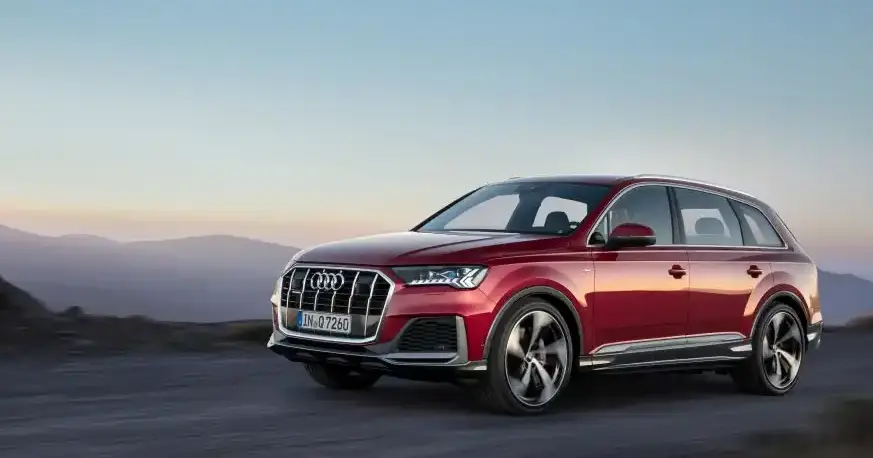
The Audi Q7 (Typ 4M, facelifted in 2019) 45 TFSI quattro tiptronic 7-seat variant represents a significant iteration of Audi’s popular luxury SUV. Introduced for the 2019 model year and continuing through 2022, this version occupied a key position in the Q7 lineup, offering a balance between performance, fuel efficiency, and practicality for families. It builds upon the foundation of the 4M generation Q7, which debuted in 2015, incorporating styling updates and enhanced technology. This particular trim level aimed to provide a more accessible entry point into the Q7 range compared to the higher-performance and more expensive 55 TFSI models, while still delivering the premium experience expected of the Audi brand.
Powertrain & Engine Architecture
At the heart of the Q7 45 TFSI lies the EA888 2.0-liter turbocharged inline-four cylinder engine, specifically the DMFB variant. This engine is a staple in the Volkswagen Group’s product lineup, known for its blend of performance and efficiency. It utilizes direct fuel injection, delivering fuel directly into the combustion chamber for improved combustion and power output. The engine also features an intercooler to cool the intake air, further enhancing performance. The valvetrain is a dual overhead camshaft (DOHC) design with four valves per cylinder, optimizing airflow for increased power. The engine produces 248 horsepower and 272.9 lb.-ft. of torque. Paired with this engine is an 8-speed tiptronic automatic transmission, which provides smooth and responsive gear changes. This transmission is designed to optimize fuel efficiency and deliver power effectively to all four wheels via Audi’s quattro all-wheel-drive system.
Driving Characteristics
The 45 TFSI quattro tiptronic delivers a comfortable and capable driving experience. While not as overtly sporty as the higher-output 55 TFSI model, the 248 hp engine provides ample power for everyday driving and highway passing. The 8-speed automatic transmission is well-tuned, offering smooth shifts and contributing to a refined driving experience. The quattro all-wheel-drive system provides excellent traction in various weather conditions. Compared to manual transmission Q7s (which were less common in the US market), the automatic prioritizes ease of use and convenience. The gear ratios are optimized for a balance of acceleration and fuel economy, with a focus on providing usable torque throughout the rev range. Acceleration from 0 to 60 mph takes approximately 6.9 seconds.
Equipment & Trim Levels
The Q7 45 TFSI typically came well-equipped as standard. Features included leather upholstery, a panoramic sunroof, a premium sound system, and Audi’s MMI infotainment system with a touchscreen display. Standard safety features included Audi pre sense basic, lane departure warning, and automatic emergency braking. Optional extras included adaptive cruise control, a head-up display, and upgraded interior trim packages. The 7-seat configuration was standard, providing flexibility for families. Trim levels often included Premium, Premium Plus, and Prestige, with each successive trim adding more luxury features and technology.
Chassis & Braking
The Q7 45 TFSI features an independent multi-link suspension at both the front and rear, providing a comfortable ride and good handling characteristics. A transverse stabilizer bar is included at both ends to reduce body roll during cornering. The braking system consists of ventilated discs on all four wheels, with larger discs at the front (350mm) compared to the rear (330mm). Anti-lock braking system (ABS) is standard. The suspension tuning is geared towards comfort and stability, making it well-suited for long-distance driving and carrying passengers.
Market Reception & Comparison
The Q7 45 TFSI was generally well-received by critics, who praised its comfortable ride, spacious interior, and user-friendly technology. Fuel economy was considered reasonable for a vehicle of its size and class, although it wasn’t a standout performer in this area. Compared to the 55 TFSI, the 45 TFSI offered a more affordable entry point into the Q7 range, but at the expense of some performance. Compared to competitors like the BMW X5 and Mercedes-Benz GLE, the Q7 45 TFSI offered a compelling combination of features, luxury, and value.
Legacy
The EA888 engine, in its various iterations, has proven to be a relatively reliable powertrain. While some early versions of the EA888 were prone to oil consumption issues, the DMFB variant found in the 2019-2022 Q7 is generally considered to be more robust. Regular maintenance, including oil changes and timely servicing of the turbocharger, is crucial for long-term reliability. On the used car market, the Q7 45 TFSI represents a good value proposition, offering a luxurious and capable SUV at a more accessible price point than the higher-performance trims. Its combination of practicality, comfort, and technology continues to make it a popular choice among buyers seeking a premium family SUV.