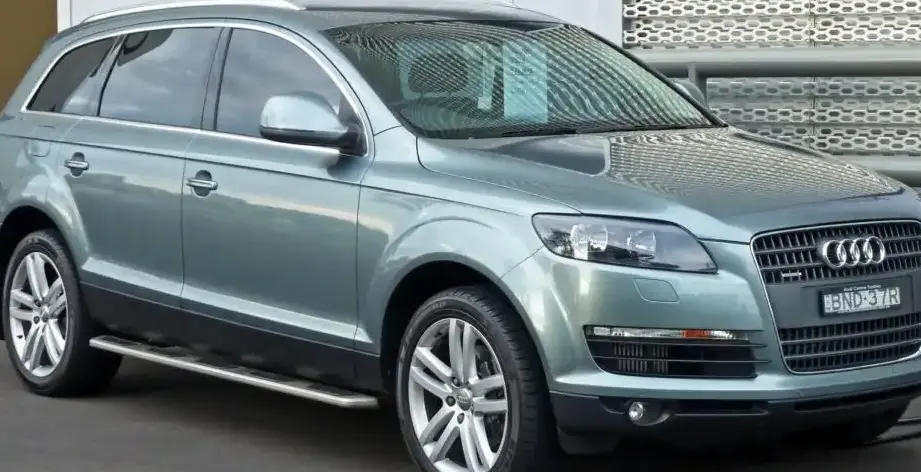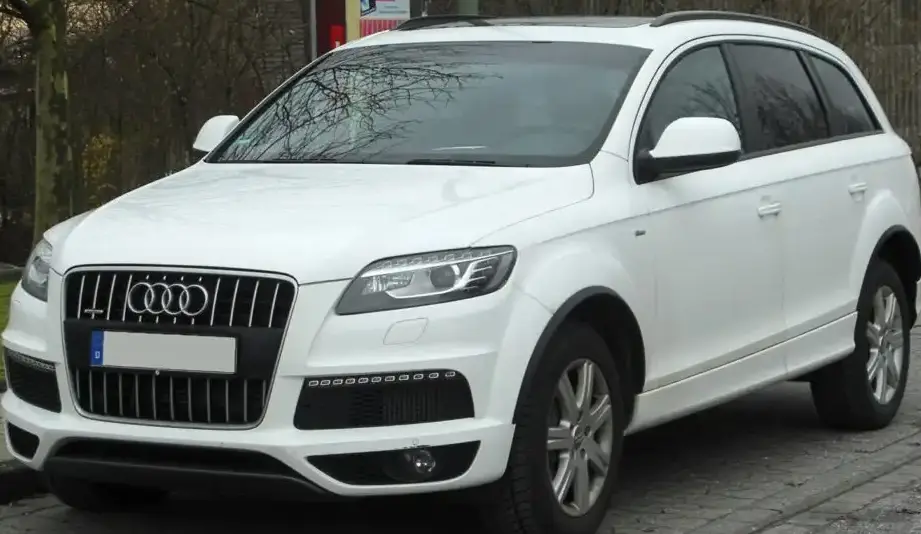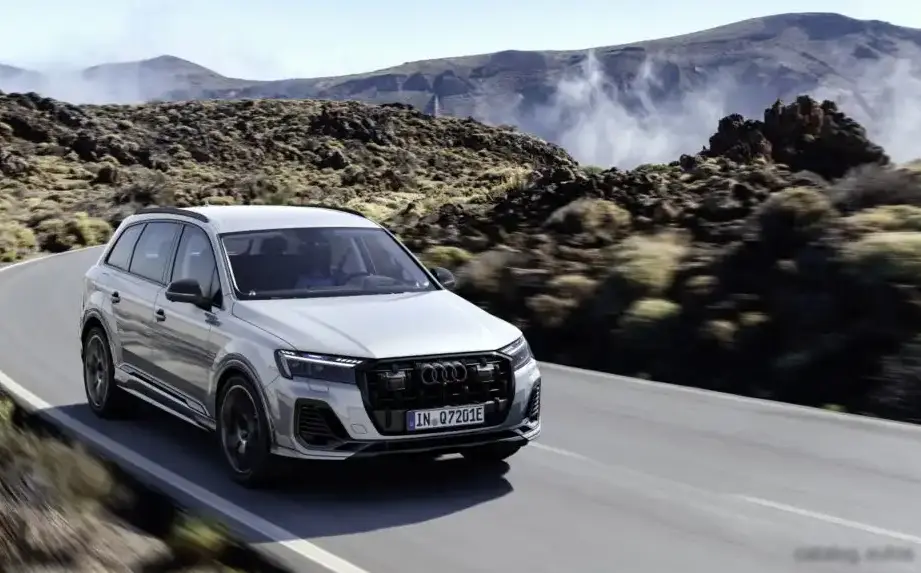
The Audi Q7 60 TFSI e quattro tiptronic, introduced in April 2024 as part of the Typ 4M facelift, represents Audi’s commitment to plug-in hybrid technology within its popular SUV lineup. This variant combines a 3.0-liter turbocharged V6 engine with an electric motor, delivering a combined system output of 490 horsepower and 700 Nm (516.29 lb-ft) of torque. Positioned as a premium offering, the 60 TFSI e caters to buyers seeking both performance and efficiency, offering a substantial all-electric range and reduced emissions compared to traditional internal combustion engine Q7 models. It builds upon the established Q7 platform (shared with the Volkswagen Touareg and Porsche Cayenne) and integrates advanced hybrid technology for a refined driving experience.
Technical Specifications
| Brand | Audi |
| Model | Q7 |
| Generation | Q7 (Typ 4M, facelift 2024) |
| Type (Engine) | 60 TFSI e V6 (490 Hp) Plug-in Hybrid quattro tiptronic |
| Start of production | April, 2024 |
| Powertrain Architecture | PHEV (Plug-in Hybrid Electric Vehicle) |
| Body type | SUV |
| Seats | 5 |
| Doors | 5 |
| Combined fuel consumption (WLTP) | 1.3-1.4 l/100 km (180.9 – 168 US mpg, 217.3 – 201.8 UK mpg, 76.9 – 71.4 km/l) |
| CO2 emissions (WLTP) | 29-33 g/km |
| Fuel Type | Petrol / electricity |
| Acceleration 0 – 100 km/h | 5 sec |
| Acceleration 0 – 62 mph | 5 sec |
| Acceleration 0 – 60 mph | 4.8 sec |
| Maximum speed | 240 km/h (149.13 mph) – Electronically limited |
| Emission standard | Euro 6e |
| Weight-to-power ratio | 4.9 kg/Hp, 205.5 Hp/tonne |
| Weight-to-torque ratio | 3.4 kg/Nm, 293.5 Nm/tonne |
| Gross battery capacity | 25.9 kWh |
| Net (usable) battery capacity | 22 kWh |
| Battery voltage | 400 V |
| Battery technology | Lithium-ion (Li-Ion) |
| Battery location | Under the trunk |
| Recuperation output | 80 kW |
| All-electric range (WLTP) | 80-84 km (49.71 – 52.2 mi) |
| Average Energy consumption (WLTP) | 28-29.1 kWh/100 km (45.06 – 46.83 kWh/100 mi, 75 – 72 MPGe, 3.6 – 3.4 km/kWh, 2.2 – 2.1 mi/kWh) |
| Max speed (electric) | 140 km/h (86.99 mph) |
| Electric motor power | 177 Hp |
| Electric motor Torque | 460 Nm (339.28 lb.-ft.) |
| Electric motor location | Between the combustion engine and the transmission |
| Electric motor type | Synchronous |
| System power | 490 Hp |
| System torque | 700 Nm (516.29 lb.-ft.) |
| Power | 340 Hp @ 5200-6400 rpm |
| Torque | 500 Nm @ 1370-4500 rpm (368.78 lb.-ft. @ 1370-4500 rpm) |
| Engine layout | Front, Longitudinal |
| Engine displacement | 2995 cm3 (182.77 cu. in.) |
| Number of cylinders | 6 |
| Engine configuration | V-engine |
| Cylinder Bore | 84.5 mm (3.33 in.) |
| Piston Stroke | 89 mm (3.5 in.) |
| Compression ratio | 11.2:1 |
| Number of valves per cylinder | 4 |
| Fuel injection system | Direct injection |
| Engine aspiration | Turbocharger, Intercooler |
| Valvetrain | DOHC |
| Engine oil capacity | 7.2 l (7.61 US qt | 6.34 UK qt) |
| Coolant | 17.4 l (18.39 US qt | 15.31 UK qt) |
| Kerb Weight | 2385 kg (5258.02 lbs.) |
| Max. weight | 3100 kg (6834.33 lbs.) |
| Max load | 715 kg (1576.31 lbs.) |
| Trunk (boot) space – minimum | 563 l (19.88 cu. ft.) |
| Trunk (boot) space – maximum | 1863 l (65.79 cu. ft.) |
| Fuel tank capacity | 75 l (19.81 US gal | 16.5 UK gal) |
| Max. roof load | 100 kg (220.46 lbs.) |
| Permitted trailer load with brakes (8%) | 2800 kg (6172.94 lbs.) |
| Permitted trailer load with brakes (12%) | 2800 kg (6172.94 lbs.) |
| Permitted trailer load without brakes | 750 kg (1653.47 lbs.) |
| Permitted towbar download | 115 kg (253.53 lbs.) |
| Length | 5072 mm (199.69 in.) |
| Width | 1970 mm (77.56 in.) |
| Width including mirrors | 2212 mm (87.09 in.) |
| Height | 1690-1748 mm (66.54 – 68.82 in.) |
| Wheelbase | 2995 mm (117.91 in.) |
| Front track | 1673 mm (65.87 in.) |
| Rear (Back) track | 1685 mm (66.34 in.) |
| Front overhang | 982 mm (38.66 in.) |
| Rear overhang | 1095 mm (43.11 in.) |
| Drag coefficient (Cd) | 0.36 |
| Minimum turning circle (turning diameter) | 12.5 m (41.01 ft.) |
| Front suspension | Independent multi-link suspension, Transverse stabilizer, Air suspension |
| Rear suspension | Independent multi-link suspension, Air suspension, Transverse stabilizer |
| Front brakes | Ventilated discs, 400 mm |
| Rear brakes | Ventilated discs, 350 mm |
| Number of gears and type of gearbox | 8 gears, automatic transmission tiptronic |
| Tires size | 255/55 R19; 285/45 R20; 285/40 R21; 285/35 R22 |
| Wheel rims size | 8.5J x 19; 9J x 20; 9.5J x 21; 10J x 22 |
Powertrain & Engine Architecture
At the heart of the Q7 60 TFSI e lies a 3.0-liter V6 engine, designated internally as the 45 TFSI, producing 340 horsepower and 500 Nm (368.78 lb-ft) of torque. This engine utilizes a single twin-scroll turbocharger and direct fuel injection to optimize power delivery and efficiency. The engine’s valvetrain employs Dual Overhead Camshafts (DOHC) with four valves per cylinder. Integrated with this engine is a 177 horsepower electric motor, powered by a 25.9 kWh (gross) / 22 kWh (net) lithium-ion battery pack. The battery is positioned under the trunk floor, impacting cargo space slightly. The electric motor is strategically placed between the engine and the eight-speed tiptronic automatic transmission, allowing for seamless transitions between electric, hybrid, and gasoline power. The powertrain features an 80 kW recuperation output, maximizing energy recovery during deceleration.
Driving Characteristics
The 60 TFSI e offers a unique driving experience, blending the refinement of a large luxury SUV with the instant torque of an electric motor. In EV mode, the Q7 can travel between 80-84 km (49.71 – 52.2 mi) on a single charge, providing silent and emission-free operation for daily commutes. When the battery is depleted or additional power is needed, the V6 engine seamlessly engages, providing a combined output of 490 horsepower and 700 Nm of torque. The eight-speed tiptronic transmission is well-tuned to manage the power delivery, offering smooth and responsive shifts. Compared to the standard Q7 45 TFSI, the 60 TFSI e offers significantly quicker acceleration (0-60 mph in 4.8 seconds) due to the electric motor’s instant torque fill. Compared to higher-performance Q7 variants like the SQ7, the 60 TFSI e prioritizes efficiency and a more relaxed driving experience.
Equipment & Trim Levels
The 60 TFSI e typically comes standard with a high level of equipment, reflecting its premium positioning. This includes Audi’s virtual cockpit digital instrument cluster, a large touchscreen infotainment system with navigation, leather upholstery, heated and ventilated front seats, and a panoramic sunroof. Standard safety features include adaptive cruise control, lane keeping assist, and automatic emergency braking. Optional extras often include upgraded audio systems, massaging seats, and various cosmetic enhancements. Interior trim options typically include wood or aluminum accents, and buyers can choose from a range of exterior colors.
Chassis & Braking
The Q7 60 TFSI e utilizes an independent multi-link suspension system at both the front and rear, enhanced with air suspension for a comfortable ride. The air suspension allows for adjustable ride height and damping settings, adapting to different driving conditions. Braking duties are handled by ventilated discs on all four wheels, with larger discs (400mm front, 350mm rear) to accommodate the vehicle’s weight and performance. Standard safety features include ABS, electronic stability control, and traction control.
Market Reception & Comparison
The Audi Q7 60 TFSI e has been generally well-received by automotive critics, praised for its blend of performance, efficiency, and luxury. Its all-electric range is competitive within its segment, and its fuel economy is significantly better than traditional gasoline-powered Q7 models. Compared to the Q7 45 TFSI, the 60 TFSI e offers a more refined and efficient driving experience, albeit at a higher price point. Compared to the Q7 55 TFSI e, the 60 TFSI e offers more power and a slightly longer electric range. Reliability reports are still emerging, but Audi’s reputation for build quality suggests that the 60 TFSI e should prove to be a durable and dependable vehicle.
Legacy
The Q7 60 TFSI e represents a significant step forward in Audi’s electrification strategy. As plug-in hybrid technology becomes increasingly prevalent, this variant is likely to become a popular choice for buyers seeking a luxurious and environmentally conscious SUV. The long-term reliability of the powertrain remains to be seen, but the combination of a proven V6 engine and a robust electric motor suggests that it should offer years of dependable service. On the used car market, the 60 TFSI e is expected to hold its value well, particularly as demand for plug-in hybrid vehicles continues to grow.