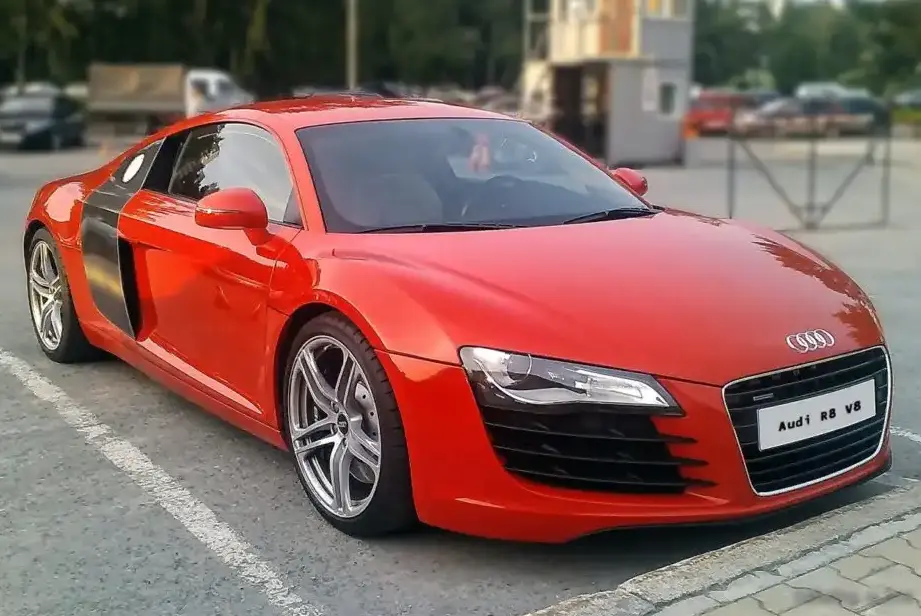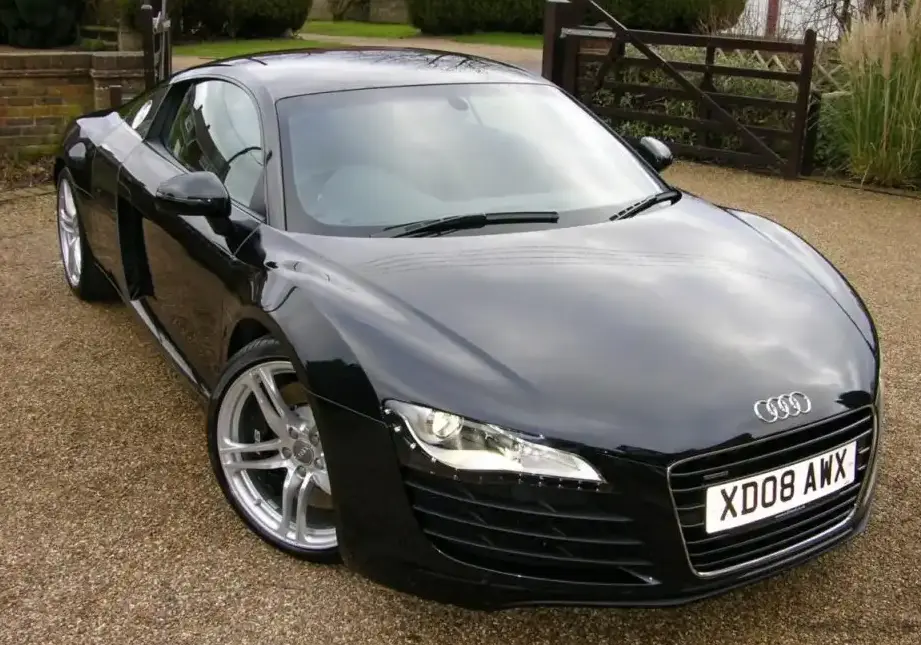
The Audi R8 Coupe (42) 4.2 FSI V8 quattro R tronic, produced from November 2006 to October 2012, represents the initial iteration of Audi’s foray into the mid-engine sports car market. Positioned as the flagship performance model, it aimed to compete directly with established rivals like the Porsche 911 and Lamborghini Gallardo (with whom it shared a platform). This variant, equipped with the naturally aspirated 4.2-liter V8 engine and Audi’s R tronic sequential manual gearbox, served as the foundation for the R8 lineup, offering a blend of high performance and relative usability. It was built on the Audi Space Frame, a lightweight aluminum chassis, and played a crucial role in establishing Audi’s credibility as a high-performance brand.
Technical Specifications
| Brand | Audi |
| Model | R8 |
| Generation | R8 Coupe (42) |
| Type (Engine) | 4.2 FSI V8 (420 Hp) quattro R tronic |
| Start of production | November, 2006 |
| End of production | October, 2012 |
| Powertrain Architecture | Internal Combustion engine |
| Body type | Coupe |
| Seats | 2 |
| Doors | 2 |
| Fuel consumption (economy) – urban | 20.4 l/100 km (11.5 US mpg, 13.8 UK mpg, 4.9 km/l) |
| Fuel consumption (economy) – extra urban | 9.6 l/100 km (24.5 US mpg, 29.4 UK mpg, 10.4 km/l) |
| Fuel consumption (economy) – combined | 13.6 l/100 km (17.3 US mpg, 20.8 UK mpg, 7.4 km/l) |
| Fuel Type | Petrol (Gasoline) |
| Acceleration 0 – 100 km/h | 4.6 sec |
| Acceleration 0 – 62 mph | 4.6 sec |
| Acceleration 0 – 60 mph | 4.4 sec |
| Maximum speed | 301 km/h (187.03 mph) |
| Emission standard | Euro 4 |
| Weight-to-power ratio | 3.7 kg/Hp, 268.4 Hp/tonne |
| Weight-to-torque ratio | 3.6 kg/Nm, 274.8 Nm/tonne |
| Power | 420 Hp @ 7800 rpm |
| Power per litre | 100.9 Hp/l |
| Torque | 430 Nm @ 4500-5500 rpm (317.15 lb.-ft. @ 4500-5500 rpm) |
| Maximum engine speed | 8250 rpm |
| Engine layout | Rear, Longitudinal |
| Engine Model/Code | BYH |
| Engine displacement | 4163 cm3 (254.04 cu. in.) |
| Number of cylinders | 8 |
| Engine configuration | V-engine |
| Cylinder Bore | 84.5 mm (3.33 in.) |
| Piston Stroke | 92.8 mm (3.65 in.) |
| Compression ratio | 12.5:1 |
| Number of valves per cylinder | 4 |
| Fuel injection system | Direct injection |
| Engine aspiration | Naturally aspirated engine |
| Valvetrain | DOHC |
| Engine oil capacity | 10 l (10.57 US qt | 8.8 UK qt) |
| Kerb Weight | 1565 kg (3450.23 lbs.) |
| Max. weight | 1865 kg (4111.62 lbs.) |
| Max load | 300 kg (661.39 lbs.) |
| Trunk (boot) space – minimum | 100 l (3.53 cu. ft.) |
| Fuel tank capacity | 75 l (19.81 US gal | 16.5 UK gal) |
| Length | 4431 mm (174.45 in.) |
| Width | 1904 mm (74.96 in.) |
| Width including mirrors | 2029 mm (79.88 in.) |
| Height | 1252 mm (49.29 in.) |
| Wheelbase | 2650 mm (104.33 in.) |
| Front track | 1638 mm (64.49 in.) |
| Rear (Back) track | 1595 mm (62.8 in.) |
| Front overhang | 999 mm (39.33 in.) |
| Rear overhang | 782 mm (30.79 in.) |
| Drag coefficient (Cd) | 0.34 |
| Minimum turning circle (turning diameter) | 11.8 m (38.71 ft.) |
| Drive wheel | All wheel drive (4×4) |
| Number of gears and type of gearbox | 6 gears, automatic transmission R tronic |
| Front suspension | Independent, type McPherson with coil spring and anti-roll bar |
| Rear suspension | Independent multi-link spring suspension with stabilizer |
| Front brakes | Ventilated discs |
| Rear brakes | Ventilated discs |
| Assisting systems | ABS (Anti-lock braking system) |
| Steering type | Steering rack and pinion |
| Tires size | 235/40 R18; 285/35 R18 |
| Wheel rims size | 8.5J x 18; 10.5J x 18 |
Powertrain & Engine Architecture
At the heart of the R8 4.2 FSI quattro R tronic lies the BYH engine code, a 4.2-liter naturally aspirated V8. This engine utilizes a direct fuel injection (FSI) system, delivering fuel directly into the combustion chamber for improved efficiency and power. The engine features a double overhead camshaft (DOHC) valvetrain with four valves per cylinder, optimizing airflow for high-revving performance. The 90-degree V8 configuration provides inherent balance, contributing to smooth operation. The R tronic transmission is a six-speed automated manual gearbox. It operates as a traditional manual transmission but utilizes actuators to shift gears, offering quicker shifts than a conventional automatic but lacking the smoothness of a torque-converter automatic. Paddle shifters mounted behind the steering wheel allow for manual control.
Driving Characteristics
The 4.2 FSI V8 with the R tronic transmission delivers a distinct driving experience. While not as brutally fast as the later 5.2-liter V10, it provides ample power and torque for spirited driving. The R tronic gearbox, while quick, can be somewhat jerky at low speeds and during stop-start traffic. The quattro all-wheel-drive system provides excellent traction, particularly in adverse weather conditions. The gear ratios are tuned for acceleration, with a relatively short final drive. Compared to the six-speed manual R8, the R tronic version offers slightly slower acceleration due to shift times, but provides convenience for daily driving. The engine’s power delivery is linear and predictable, making it accessible to drivers of varying skill levels.
Equipment & Trim Levels
The R8 4.2 FSI quattro R tronic came standard with a generous array of features, including leather upholstery, power-adjustable seats, a premium audio system, and automatic climate control. Optional extras included carbon fiber interior trim, upgraded navigation systems, and a sport exhaust system. The exterior featured a distinctive design with LED daytime running lights and a rear spoiler. The interior focused on a driver-centric layout, with controls logically arranged and within easy reach. While not as lavishly equipped as some grand tourers, the R8 prioritized a sporty and functional interior.
Chassis & Braking
The R8’s chassis is constructed from Audi’s Aluminum Space Frame (ASF), a lightweight and rigid structure that contributes to the car’s excellent handling. The suspension utilizes independent McPherson struts at the front and a multi-link setup at the rear, providing a balance between comfort and control. Stabilizer bars are fitted front and rear to reduce body roll. Braking duties are handled by ventilated disc brakes on all four wheels, providing ample stopping power. ABS (Anti-lock Braking System) is standard. The R8’s weight distribution is near perfect, enhancing its agility and responsiveness.
Market Reception & Comparison
The Audi R8 4.2 FSI quattro R tronic was generally well-received by automotive critics. It was praised for its striking design, impressive performance, and engaging driving experience. However, some critics found the R tronic transmission to be less refined than traditional automatics or manual gearboxes. Fuel economy was also a concern, with the R8 consuming a significant amount of fuel, especially in urban driving. Compared to the manual version, the R tronic offered convenience at the expense of some performance. Compared to the Porsche 911, the R8 offered a more accessible and user-friendly experience, while the 911 prioritized outright performance and driving purity.
Legacy
The Audi R8 4.2 FSI quattro R tronic laid the groundwork for Audi’s future high-performance models. The engine proved to be relatively reliable, although regular maintenance is essential. The R tronic transmission, while occasionally problematic, can be maintained with proper servicing. Today, the first-generation R8 remains a desirable sports car in the used market, offering a compelling combination of performance, style, and exclusivity. Its impact on Audi’s brand image was significant, establishing the company as a serious contender in the high-performance automotive segment. The ASF construction and advanced technologies introduced in the R8 continue to influence Audi’s engineering philosophy.