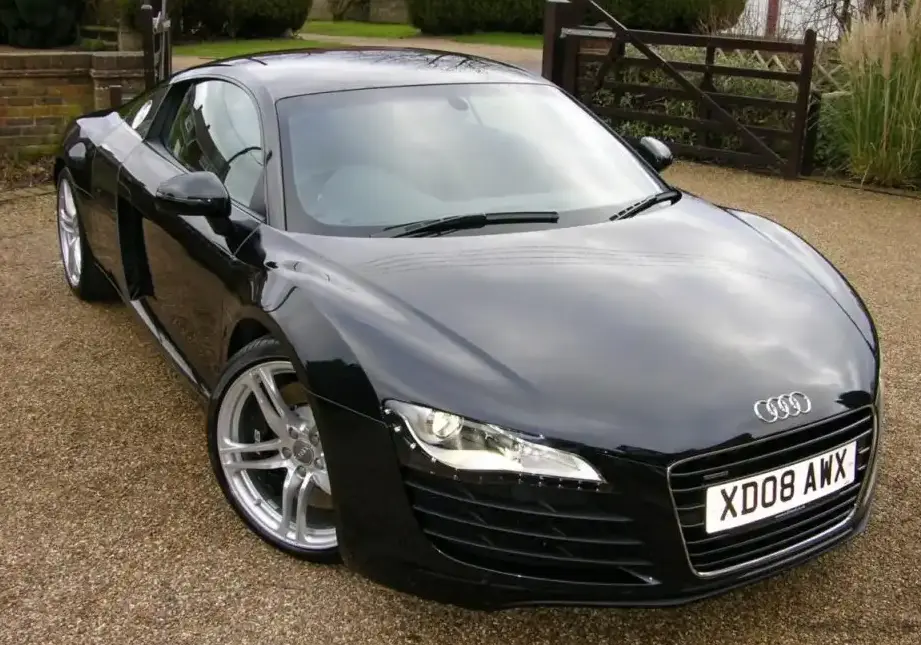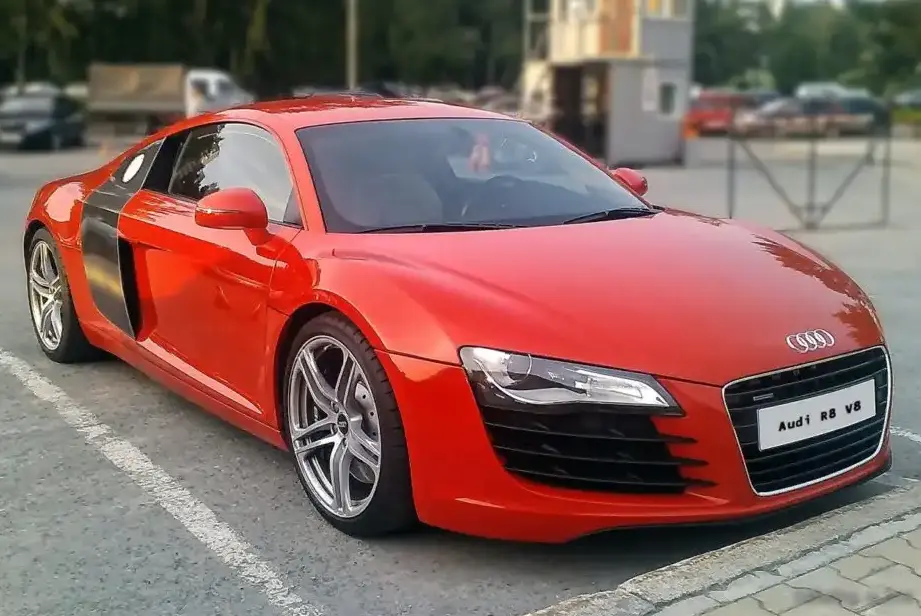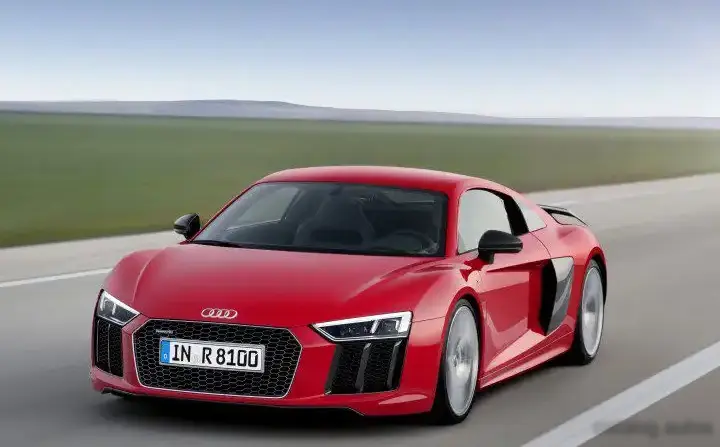
The Audi R8 II Coupe (4S) 5.2 FSI V10 plus quattro S tronic represents the pinnacle of the second-generation R8 lineup, produced from 2015 to 2018. Positioned as the highest-performance variant, it built upon the foundation of the 4S platform (shared with the Lamborghini Huracán) to deliver an uncompromising supercar experience. This model distinguished itself through its naturally aspirated 5.2-liter V10 engine, advanced quattro all-wheel-drive system, and the quick-shifting S tronic dual-clutch transmission. It served as Audi’s flagship sports car, competing directly with models like the Porsche 911 Turbo and McLaren 570S.
Technical Specifications
| Brand | Audi |
| Model | R8 |
| Generation | R8 II Coupe (4S) |
| Type (Engine) | 5.2 FSI V10 plus (610 Hp) quattro S tronic |
| Start of production | 2015 |
| End of production | 2018 |
| Powertrain Architecture | Internal Combustion engine |
| Body type | Coupe |
| Seats | 2 |
| Doors | 2 |
| Fuel consumption (economy) – urban | 17.5 l/100 km (13.4 US mpg, 16.1 UK mpg, 5.7 km/l) |
| Fuel consumption (economy) – extra urban | 9.3 l/100 km (25.3 US mpg, 30.4 UK mpg, 10.8 km/l) |
| Fuel consumption (economy) – combined | 12.3 l/100 km (19.1 US mpg, 23 UK mpg, 8.1 km/l) |
| CO2 emissions | 287 g/km |
| Fuel Type | Petrol (Gasoline) |
| Acceleration 0 – 100 km/h | 3.2 sec |
| Acceleration 0 – 62 mph | 3.2 sec |
| Acceleration 0 – 60 mph | 3 sec |
| Maximum speed | 330 km/h (205.05 mph) |
| Emission standard | Euro 6 |
| Weight-to-power ratio | 2.5 kg/Hp, 392.3 Hp/tonne |
| Weight-to-torque ratio | 2.8 kg/Nm, 360.1 Nm/tonne |
| Power | 610 Hp @ 8250 rpm |
| Power per litre | 117.2 Hp/l |
| Torque | 560 Nm @ 6500 rpm (413.03 lb.-ft. @ 6500 rpm) |
| Engine layout | Middle, Longitudinal |
| Engine Model/Code | CSPA |
| Engine displacement | 5204 cm3 (317.57 cu. in.) |
| Number of cylinders | 10 |
| Engine configuration | V-engine |
| Cylinder Bore | 84.5 mm (3.33 in.) |
| Piston Stroke | 92.8 mm (3.65 in.) |
| Compression ratio | 12.7:1 |
| Number of valves per cylinder | 4 |
| Fuel injection system | Direct injection and Multi-port manifold injection |
| Engine aspiration | Naturally aspirated engine |
| Valvetrain | DOHC |
| Engine oil capacity | 8.3 l (8.77 US qt | 7.3 UK qt) |
| Coolant | 24.7 l (26.1 US qt | 21.73 UK qt) |
| Kerb Weight | 1555 kg (3428.19 lbs.) |
| Max. weight | 1895 kg (4177.76 lbs.) |
| Max load | 340 kg (749.57 lbs.) |
| Trunk (boot) space – minimum | 112 l (3.96 cu. ft.) |
| Fuel tank capacity | 73 l (19.28 US gal | 16.06 UK gal) |
| Length | 4426 mm (174.25 in.) |
| Width | 1940 mm (76.38 in.) |
| Width including mirrors | 2037 mm (80.2 in.) |
| Height | 1240 mm (48.82 in.) |
| Wheelbase | 2650 mm (104.33 in.) |
| Front track | 1638 mm (64.49 in.) |
| Rear (Back) track | 1599 mm (62.95 in.) |
| Front overhang | 994 mm (39.13 in.) |
| Rear overhang | 782 mm (30.79 in.) |
| Drag coefficient (Cd) | 0.36 |
| Minimum turning circle (turning diameter) | 11.2 m (36.75 ft.) |
| Drivetrain Architecture | The Internal combustion engine (ICE) drives the rear wheels permanently, and the front wheels are driven through an electrically or mechanically operated clutch if necessary. |
| Drive wheel | All wheel drive (4×4) |
| Number of gears and type of gearbox | 7 gears, automatic transmission S tronic |
| Front suspension | Coil spring, Double wishbone, Transverse stabilizer |
| Rear suspension | Double wishbone, Transverse stabilizer, Coil spring |
| Front brakes | Ventilated discs, 380×38 mm |
| Rear brakes | Ventilated discs, 356×32 mm |
| Assisting systems | ABS (Anti-lock braking system) |
| Steering type | Steering rack and pinion |
| Power steering | Electric Steering |
| Tires size | Front wheel tires: 245/35 R19; 245/30 R20Rear wheel tires: 295/35 R19; 305/30 R20 |
| Wheel rims size | Front wheel rims: 8.5J x 19; 8.5J x 20Rear wheel rims: 11J x 19; 11J x 20 |
INTRODUCTION
The Audi R8 II Coupe (4S) 5.2 FSI V10 plus quattro S tronic, launched in 2015, represented a significant evolution of Audi’s mid-engine sports car. Built on the second-generation R8 platform (4S), it shared its core architecture with the Lamborghini Huracán, benefiting from extensive development and advanced materials. This particular variant, the “plus” model, was the top-tier offering, boasting increased power, enhanced aerodynamics, and a more focused driving experience. It was produced until 2018, marking the high-water mark for the second-generation R8 before further refinements were introduced.
Powertrain & Engine Architecture
At the heart of the R8 V10 plus lies the CSPA engine, a naturally aspirated 5.2-liter V10. This engine, a descendant of the unit first seen in the Lamborghini Gallardo, produces 610 horsepower at 8,250 rpm and 413 lb-ft of torque at 6,500 rpm. It features direct fuel injection combined with multi-point manifold injection, optimizing combustion efficiency and power delivery. The engine utilizes a dual overhead camshaft (DOHC) valvetrain with four valves per cylinder. The 7-speed S tronic dual-clutch transmission provides incredibly fast and precise gear changes, contributing to the car’s blistering acceleration. Unlike some competitors, Audi opted to retain a naturally aspirated engine, prioritizing a linear powerband and a visceral driving experience over the low-end torque of turbocharged alternatives.
Driving Characteristics
The R8 V10 plus delivers a truly exhilarating driving experience. The combination of the high-revving V10 and the S tronic transmission results in a 0-60 mph time of around 3 seconds and a top speed of 205 mph. The quattro all-wheel-drive system provides exceptional traction, allowing for confident acceleration even in challenging conditions. The gear ratios are tuned for performance, with shorter gearing in the lower gears for rapid acceleration and taller gearing for efficient cruising. Compared to the standard R8 V10, the “plus” model offers a noticeably more aggressive throttle response and a more engaging driving feel. While the standard R8 offered a more approachable experience, the V10 plus demanded a more skilled driver to fully exploit its capabilities.
Equipment & Trim Levels
The R8 V10 plus came standard with a comprehensive list of features, befitting its flagship status. Interior appointments included fine Nappa leather upholstery, carbon fiber trim, and sport seats. Standard equipment also included Audi’s virtual cockpit digital instrument cluster, a premium Bang & Olufsen sound system, and a navigation system. Optional extras included ceramic brakes, a carbon fiber rear spoiler, and a variety of customization options through Audi Exclusive, allowing buyers to personalize their R8 to their exact specifications. The interior design prioritized a driver-focused layout, with controls logically arranged and easily accessible.
Chassis & Braking
The R8 II Coupe (4S) features a lightweight aluminum chassis, contributing to its impressive power-to-weight ratio. The suspension utilizes a double wishbone setup at both the front and rear, with coil springs and transverse stabilizers to minimize body roll. The V10 plus model benefited from a slightly stiffer suspension tuning compared to the standard R8, further enhancing its handling precision. Braking duties are handled by ventilated discs at all four corners, with the option of upgrading to carbon ceramic brakes for even greater stopping power and fade resistance. The steering is a rack-and-pinion system with electric power assistance, providing precise and responsive control.
Market Reception & Comparison
The Audi R8 V10 plus was widely praised by automotive critics for its stunning performance, engaging driving dynamics, and luxurious interior. It was often lauded as a true supercar that could compete with the best from Ferrari and Porsche. Compared to the standard R8 V10, the “plus” model was seen as a more serious performance machine, appealing to enthusiasts who prioritized track capability and outright speed. Fuel economy, unsurprisingly, was not a strong point, with combined fuel consumption around 19 mpg. However, the R8 V10 plus offered a compelling blend of performance, luxury, and technology that made it a desirable choice in its segment.
Legacy
The Audi R8 II Coupe (4S) 5.2 FSI V10 plus quattro S tronic remains a highly sought-after supercar in the used car market. The naturally aspirated V10 engine is particularly prized by enthusiasts for its unique sound and character. While maintenance costs can be significant, the R8 V10 plus has proven to be a relatively reliable performance car, especially when properly maintained. Its enduring appeal lies in its ability to deliver a truly visceral and engaging driving experience, making it a modern classic that continues to captivate car enthusiasts today.