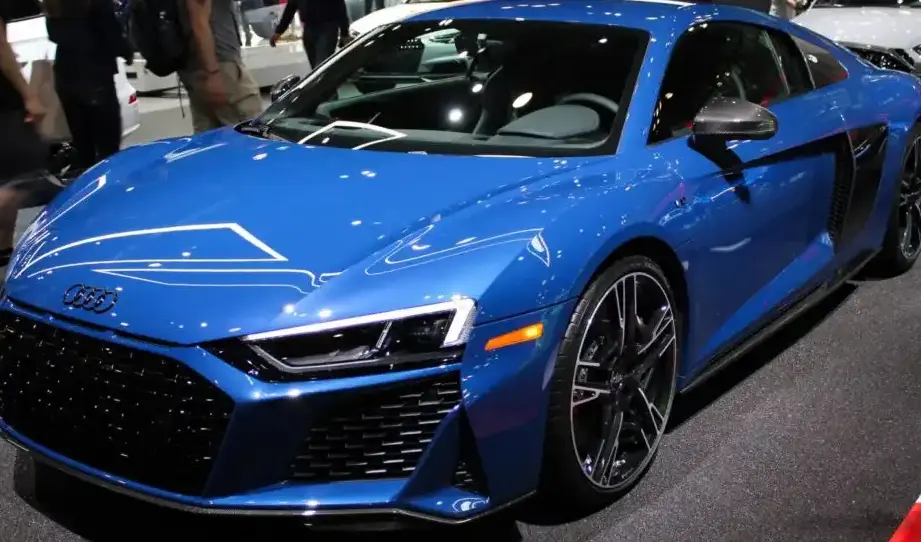
The Audi R8 II Coupe (4S), specifically the facelifted version introduced in May 2019 and produced through July 2021, represents the pinnacle of Audi’s mid-engine sports car engineering. This variant, equipped with the 5.2 FSI V10 engine producing 570 horsepower and paired with a seven-speed S tronic dual-clutch transmission and quattro all-wheel drive, was positioned as the top-tier performance offering within the R8 Coupe lineup. It built upon the foundation of the first-generation R8, moving to the newer 4S platform (shared with the Lamborghini Huracán) and incorporating updated styling, technology, and enhanced performance characteristics. This model aimed to deliver a more focused and engaging driving experience compared to the standard R8 V10.
Technical Specifications
| Brand | Audi |
| Model | R8 |
| Generation | R8 II Coupe (4S, facelift 2019) |
| Type (Engine) | 5.2 FSI V10 (570 Hp) quattro S tronic |
| Start of production | May, 2019 |
| End of production | July, 2021 |
| Powertrain Architecture | Internal Combustion engine |
| Body type | Coupe |
| Seats | 2 |
| Doors | 2 |
| Fuel consumption at Low speed (WLTP) | 23.4-25.5 l/100 km (10.1 – 9.2 US mpg, 12.1 – 11.1 UK mpg, 4.3 – 3.9 km/l) |
| Fuel consumption at Medium speed (WLTP) | 13.3 l/100 km (17.7 US mpg, 21.2 UK mpg, 7.5 km/l) |
| Fuel consumption at high speed (WLTP) | 11.1-11.2 l/100 km (21.2 – 21 US mpg, 25.4 – 25.2 UK mpg, 9 – 8.9 km/l) |
| Fuel consumption at very high speed (WLTP) | 10.9-11.1 l/100 km (21.6 – 21.2 US mpg, 25.9 – 25.4 UK mpg, 9.2 – 9 km/l) |
| Combined fuel consumption (WLTP) | 13.1-13.5 l/100 km (18 – 17.4 US mpg, 21.6 – 20.9 UK mpg, 7.6 – 7.4 km/l) |
| CO2 emissions (WLTP) | 296-307 g/km |
| Fuel consumption (economy) – urban (NEDC, WLTP equivalent) | 19.4 l/100 km (12.1 US mpg, 14.6 UK mpg, 5.2 km/l) |
| Fuel consumption (economy) – extra urban (NEDC, WLTP equivalent) | 9.1 l/100 km (25.8 US mpg, 31 UK mpg, 11 km/l) |
| Fuel consumption (economy) – combined (NEDC, WLTP equivalent) | 12.9 l/100 km (18.2 US mpg, 21.9 UK mpg, 7.8 km/l) |
| CO2 emissions (NEDC, WLTP equivalent) | 293 g/km |
| Fuel Type | Petrol (Gasoline) |
| Acceleration 0 – 100 km/h | 3.4 sec |
| Acceleration 0 – 62 mph | 3.4 sec |
| Acceleration 0 – 60 mph | 3.2 sec |
| Maximum speed | 324 km/h (201.32 mph) |
| Emission standard | Euro 6d-ISC-FCM |
| Weight-to-power ratio | 2.9 kg/Hp, 343.4 Hp/tonne |
| Weight-to-torque ratio | 3 kg/Nm, 337.3 Nm/tonne |
| Power | 570 Hp @ 8100 rpm |
| Power per litre | 109.5 Hp/l |
| Torque | 560 Nm @ 6300 rpm (413.03 lb.-ft. @ 6300 rpm) |
| Engine layout | Middle, Longitudinal |
| Engine Model/Code | DKAC |
| Engine displacement | 5204 cm3 (317.57 cu. in.) |
| Number of cylinders | 10 |
| Engine configuration | V-engine |
| Cylinder Bore | 84.5 mm (3.33 in.) |
| Piston Stroke | 92.8 mm (3.65 in.) |
| Compression ratio | 12.7:1 |
| Number of valves per cylinder | 4 |
| Fuel injection system | Direct injection and Multi-port manifold injection |
| Engine aspiration | Naturally aspirated engine |
| Valvetrain | DOHC |
| Engine oil capacity | 8.3 l (8.77 US qt | 7.3 UK qt) |
| Coolant | 24.7 l (26.1 US qt | 21.73 UK qt) |
| Kerb Weight | 1660 kg (3659.67 lbs.) |
| Max. weight | 1960 kg (4321.06 lbs.) |
| Max load | 300 kg (661.39 lbs.) |
| Trunk (boot) space – minimum | 112 l (3.96 cu. ft.) |
| Fuel tank capacity | 83 l (21.93 US gal | 18.26 UK gal) |
| Length | 4429 mm (174.37 in.) |
| Width | 1940 mm (76.38 in.) |
| Width including mirrors | 2037 mm (80.2 in.) |
| Height | 1236 mm (48.66 in.) |
| Wheelbase | 2650 mm (104.33 in.) |
| Front track | 1645 mm (64.76 in.) |
| Rear (Back) track | 1599 mm (62.95 in.) |
| Front overhang | 993 mm (39.09 in.) |
| Rear overhang | 786 mm (30.94 in.) |
| Drag coefficient (Cd) | 0.35 |
| Minimum turning circle (turning diameter) | 11.2 m (36.75 ft.) |
| Drivetrain Architecture | The Internal combustion engine (ICE) drives the rear wheels permanently, and the front wheels are driven through an electrically or mechanically operated clutch if necessary. |
| Drive wheel | All wheel drive (4×4) |
| Number of gears and type of gearbox | 7 gears, automatic transmission S tronic |
| Front suspension | Coil spring, Double wishbone, Transverse stabilizer |
| Rear suspension | Double wishbone, Transverse stabilizer, Coil spring |
| Front brakes | Ventilated discs, 365 mm |
| Rear brakes | Ventilated discs, 356 mm |
| Assisting systems | ABS (Anti-lock braking system) |
| Steering type | Steering rack and pinion |
| Power steering | Electric Steering |
| Tires size | Front wheel tires: 245/35 R19; 245/30 R20Rear wheel tires: 295/35 R19; 305/30 R20 |
| Wheel rims size | Front wheel rims: 8.5J x 19; 8.5J x 20Rear wheel rims: 11J x 19; 11J x 20 |
INTRODUCTION
The 2019-2021 Audi R8 II Coupe 5.2 FSI V10 (570 Hp) quattro S tronic represents the culmination of Audi’s supercar development. Built on the 4S platform, this iteration of the R8 offered a significant step up in performance and refinement compared to earlier models. The facelift brought subtle but effective styling updates, along with enhancements to the engine and transmission. This model occupied the highest performance tier within the R8 range, catering to enthusiasts seeking a thrilling and capable grand tourer with exceptional track potential. It was sold primarily in markets where high-performance sports cars are in demand, including North America, Europe, and parts of Asia.
Powertrain & Engine Architecture
At the heart of this R8 variant lies the naturally aspirated 5.2-liter V10 engine, designated as the DKAC code. This engine is a marvel of engineering, featuring direct fuel injection (FSI) combined with multi-port manifold injection for optimal combustion efficiency and power delivery. The engine boasts a high 12.7:1 compression ratio and a dual overhead camshaft (DOHC) valvetrain with four valves per cylinder. The 570 horsepower peak is achieved at 8,100 rpm, while the substantial 560 Nm (413 lb-ft) of torque is available from 6,300 rpm. The engine’s architecture is longitudinal, positioned mid-ship to optimize weight distribution. Paired with the engine is Audi’s seven-speed S tronic dual-clutch transmission. This transmission offers incredibly fast and precise gear changes, contributing significantly to the car’s acceleration and responsiveness. The S tronic features a sophisticated electronic control unit that adapts shift points based on driving style and conditions. The quattro all-wheel-drive system further enhances traction and stability, distributing power between the front and rear axles as needed.
Driving Characteristics
The R8 II Coupe 5.2 FSI V10 with the S tronic transmission delivers a driving experience that is both exhilarating and remarkably accessible. The naturally aspirated V10 provides a linear and immediate power delivery, lacking the turbo lag often found in forced-induction engines. The S tronic transmission’s quick shifts contribute to a 0-60 mph time of around 3.2 seconds and a top speed of 201.32 mph. Compared to a manual transmission R8, the S tronic offers faster acceleration and reduced driver fatigue, particularly in traffic. While some purists might prefer the engagement of a manual, the S tronic’s responsiveness and efficiency make it a compelling choice for both road and track use. The quattro all-wheel-drive system provides exceptional grip, inspiring confidence in various weather conditions. The steering is precise and well-weighted, offering good feedback to the driver. The suspension, tuned for performance, provides a firm but controlled ride, minimizing body roll during cornering.
Equipment & Trim Levels
The 570 hp R8 Coupe came standard with a comprehensive list of features. Interior appointments included fine Nappa leather upholstery, a flat-bottomed steering wheel, and carbon fiber trim. Standard technology included Audi’s virtual cockpit, a fully digital instrument cluster, and a premium Bang & Olufsen sound system. Optional extras included a variety of carbon fiber exterior and interior components, performance exhaust systems, and upgraded brake systems. Customers could also personalize their R8 with a wide range of exterior colors and interior finishes. The overall interior design focused on a driver-centric layout, with controls logically arranged and easily accessible.
Chassis & Braking
The R8 II Coupe features a lightweight chassis constructed primarily from aluminum and carbon fiber reinforced plastic (CFRP). This construction contributes to the car’s relatively low weight of 1660 kg (3659.67 lbs). The suspension utilizes a double-wishbone setup at both the front and rear, with coil springs and transverse stabilizers to minimize body roll. The braking system consists of ventilated discs at all four corners, with front discs measuring 365 mm and rear discs measuring 356 mm. The ABS (Anti-lock braking system) is standard, providing enhanced stopping power and control. The chassis and braking systems were designed to handle the high performance capabilities of the V10 engine and quattro all-wheel drive.
Market Reception & Comparison
The 2019-2021 Audi R8 II Coupe 5.2 FSI V10 (570 Hp) quattro S tronic was widely praised by automotive critics for its performance, handling, and refinement. It was often compared favorably to rivals such as the Porsche 911 Turbo and the McLaren 570S. While the R8 offered a slightly less focused track experience than some competitors, it excelled as a comfortable and capable grand tourer. Fuel economy, as expected for a high-performance V10 engine, was relatively poor, with combined fuel consumption ranging from 13.1-13.5 l/100 km. However, the R8’s overall reliability was generally considered good, with few reported issues. Compared to the lower-powered R8 V10 models, the 570 hp variant offered a significant performance upgrade, justifying its higher price tag.
Legacy
The 5.2 FSI V10 engine in this R8 variant is considered a modern classic, renowned for its smooth power delivery and distinctive sound. While the R8 production ended in 2023, the 4S model, particularly the 570 hp version, remains highly sought after in the used car market. Its combination of performance, luxury, and relative reliability makes it a compelling choice for enthusiasts seeking a high-end supercar. The powertrain, while complex, has proven to be reasonably durable with proper maintenance. The R8 II Coupe 5.2 FSI V10 quattro S tronic cemented Audi’s reputation as a manufacturer capable of producing world-class sports cars.