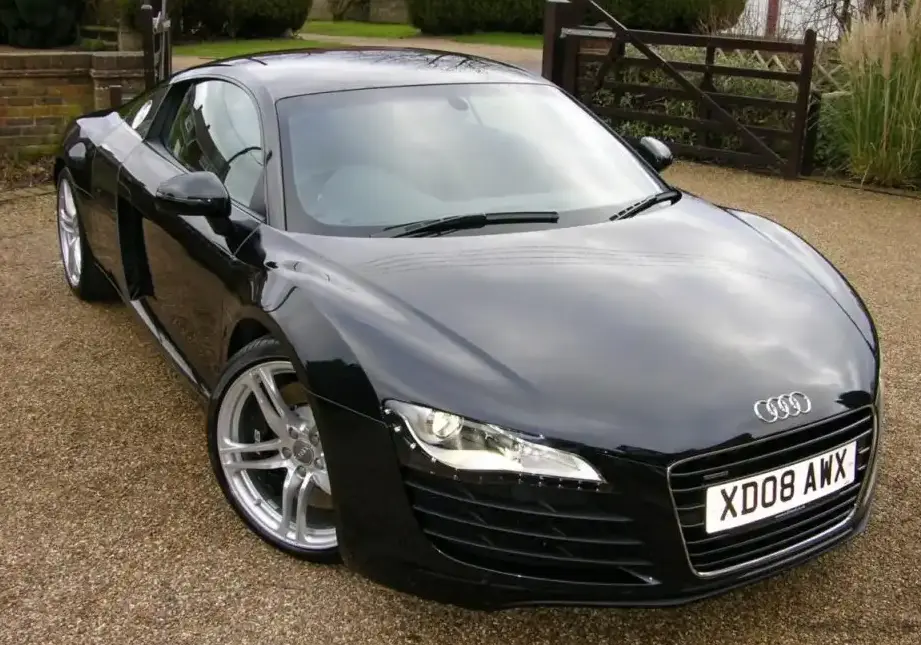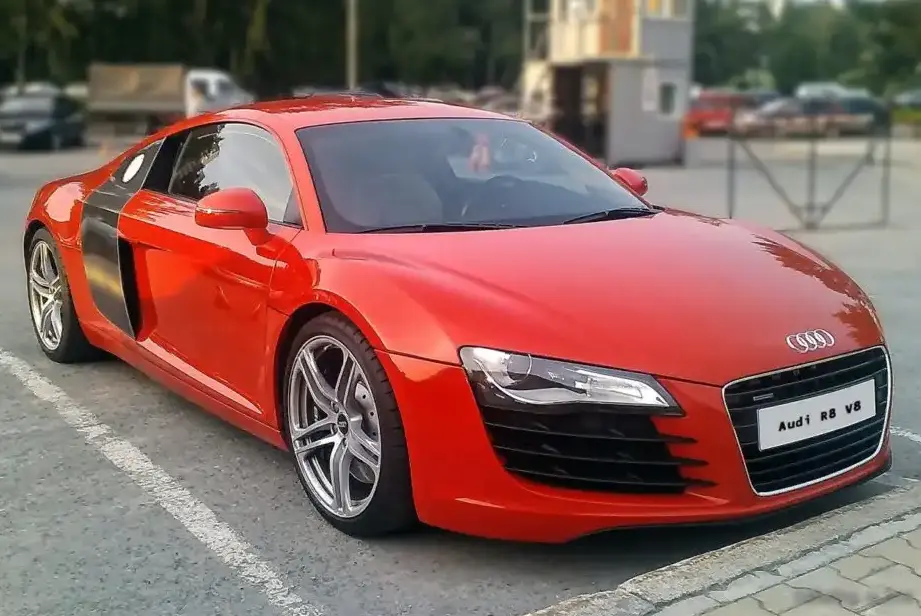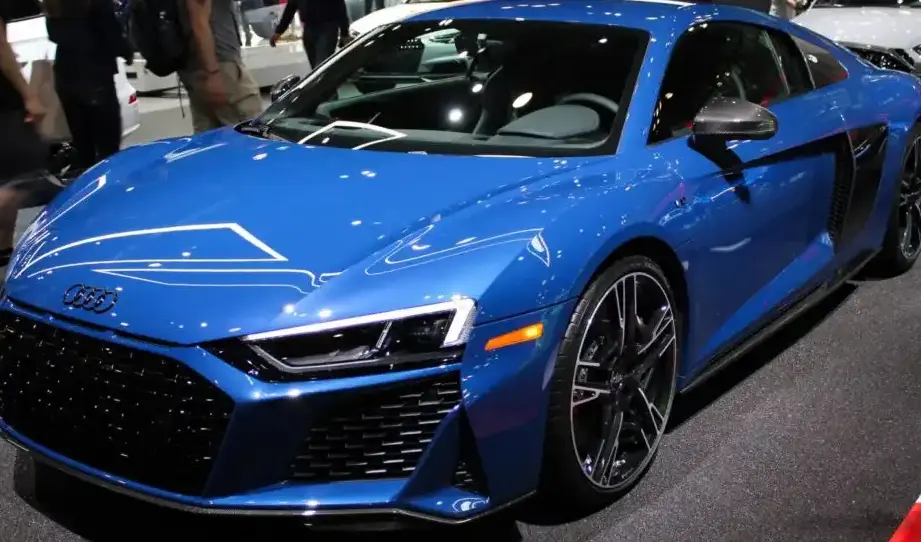
The Audi R8 II Coupe (4S), particularly the facelifted version introduced in 2019, represents the pinnacle of Audi’s high-performance offerings. Specifically, the Performance 5.2 FSI V10 quattro S tronic variant, produced from February 2019 to October 2023, is a significant iteration of the R8 lineage. This model sits at the top of the R8 range, offering the most potent engine and advanced transmission technology available. It builds upon the foundation of the 4S platform (shared with the Lamborghini Huracán) and refines the driving experience with increased power, improved aerodynamics, and enhanced interior appointments. The R8 II aimed to compete directly with other high-end supercars like the Porsche 911 Turbo and McLaren 570S, offering a blend of performance, luxury, and everyday usability.
Technical Specifications
| Brand | Audi |
| Model | R8 |
| Generation | R8 II Coupe (4S, facelift 2019) |
| Type (Engine) | Performance 5.2 FSI V10 (620 Hp) quattro S tronic |
| Start of production | February, 2019 |
| End of production | October, 2023 |
| Powertrain Architecture | Internal Combustion engine |
| Body type | Coupe |
| Seats | 2 |
| Doors | 2 |
| Fuel consumption at Low speed (WLTP) | 23.4-23.9 l/100 km (10.1 – 9.8 US mpg, 12.1 – 11.8 UK mpg, 4.3 – 4.2 km/l) |
| Fuel consumption at Medium speed (WLTP) | 12.9-13.3 l/100 km (18.2 – 17.7 US mpg, 21.9 – 21.2 UK mpg, 7.8 – 7.5 km/l) |
| Fuel consumption at high speed (WLTP) | 10.9-11 l/100 km (21.6 – 21.4 US mpg, 25.9 – 25.7 UK mpg, 9.2 – 9.1 km/l) |
| Fuel consumption at very high speed (WLTP) | 10.7 l/100 km (22 US mpg, 26.4 UK mpg, 9.3 km/l) |
| Combined fuel consumption (WLTP) | 12.9-13.3 l/100 km (18.2 – 17.7 US mpg, 21.9 – 21.2 UK mpg, 7.8 – 7.5 km/l) |
| CO2 emissions (WLTP) | 293-302 g/km |
| Fuel consumption (economy) – urban | 19.8-20 l/100 km (11.9 – 11.8 US mpg, 14.3 – 14.1 UK mpg, 5.1 – 5 km/l) |
| Fuel consumption (economy) – extra urban | 9-9.1 l/100 km (26.1 – 25.8 US mpg, 31.4 – 31 UK mpg, 11.1 – 11 km/l) |
| Fuel consumption (economy) – combined | 13-13.1 l/100 km (18.1 – 18 US mpg, 21.7 – 21.6 UK mpg, 7.7 – 7.6 km/l) |
| CO2 emissions | 297-299 g/km |
| Fuel Type | Petrol (Gasoline) |
| Acceleration 0 – 100 km/h | 3.1 sec |
| Acceleration 0 – 62 mph | 3.1 sec |
| Acceleration 0 – 60 mph | 2.9 sec |
| Maximum speed | 331 km/h (205.67 mph) |
| Emission standard | Euro 6d-ISC-FCM |
| Weight-to-power ratio | 2.6 kg/Hp, 388.7 Hp/tonne |
| Weight-to-torque ratio | 2.8 kg/Nm, 363.6 Nm/tonne |
| Power | 620 Hp @ 8000 rpm |
| Power per litre | 119.1 Hp/l |
| Torque | 580 Nm @ 6600 rpm (427.79 lb.-ft. @ 6600 rpm) |
| Engine layout | Middle, Longitudinal |
| Engine Model/Code | DMWA |
| Engine displacement | 5204 cm3 (317.57 cu. in.) |
| Number of cylinders | 10 |
| Engine configuration | V-engine |
| Cylinder Bore | 84.5 mm (3.33 in.) |
| Piston Stroke | 92.8 mm (3.65 in.) |
| Compression ratio | 12.7:1 |
| Number of valves per cylinder | 4 |
| Fuel injection system | Direct injection and Multi-port manifold injection |
| Engine aspiration | Naturally aspirated engine |
| Valvetrain | DOHC |
| Engine oil capacity | 8.3 l (8.77 US qt | 7.3 UK qt) |
| Coolant | 24.7 l (26.1 US qt | 21.73 UK qt) |
| Kerb Weight | 1595 kg (3516.37 lbs.) |
| Max. weight | 1915 kg (4221.85 lbs.) |
| Max load | 320 kg (705.48 lbs.) |
| Trunk (boot) space – minimum | 112 l (3.96 cu. ft.) |
| Fuel tank capacity | 73 l (19.28 US gal | 16.06 UK gal) |
| Length | 4429 mm (174.37 in.) |
| Width | 1940 mm (76.38 in.) |
| Width including mirrors | 2037 mm (80.2 in.) |
| Height | 1236 mm (48.66 in.) |
| Wheelbase | 2650 mm (104.33 in.) |
| Front track | 1645 mm (64.76 in.) |
| Rear (Back) track | 1599 mm (62.95 in.) |
| Front overhang | 993 mm (39.09 in.) |
| Rear overhang | 786 mm (30.94 in.) |
| Drag coefficient (Cd) | 0.35 |
| Minimum turning circle (turning diameter) | 11.2 m (36.75 ft.) |
| Drivetrain Architecture | The Internal combustion engine (ICE) drives the rear wheels permanently, and the front wheels are driven through an electrically or mechanically operated clutch if necessary. |
| Drive wheel | All wheel drive (4×4) |
| Number of gears and type of gearbox | 7 gears, automatic transmission S tronic |
| Front suspension | Coil spring, Double wishbone, Transverse stabilizer |
| Rear suspension | Double wishbone, Transverse stabilizer, Coil spring |
| Front brakes | Ventilated discs, 380 mm |
| Rear brakes | Ventilated discs, 356 mm |
| Assisting systems | ABS (Anti-lock braking system) |
| Steering type | Steering rack and pinion |
| Power steering | Electric Steering |
| Tires size | Front wheel tires: 245/35 R19; 245/30 R20Rear wheel tires: 295/35 R19; 305/30 R20 |
| Wheel rims size | Front wheel rims: 8.5J x 19; 8.5J x 20Rear wheel rims: 11J x 19; 11J x 20 |
Powertrain & Engine Architecture
The heart of the R8 Performance is the DMWA 5.2-liter naturally aspirated V10 engine. This engine is a direct descendant of the unit first introduced in the Lamborghini Gallardo and has been continuously refined over the years. It features a 90-degree V-angle, dry-sump lubrication, and a dual-clutch direct injection system. The engine produces 620 horsepower at 8,000 rpm and 427.79 lb-ft of torque at 6,600 rpm. The high compression ratio of 12.7:1 contributes to its responsiveness. The engine utilizes a double overhead camshaft (DOHC) valvetrain with four valves per cylinder. The exhaust system is meticulously tuned to enhance both performance and the characteristic V10 sound. Paired with the engine is a 7-speed S tronic dual-clutch transmission. This transmission offers incredibly fast and precise shifts, contributing significantly to the car’s acceleration. The quattro all-wheel-drive system distributes power between the front and rear axles, providing exceptional traction and stability.
Driving Characteristics
The 620-hp R8 Performance delivers breathtaking acceleration. The 0-60 mph sprint is achieved in approximately 2.9 seconds, and it reaches a top speed of 205.67 mph. The S tronic transmission’s quick shifts and the quattro system’s intelligent power distribution ensure minimal wheelspin and maximum grip. Compared to earlier R8 models or those with the standard V10, the Performance variant feels significantly more urgent and responsive. The gear ratios are optimized for acceleration, providing strong pull throughout the rev range. While the engine is naturally aspirated, it doesn’t suffer from significant turbo lag, offering a linear and predictable power delivery. The steering is precise and well-weighted, providing excellent feedback to the driver. The suspension is firm but compliant, offering a good balance between performance and comfort.
Equipment & Trim Levels
The R8 Performance came standard with a comprehensive list of features, including a leather interior, heated and ventilated sport seats, a Bang & Olufsen sound system, and a virtual cockpit digital instrument cluster. Carbon fiber interior trim was standard, emphasizing the car’s performance focus. Optional extras included a carbon fiber engine bay, various exterior styling packages, and upgraded brake systems. The infotainment system featured navigation, Bluetooth connectivity, and Apple CarPlay/Android Auto integration. The interior design was driver-focused, with all controls positioned for easy access during spirited driving.
Chassis & Braking
The R8 II utilizes a lightweight aluminum space frame chassis, providing a rigid and strong foundation for the vehicle. The suspension features double wishbones at all four corners, with coil springs and transverse stabilizers. The braking system consists of ventilated discs with high-performance calipers. The front brakes measure 380 mm, while the rear brakes are 356 mm. ABS (Anti-lock braking system) is standard. The chassis is tuned to provide a balance between handling precision and ride comfort. The car’s relatively low weight (1595 kg / 3516.37 lbs) contributes to its agility and responsiveness.
Market Reception & Comparison
The Audi R8 II Performance 5.2 FSI V10 quattro S tronic was widely praised by automotive critics for its exceptional performance, handling, and overall driving experience. It was often compared favorably to rivals such as the Porsche 911 Turbo and McLaren 570S. While the R8’s fuel economy (12.9-13.3 l/100 km) was not a strong point, it was considered acceptable for a supercar of its caliber. Reliability was generally good, although maintenance costs were relatively high due to the complexity of the engine and drivetrain. Compared to the standard R8 V10, the Performance variant offered a significant step up in performance and exclusivity, justifying its higher price tag.
Legacy
The R8 II Performance represents a high point in Audi’s supercar development. The DMWA V10 engine is considered a masterpiece of naturally aspirated engine design. While production has ended, the R8 II Performance remains a highly sought-after vehicle in the used car market. Its combination of performance, luxury, and relative usability makes it an appealing option for enthusiasts. The powertrain, while complex, has proven to be reasonably reliable with proper maintenance. The R8 II Performance has cemented its place as a modern classic, representing a golden era of high-performance automobiles.