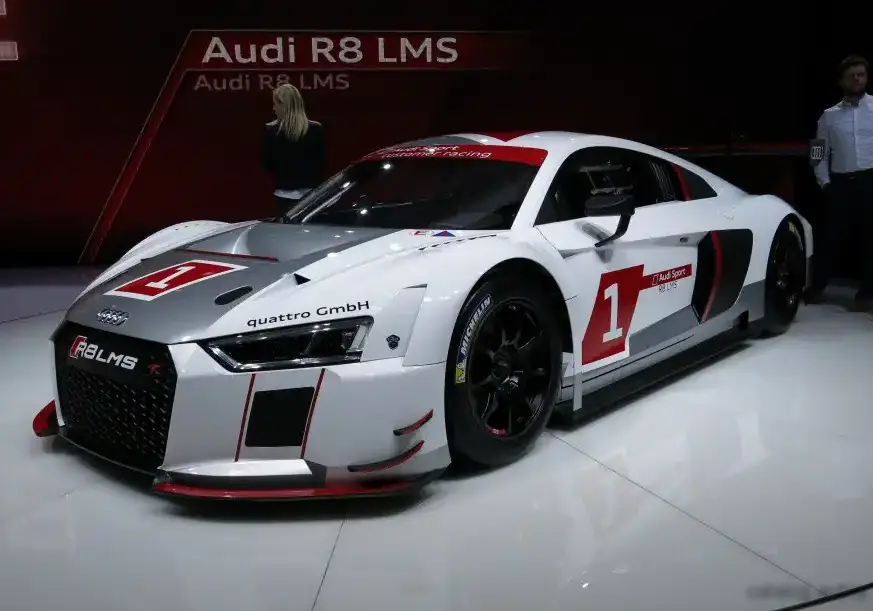
The Audi R8 II LMS 5.2 FSI V10, produced between 2015 and 2018, represents a significant evolution in Audi’s motorsport heritage. This variant is a dedicated racing car, built to comply with GT3 regulations, and is not a road-legal vehicle. It’s based on the second generation (R8 II) of the R8, designated internally as the 4S platform, and served as Audi’s primary weapon in various GT racing series worldwide. Unlike the road-going R8, the LMS variant is stripped of all non-essential components and heavily modified for optimal track performance. It’s a purpose-built machine designed for professional racing teams and drivers.
Technical Specifications
| Brand | Audi |
| Model | R8 |
| Generation | R8 II LMS |
| Type (Engine) | 5.2 FSI V10 (585 Hp) |
| Start of production | 2015 |
| End of production | 2018 |
| Powertrain Architecture | Internal Combustion engine |
| Body type | Coupe |
| Seats | 2 |
| Doors | 2 |
| Fuel Type | Petrol (Gasoline) |
| Weight-to-power ratio | 2.1 kg/Hp, 477.6 Hp/tonne |
| Weight-to-torque ratio | 2.2 kg/Nm, 449 Nm/tonne |
| Power | 585 Hp |
| Power per litre | 112.4 Hp/l |
| Torque | 550 Nm / 405.66 lb.-ft. |
| Engine layout | Middle, Longitudinal |
| Engine displacement | 5204 cm3 / 317.57 cu. in. |
| Number of cylinders | 10 |
| Engine configuration | V-engine |
| Cylinder Bore | 84.5 mm / 3.33 in. |
| Piston Stroke | 92.8 mm / 3.65 in. |
| Number of valves per cylinder | 4 |
| Fuel injection system | Direct injection and Multi-port manifold injection |
| Engine aspiration | Naturally aspirated engine |
| Valvetrain | DOHC |
| Engine oil capacity | 8.5 l / 8.98 US qt | 7.48 UK qt |
| Coolant | 13.5 l / 14.27 US qt | 11.88 UK qt |
| Kerb Weight | 1225 kg / 2700.66 lbs. |
| Fuel tank capacity | 120 l / 31.7 US gal | 26.4 UK gal |
| Length | 4583 mm / 180.43 in. |
| Width | 1997 mm / 78.62 in. |
| Height | 1171 mm / 46.1 in. |
| Wheelbase | 2700 mm / 106.3 in. |
| Front track | 1667 mm / 65.63 in. |
| Rear (Back) track | 1670 mm / 65.75 in. |
| Drivetrain Architecture | The Internal combustion engine (ICE) drives the rear wheels of the vehicle. |
| Drive wheel | Rear wheel drive |
| Number of gears and type of gearbox | 6 gears, manual transmission |
| Front suspension | Coil spring, Double wishbone, Transverse stabilizer |
| Rear suspension | Double wishbone, Transverse stabilizer, Coil spring |
| Front brakes | Ventilated discs |
| Rear brakes | Ventilated discs |
| Assisting systems | ABS (Anti-lock braking system) |
| Steering type | Steering rack and pinion |
| Power steering | Electric Steering |
| Wheel rims size | Front wheel rims: 12.5J x 18Rear wheel rims: 13J x 18 |
Powertrain & Engine Architecture
At the heart of the R8 II LMS lies Audi’s naturally aspirated 5.2-liter V10 engine, designated as the CFG engine code. This engine is a direct descendant of the powerplant found in the road-going R8, but extensively modified for racing. Key changes include a revised crankshaft, connecting rods, and pistons to enhance durability and responsiveness. The engine utilizes a direct fuel injection system combined with multi-port manifold injection, optimizing both power delivery and fuel efficiency under racing conditions. The DOHC valvetrain, with four valves per cylinder, ensures optimal gas flow. The engine produces 585 horsepower and 550 Nm (405.66 lb-ft) of torque. The engine is mounted longitudinally in a mid-engine configuration, contributing to the car’s balanced handling. The R8 II LMS utilizes a 6-speed sequential manual gearbox, operated via steering wheel-mounted paddles, allowing for rapid gear changes without interrupting power delivery.
Driving Characteristics
The R8 II LMS delivers a raw and visceral driving experience, prioritizing performance over comfort. The sequential gearbox, combined with the high-revving V10 engine, allows for incredibly quick acceleration and precise control. The car’s weight distribution, optimized by the mid-engine layout, contributes to exceptional balance and cornering ability. Compared to a road-going R8, the LMS variant has significantly reduced weight and a much stiffer suspension setup, resulting in a more direct and responsive feel. While the road car offers a range of driving modes, the LMS is focused solely on maximizing performance on the track. The absence of sound deadening and other comfort features further enhances the driver’s connection to the car and the track.
Equipment & Trim Levels
As a dedicated racing car, the R8 II LMS has minimal interior appointments. The cockpit is spartan, featuring a roll cage, racing seat with a six-point harness, and a fully adjustable steering wheel. The dashboard is dominated by a digital display providing essential information such as speed, lap times, and engine parameters. Air conditioning and other comfort features are typically omitted to save weight. The car is equipped with a fire suppression system and other safety features required by racing regulations. Customization options are available to teams, including different seat configurations, steering wheel designs, and data logging systems.
Chassis & Braking
The R8 II LMS utilizes a lightweight steel space frame chassis, providing a rigid and safe platform for racing. The suspension system consists of fully adjustable coil springs, double wishbones, and transverse stabilizers at both the front and rear. This allows teams to fine-tune the car’s handling characteristics to suit different track conditions. The braking system features ventilated discs on all four wheels, coupled with an ABS system optimized for track use. The braking bias can be adjusted to further refine the car’s handling balance. The car rides on 18-inch wheels, with wider tires at the rear to maximize traction.
Market Reception & Comparison
The Audi R8 II LMS was widely praised by racing teams and drivers for its performance, reliability, and drivability. It quickly became a competitive force in GT3 racing, achieving numerous victories in championships around the world. Compared to other GT3 cars, the R8 II LMS was noted for its balanced handling, powerful engine, and relatively easy-to-drive nature. While some competitors offered more outright speed, the R8 LMS was often favored for its consistency and durability. Its reliability proved to be a significant advantage in endurance races.
Legacy
The Audi R8 II LMS represents a high point in Audi’s GT racing program. It established the R8 as a formidable competitor in the GT3 category and helped to solidify Audi’s reputation as a leading manufacturer of racing cars. The knowledge and technology gained from the development of the R8 II LMS have been incorporated into future Audi racing programs and even influenced the design of road-going Audi models. Today, the R8 II LMS remains a popular choice among privateer racing teams and collectors, and continues to be a competitive force in GT3 racing events worldwide. Its robust powertrain and relatively simple mechanical design contribute to its continued reliability and maintainability.