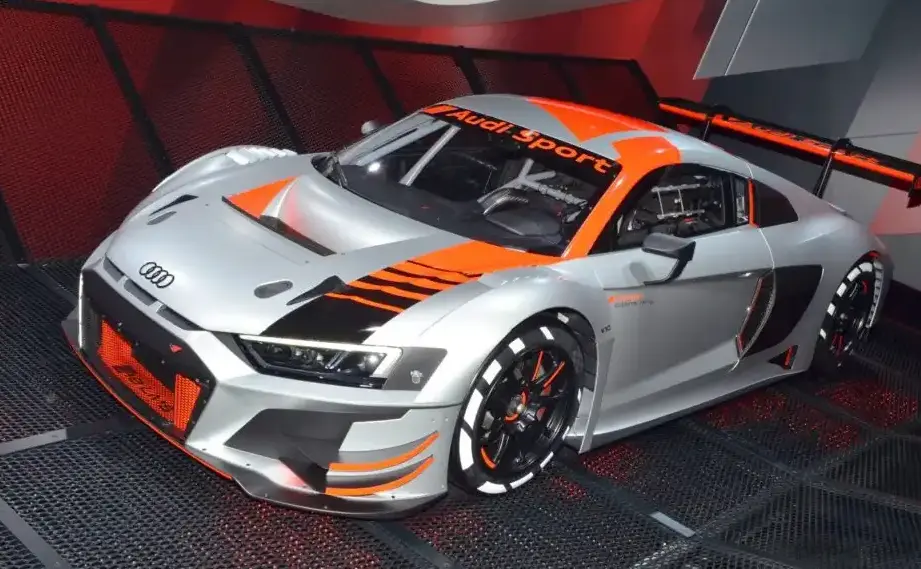
The Audi R8 II LMS (facelift 2019) GT3 5.2 V10 (585 Hp) represents a significant evolution in Audi’s motorsport heritage. Introduced in 2019 and continuing through the 2022 model year, this vehicle is a dedicated racing car built to comply with GT3 regulations, designed for competition in global endurance and sprint racing series. It builds upon the foundation of the first-generation R8 LMS, incorporating extensive aerodynamic refinements, engine upgrades, and chassis improvements based on feedback from customer racing teams. The facelift brought substantial changes to enhance performance, reliability, and driver experience, solidifying the R8 LMS GT3’s position as a front-running contender in the highly competitive GT3 landscape.
Technical Specifications
| Brand | Audi |
| Model | R8 |
| Generation | R8 II LMS (facelift 2019) |
| Type (Engine) | GT3 5.2 V10 (585 Hp) |
| Start of production | 2019 |
| End of production | 2022 |
| Powertrain Architecture | Internal Combustion engine |
| Body type | Coupe |
| Seats | 2 |
| Doors | 2 |
| Fuel Type | Petrol (Gasoline) |
| Weight-to-power ratio | 2.1 kg/Hp, 477.6 Hp/tonne |
| Weight-to-torque ratio | 2.2 kg/Nm, 449 Nm/tonne |
| Power | 585 Hp |
| Power per litre | 112.5 Hp/l |
| Torque | 550 Nm / 405.66 lb.-ft. |
| Engine layout | Middle, Longitudinal |
| Engine displacement | 5200 cm3 / 317.32 cu. in. |
| Number of cylinders | 10 |
| Engine configuration | V-engine |
| Number of valves per cylinder | 4 |
| Fuel injection system | Direct injection and Multi-port manifold injection |
| Engine aspiration | Naturally aspirated engine |
| Valvetrain | DOHC |
| Kerb Weight | 1225 kg / 2700.66 lbs. |
| Fuel tank capacity | 120 l / 31.7 US gal | 26.4 UK gal |
| Length | 4573 mm / 180.04 in. |
| Width | 1997 mm / 78.62 in. |
| Height | 1171 mm / 46.1 in. |
| Drivetrain Architecture | The Internal combustion engine (ICE) drives the rear wheels of the vehicle. |
| Drive wheel | Rear wheel drive |
| Number of gears and type of gearbox | 6 gears, manual transmission |
| Front suspension | Coil spring, Double wishbone, Transverse stabilizer |
| Rear suspension | Double wishbone, Transverse stabilizer, Coil spring |
| Front brakes | Ventilated discs, 380×34 mm |
| Rear brakes | Ventilated discs, 355×32 mm |
| Assisting systems | ABS (Anti-lock braking system) |
| Steering type | Steering rack and pinion |
| Power steering | Electric Steering |
| Tires size | Front wheel tires: 300/35 R18Rear wheel tires: 310/40 R18 |
| Wheel rims size | Front wheel rims: 12.5J x 18Rear wheel rims: 13J x 18 |
Powertrain & Engine Architecture
At the heart of the R8 LMS GT3 lies a naturally aspirated 5.2-liter V10 engine, designated as the CFG engine. This engine is a highly modified version of the production R8’s V10, optimized for racing conditions. Key changes include a revised crankshaft, connecting rods, and pistons to enhance durability and responsiveness. The engine utilizes both direct injection and multi-port manifold injection, a system designed to maximize power output and fuel efficiency across the rev range. The DOHC valvetrain, with four valves per cylinder, ensures optimal gas flow. The engine produces 585 horsepower and 550 Nm (405.66 lb-ft) of torque. The engine is longitudinally mounted in a mid-engine configuration, contributing to the car’s balanced handling characteristics. A six-speed sequential manual gearbox, operated via steering wheel-mounted paddles, delivers power to the rear wheels. This gearbox is specifically designed for rapid gear changes, crucial in racing environments.
Driving Characteristics
The R8 LMS GT3 delivers a driving experience focused on precision and control. The combination of the high-revving V10 engine and the sequential gearbox provides immediate throttle response and quick gearshifts. The car’s weight distribution, optimized by the mid-engine layout, contributes to neutral handling and predictable cornering behavior. Compared to a road-going R8, the LMS GT3 features significantly stiffer suspension and more aggressive aerodynamics, resulting in a much firmer ride and increased downforce. The manual gearbox, while demanding, offers the driver complete control over power delivery. The gear ratios are carefully selected to maximize acceleration on short circuits and maintain high speeds on longer tracks. The car’s braking performance is exceptional, thanks to the large ventilated disc brakes and the sophisticated ABS system.
Equipment & Trim Levels
As a dedicated racing car, the Audi R8 LMS GT3 is not offered with traditional trim levels. However, it is highly customizable to meet the specific needs of racing teams. Standard equipment includes a full roll cage, racing seats with six-point harnesses, a fire suppression system, and a data acquisition system. Teams can specify various options, including different aerodynamic packages, suspension setups, and brake components. The interior is spartan and functional, prioritizing driver safety and performance. The steering wheel is a multi-functional unit, providing access to various car settings and data displays.
Chassis & Braking
The chassis of the R8 LMS GT3 is a steel space frame, providing a rigid and lightweight platform. The suspension system features fully adjustable coil springs, double wishbones, and transverse stabilizers at both the front and rear. This allows teams to fine-tune the car’s handling characteristics to suit different track conditions. The braking system consists of ventilated discs with multi-piston calipers. The front brakes measure 380×34 mm, while the rear brakes are 355×32 mm. An advanced ABS system helps to prevent wheel lockup during hard braking. The car rides on 18-inch wheels, with wider tires at the rear to maximize traction.
Market Reception & Comparison
The Audi R8 LMS GT3 has been widely praised by racing teams and drivers for its performance, reliability, and drivability. It has achieved numerous victories in major GT3 championships around the world, including the GT World Challenge Europe, the IMSA WeatherTech SportsCar Championship, and the Nürburgring 24 Hours. Compared to its rivals, such as the Porsche 911 GT3 R and the Mercedes-AMG GT3, the R8 LMS GT3 is often lauded for its balanced handling and user-friendly nature. While some competitors may offer slightly higher peak power, the R8 LMS GT3’s consistent performance and durability have made it a favorite among professional and amateur racers alike.
Legacy
The Audi R8 LMS GT3 has established itself as a dominant force in GT3 racing. Its success has cemented Audi’s reputation as a leading manufacturer of racing cars. The 2019 facelift further enhanced the car’s competitiveness, ensuring its continued relevance in the years to come. On the used car market, well-maintained R8 LMS GT3s remain highly sought after by racing teams and collectors. The car’s robust construction and readily available spare parts contribute to its long-term reliability and value. The R8 LMS GT3 represents a significant chapter in Audi’s motorsport history, and its legacy will continue to be felt for years to come.