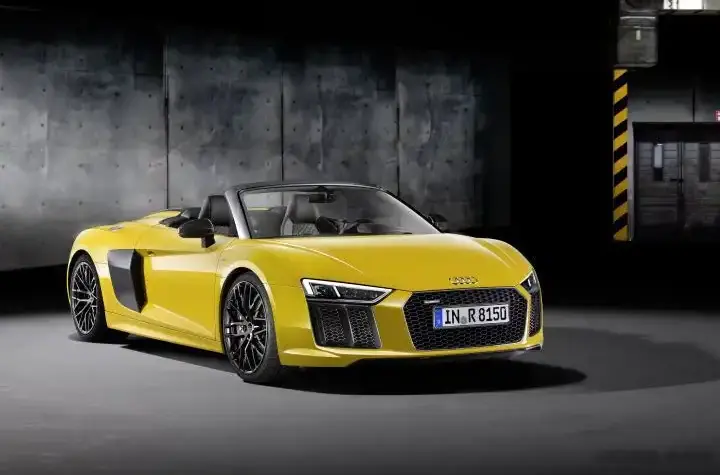
The Audi R8 II Spyder (4S) 5.2 FSI V10 plus quattro S tronic represents the pinnacle of open-top performance within the second generation R8 lineup, produced from 2017 to 2018. Positioned as the highest-performance variant of the Spyder, it builds upon the foundation of the 4S platform (shared with the Lamborghini Huracán) offering a thrilling driving experience combined with luxurious appointments. This model aimed to deliver the visceral excitement of a naturally aspirated V10 engine with the added convenience of a dual-clutch transmission and all-wheel drive, catering to drivers seeking uncompromising performance in a convertible package.
Technical Specifications
| Brand | Audi |
| Model | R8 |
| Generation | R8 II Spyder (4S) |
| Type (Engine) | 5.2 FSI V10 plus (610 Hp) quattro S tronic |
| Start of production | 2017 |
| End of production | 2018 |
| Powertrain Architecture | Internal Combustion engine |
| Body type | Cabriolet |
| Seats | 2 |
| Doors | 2 |
| Fuel consumption (economy) – urban | 17.8 l/100 km (13.2 US mpg, 15.9 UK mpg, 5.6 km/l) |
| Fuel consumption (economy) – extra urban | 9.5 l/100 km (24.8 US mpg, 29.7 UK mpg, 10.5 km/l) |
| Fuel consumption (economy) – combined | 12.5 l/100 km (18.8 US mpg, 22.6 UK mpg, 8 km/l) |
| CO2 emissions | 292 g/km |
| Fuel Type | Petrol (Gasoline) |
| Acceleration 0 – 100 km/h | 3.3 sec |
| Acceleration 0 – 62 mph | 3.3 sec |
| Acceleration 0 – 60 mph | 3.1 sec |
| Maximum speed | 328 km/h (203.81 mph) |
| Emission standard | Euro 6 |
| Weight-to-power ratio | 2.8 kg/Hp, 359.9 Hp/tonne |
| Weight-to-torque ratio | 3 kg/Nm, 330.4 Nm/tonne |
| Power | 610 Hp @ 8250 rpm |
| Power per litre | 117.2 Hp/l |
| Torque | 560 Nm @ 6500 rpm (413.03 lb.-ft. @ 6500 rpm) |
| Engine layout | Middle, Longitudinal |
| Engine Model/Code | CSPA |
| Engine displacement | 5204 cm3 (317.57 cu. in.) |
| Number of cylinders | 10 |
| Engine configuration | V-engine |
| Cylinder Bore | 84.5 mm (3.33 in.) |
| Piston Stroke | 92.8 mm (3.65 in.) |
| Compression ratio | 12.5:1 |
| Number of valves per cylinder | 4 |
| Fuel injection system | Direct injection and Multi-port manifold injection |
| Engine aspiration | Naturally aspirated engine |
| Valvetrain | DOHC |
| Engine oil capacity | 8.3 l (8.77 US qt | 7.3 UK qt) |
| Coolant | 24.7 l (26.1 US qt | 21.73 UK qt) |
| Kerb Weight | 1695 kg (3736.84 lbs.) |
| Max. weight | 2035 kg (4486.41 lbs.) |
| Max load | 340 kg (749.57 lbs.) |
| Trunk (boot) space – minimum | 112 l (3.96 cu. ft.) |
| Fuel tank capacity | 80 l (21.13 US gal | 17.6 UK gal) |
| Length | 4426 mm (174.25 in.) |
| Width | 1940 mm (76.38 in.) |
| Width including mirrors | 2037 mm (80.2 in.) |
| Height | 1244 mm (48.98 in.) |
| Wheelbase | 2650 mm (104.33 in.) |
| Front track | 1638 mm (64.49 in.) |
| Rear (Back) track | 1599 mm (62.95 in.) |
| Front overhang | 994 mm (39.13 in.) |
| Rear overhang | 782 mm (30.79 in.) |
| Drag coefficient (Cd) | 0.365 |
| Minimum turning circle (turning diameter) | 11.2 m (36.75 ft.) |
| Drivetrain Architecture | All wheel drive (4×4). ICE drives rear wheels, front wheels engaged via clutch. |
| Drive wheel | All wheel drive (4×4) |
| Number of gears and type of gearbox | 7 gears, automatic transmission S tronic |
| Front suspension | Coil spring, Double wishbone, Transverse stabilizer |
| Rear suspension | Double wishbone, Transverse stabilizer, Coil spring |
| Front brakes | Ventilated discs, 380×38 mm |
| Rear brakes | Ventilated discs, 356×32 mm |
| Assisting systems | ABS (Anti-lock braking system) |
| Steering type | Steering rack and pinion |
| Power steering | Electric Steering |
| Tires size | Front: 245/35 R19 or 245/30 R20; Rear: 295/35 R19 or 305/30 R20 |
| Wheel rims size | Front: 8.5J x 19 or 8.5J x 20; Rear: 11J x 19 or 11J x 20 |
INTRODUCTION
The Audi R8 II Spyder (4S) 5.2 FSI V10 plus quattro S tronic, produced between 2017 and 2018, represents the high-water mark of the second-generation R8 Spyder. Built on the robust 4S platform, also underpinning the Lamborghini Huracán, this model combined the thrill of a naturally aspirated V10 engine with the convenience of a seven-speed S tronic dual-clutch transmission and Audi’s quattro all-wheel-drive system. It was positioned as the ultimate expression of performance within the Spyder range, offering a more focused and powerful experience than the standard V10 models. The “plus” designation signified increased power output and a more aggressive aesthetic, solidifying its status as a true supercar.
Powertrain & Engine Architecture
At the heart of the R8 Spyder 5.2 FSI plus lies the CSPA engine, a 5.2-liter naturally aspirated V10. This engine boasts a dry-sump lubrication system, crucial for maintaining oil supply during high-G maneuvers. It produces 610 horsepower at 8,250 rpm and 413 lb-ft of torque at 6,500 rpm. The engine utilizes both direct injection and multi-port manifold injection, optimizing combustion efficiency and power delivery. The valvetrain employs double overhead camshafts (DOHC) with four valves per cylinder. The S tronic seven-speed dual-clutch transmission provides incredibly fast and precise gear changes, contributing to the car’s blistering acceleration. The quattro all-wheel-drive system intelligently distributes power between the front and rear axles, maximizing traction and stability. Unlike some all-wheel-drive systems, the R8’s system can vary the front axle engagement, allowing for a more rear-biased feel when desired.
Driving Characteristics
The R8 Spyder 5.2 FSI plus delivers a truly exhilarating driving experience. The naturally aspirated V10 provides a linear and immediate throttle response, lacking the turbo lag found in many modern performance cars. Acceleration is ferocious, with 0-60 mph arriving in just 3.1 seconds and a top speed of 203.81 mph. The S tronic transmission shifts with lightning speed, keeping the engine in its optimal power band. The quattro all-wheel-drive system provides immense grip, inspiring confidence even in challenging conditions. However, the car doesn’t feel sterile; the system allows for a degree of controlled oversteer, making it engaging for experienced drivers. Compared to the standard R8 Spyder V10, the “plus” model offers significantly more power and a more aggressive engine tune, resulting in a noticeably more visceral and performance-focused driving experience. The automatic transmission, while incredibly quick, doesn’t offer the same level of driver engagement as a manual gearbox, which wasn’t available in this specific configuration.
Equipment & Trim Levels
The R8 Spyder 5.2 FSI plus came generously equipped as standard. Interior features included premium leather upholstery, heated and electrically adjustable seats, a navigation system, and a high-end Bang & Olufsen sound system. Carbon fiber interior trim was standard, enhancing the sporty aesthetic. Exterior features included a unique front splitter, side blades, and rear diffuser, all crafted from carbon fiber. Optional extras included a full leather interior package, diamond-stitched upholstery, and various exterior color options. The Spyder’s soft top was fully automatic and could be raised or lowered in seconds, even at speed.
Chassis & Braking
The R8 Spyder 5.2 FSI plus utilizes a lightweight aluminum chassis, contributing to its impressive power-to-weight ratio. The suspension features double wishbones at all four corners, along with coil springs and transverse stabilizers. The braking system consists of ventilated discs with large calipers, providing exceptional stopping power. ABS (Anti-lock Braking System) is standard. The steering is a rack-and-pinion system with electric power assistance, offering precise and responsive control.
Market Reception & Comparison
The R8 Spyder 5.2 FSI plus was widely praised by automotive critics for its stunning performance, engaging driving dynamics, and luxurious interior. It was often compared favorably to rivals such as the Porsche 911 Turbo Cabriolet and the Ferrari 488 Spider. While the R8 offered a more accessible and user-friendly experience, it didn’t quite match the outright track performance of some of its competitors. Fuel economy, unsurprisingly, was poor, with combined figures around 18.8 US mpg. However, this was typical for a supercar of this caliber. Reliability was generally good, although the complex engine and transmission required regular maintenance.
Legacy
The Audi R8 II Spyder 5.2 FSI plus quattro S tronic remains a highly desirable supercar in the used car market. Its combination of performance, luxury, and relative usability has ensured its enduring appeal. The naturally aspirated V10 engine is particularly prized by enthusiasts, as it represents a dying breed in the automotive world. While maintenance costs can be significant, the R8’s robust construction and relatively straightforward design (compared to some modern supercars) mean that it is generally a reliable and rewarding ownership experience. The 4S generation R8, and particularly the “plus” variants, are considered by many to be the peak of Audi’s supercar development, offering a compelling alternative to more established brands.