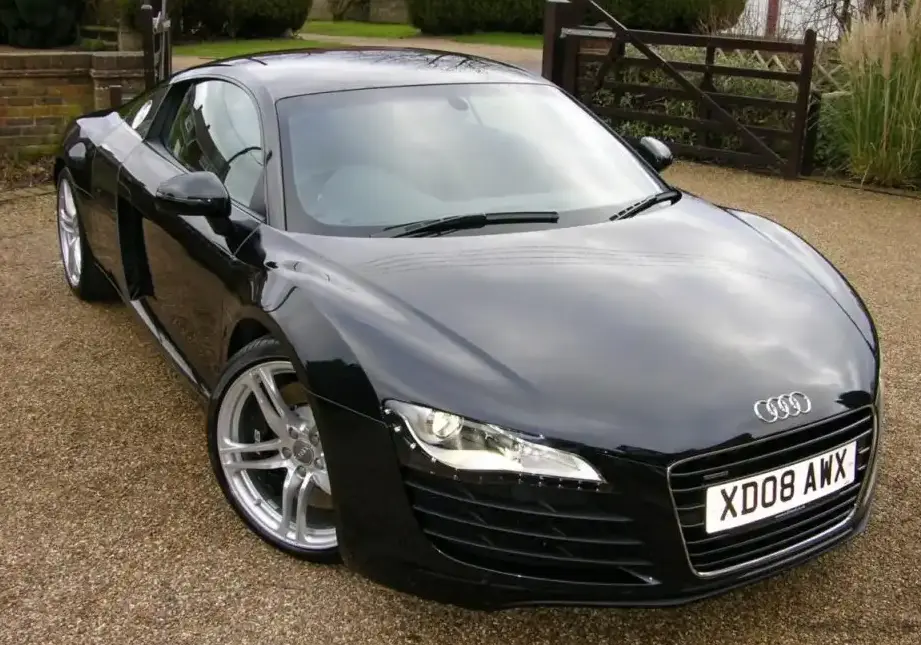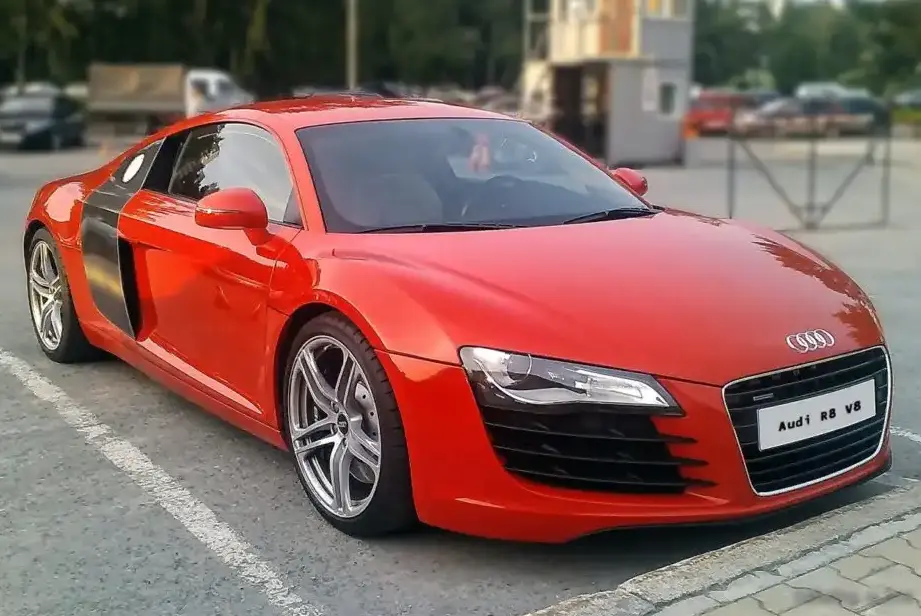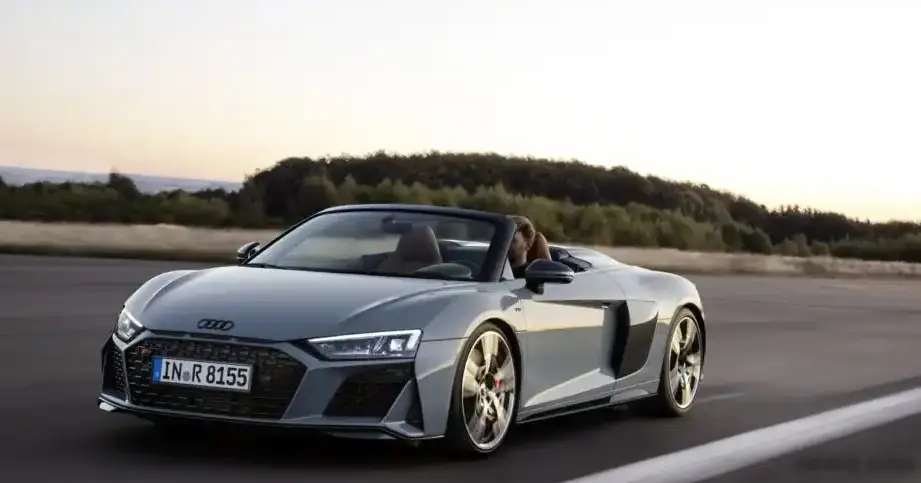
The Audi R8 II Spyder (4S), particularly the facelifted version introduced in 2019, represents the open-top iteration of Audi’s mid-engine sports car. Production of this specific configuration – the 5.2 FSI V10 with 540 horsepower and a seven-speed S tronic dual-clutch transmission driving the rear wheels – ran from January 2020 to July 2021. Positioned as the flagship Spyder variant, it offered a compelling blend of performance, luxury, and open-air driving excitement. The 4S generation, built on an evolution of the aluminum space frame chassis first seen in the original R8, aimed to refine the driving experience and enhance the car’s overall sophistication.
Technical Specifications
| Brand | Audi |
| Model | R8 |
| Generation | R8 II Spyder (4S, facelift 2019) |
| Type | 5.2 FSI V10 (540 Hp) RWD S tronic |
| Start of production | January, 2020 |
| End of production | July, 2021 |
| Powertrain Architecture | Internal Combustion engine |
| Body type | Cabriolet |
| Seats | 2 |
| Doors | 2 |
| Fuel consumption at Low speed (WLTP) | 24.2 l/100 km (9.7 US mpg, 11.7 UK mpg, 4.1 km/l) |
| Fuel consumption at Medium speed (WLTP) | 13.7 l/100 km (17.2 US mpg, 20.6 UK mpg, 7.3 km/l) |
| Fuel consumption at high speed (WLTP) | 11.4 l/100 km (20.6 US mpg, 24.8 UK mpg, 8.8 km/l) |
| Fuel consumption at very high speed (WLTP) | 11.3 l/100 km (20.8 US mpg, 25 UK mpg, 8.8 km/l) |
| Combined fuel consumption (WLTP) | 13.5-13.7 l/100 km (17.4 – 17.2 US mpg, 20.9 – 20.6 UK mpg, 7.4 – 7.3 km/l) |
| CO2 emissions (WLTP) | 307-311 g/km |
| Fuel consumption (economy) – urban (NEDC, WLTP equivalent) | 19.5-20.2 l/100 km (12.1 – 11.6 US mpg, 14.5 – 14 UK mpg, 5.1 – 5 km/l) |
| Fuel consumption (economy) – extra urban (NEDC, WLTP equivalent) | 9.1-9.3 l/100 km (25.8 – 25.3 US mpg, 31 – 30.4 UK mpg, 11 – 10.8 km/l) |
| Fuel consumption (economy) – combined (NEDC, WLTP equivalent) | 13.1-13.2 l/100 km (18 – 17.8 US mpg, 21.6 – 21.4 UK mpg, 7.6 – 7.6 km/l) |
| CO2 emissions (NEDC, WLTP equivalent) | 298-303 g/km |
| Fuel Type | Petrol (Gasoline) |
| Acceleration 0 – 100 km/h | 3.8 sec |
| Acceleration 0 – 62 mph | 3.8 sec |
| Acceleration 0 – 60 mph | 3.6 sec |
| Maximum speed | 322 km/h (200.08 mph) |
| Emission standard | Euro 6d-ISC-FCM |
| Weight-to-power ratio | 3.1 kg/Hp, 320.5 Hp/tonne |
| Weight-to-torque ratio | 3.1 kg/Nm, 320.5 Nm/tonne |
| Power | 540 Hp @ 7900 rpm |
| Power per litre | 103.8 Hp/l |
| Torque | 540 Nm @ 6400 rpm (398.28 lb.-ft. @ 6400 rpm) |
| Engine layout | Middle, Longitudinal |
| Engine Model/Code | DKAB |
| Engine displacement | 5204 cm3 (317.57 cu. in.) |
| Number of cylinders | 10 |
| Engine configuration | V-engine |
| Cylinder Bore | 84.5 mm (3.33 in.) |
| Piston Stroke | 92.8 mm (3.65 in.) |
| Number of valves per cylinder | 4 |
| Fuel injection system | Direct injection and Multi-port manifold injection |
| Engine aspiration | Naturally aspirated engine |
| Valvetrain | DOHC |
| Engine oil capacity | 8.3 l (8.77 US qt | 7.3 UK qt) |
| Coolant | 24.7 l (26.1 US qt | 21.73 UK qt) |
| Kerb Weight | 1685 kg (3714.79 lbs.) |
| Max. weight | 1995 kg (4398.22 lbs.) |
| Max load | 310 kg (683.43 lbs.) |
| Trunk (boot) space – minimum | 112 l (3.96 cu. ft.) |
| Fuel tank capacity | 80 l (21.13 US gal | 17.6 UK gal) |
| Length | 4429 mm (174.37 in.) |
| Width | 1940 mm (76.38 in.) |
| Width including mirrors | 2037 mm (80.2 in.) |
| Height | 1242 mm (48.9 in.) |
| Wheelbase | 2650 mm (104.33 in.) |
| Front track | 1645 mm (64.76 in.) |
| Rear (Back) track | 1599 mm (62.95 in.) |
| Front overhang | 993 mm (39.09 in.) |
| Rear overhang | 786 mm (30.94 in.) |
| Minimum turning circle (turning diameter) | 11.2 m (36.75 ft.) |
| Drive wheel | Rear wheel drive |
| Number of gears and type of gearbox | 7 gears, automatic transmission S tronic |
| Front suspension | Coil spring, Double wishbone, Transverse stabilizer |
| Rear suspension | Double wishbone, Transverse stabilizer, Coil spring |
| Front brakes | Ventilated discs, 365 mm |
| Rear brakes | Ventilated discs, 356 mm |
| Front tires | 245/35 R19; 245/30 R20 |
| Rear tires | 295/35 R19; 305/30 R20 |
| Front wheel rims | 8.5J x 19; 8.5J x 20 |
| Rear wheel rims | 11J x 19; 11J x 20 |
Powertrain & Engine Architecture
At the heart of the R8 II Spyder 5.2 FSI lies the naturally aspirated 5.2-liter V10 engine, designated internally as the DKAB. This engine is a direct descendant of the V10 used in the Lamborghini Gallardo and Huracán, benefiting from years of refinement. It features a 90-degree V-angle, dry-sump lubrication, and a high 12.5:1 compression ratio. The engine employs both direct injection and multi-port fuel injection, optimizing combustion efficiency and power delivery. The dual-injection system allows for precise fuel metering across the rev range. The valvetrain utilizes double overhead camshafts (DOHC) with four valves per cylinder, enabling high airflow and contributing to the engine’s impressive 7900 rpm redline. The S tronic seven-speed dual-clutch transmission provides incredibly fast and smooth gear changes, enhancing the driving experience. This transmission features a multi-plate wet clutch and allows for both fully automatic operation and manual gear selection via steering wheel-mounted paddles.
Driving Characteristics
The 540 horsepower and 398 lb-ft of torque, combined with the rear-wheel drive configuration, deliver exhilarating performance. Acceleration from 0 to 60 mph takes just 3.6 seconds, and the car reaches a top speed of 200.08 mph. The S tronic transmission’s quick shifts and well-chosen gear ratios ensure that power is readily available throughout the rev range. While not as brutally fast as some all-wheel-drive variants, the rear-wheel-drive Spyder offers a more engaging and playful driving experience, particularly for experienced drivers. The naturally aspirated engine provides a linear power delivery and a distinctive exhaust note, adding to the overall sensory experience. The Spyder’s open-top configuration further enhances the connection between driver and machine.
Equipment & Trim Levels
The R8 II Spyder 5.2 FSI came standard with a high level of equipment, befitting its flagship status. Interior features included leather upholstery, heated and electrically adjustable seats, a premium Bang & Olufsen sound system, and a navigation system with MMI touch response. Exterior features included LED headlights, a power-operated soft top, and 19-inch alloy wheels. Optional extras included carbon fiber trim, diamond-stitched leather upholstery, and a sport exhaust system. Audi’s virtual cockpit, a fully digital instrument cluster, was also a standard feature, providing customizable displays and real-time performance data.
Chassis & Braking
The R8 II Spyder utilizes an aluminum space frame chassis, providing a lightweight and rigid foundation for the car. The suspension features double wishbones at all four corners, with coil springs and transverse stabilizers. The suspension is tuned to provide a balance between comfort and handling. Braking duties are handled by ventilated discs at all four corners, with six-piston calipers at the front and four-piston calipers at the rear. ABS and electronic stability control are standard features, providing enhanced safety and control.
Market Reception & Comparison
Critics praised the R8 II Spyder 5.2 FSI for its stunning performance, engaging driving dynamics, and luxurious interior. The rear-wheel-drive configuration was particularly well-received by enthusiasts who appreciated its more playful handling characteristics. Compared to the all-wheel-drive R8 Spyder, the RWD version offered a slightly lower price point and a more traditional sports car feel. Fuel economy, however, was a notable drawback, with combined fuel consumption ranging from 17.2 to 17.4 US mpg. Reliability was generally good, although the complex engine and transmission required regular maintenance.
Legacy
The Audi R8 II Spyder 5.2 FSI represents a high point in Audi’s sports car history. Its naturally aspirated V10 engine and engaging driving dynamics have made it a sought-after vehicle among collectors and enthusiasts. While the R8 has been discontinued, the 5.2 FSI engine continues to be celebrated for its performance and sound. On the used car market, well-maintained examples of the R8 II Spyder 5.2 FSI command premium prices, reflecting their desirability and limited production numbers. The powertrain, while requiring diligent maintenance, has proven relatively robust when properly cared for, ensuring its continued enjoyment for years to come.