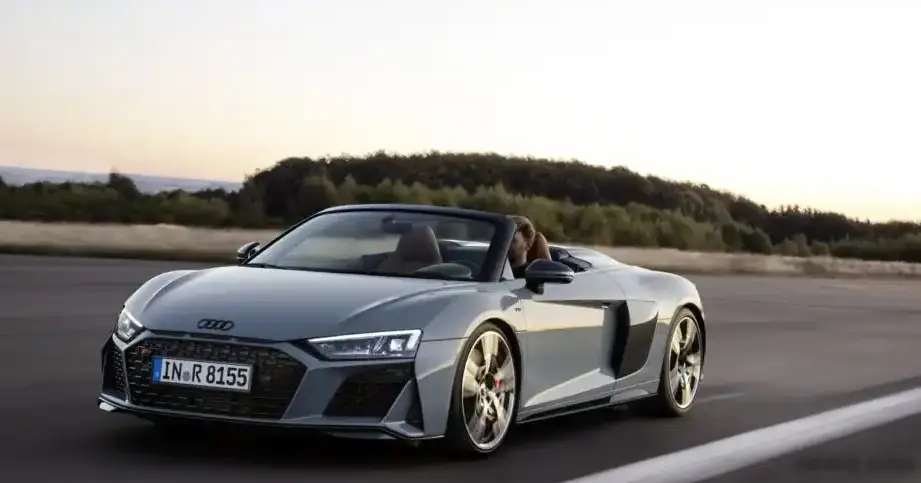
The Audi R8 II Spyder, specifically the 5.2 FSI V10 (570 Hp) quattro S tronic variant produced from February 2019 to July 2021, represents the pinnacle of Audi’s open-top, high-performance sports car lineage. This iteration falls within the second generation (4S) of the R8, benefitting from a mid-cycle facelift that refined both its aesthetics and technology. Positioned as the flagship Spyder model, it offered a compelling blend of exhilarating performance, sophisticated engineering, and luxurious appointments. It builds upon the foundation of the 1HX0/A3 platform, shared with the Lamborghini Huracán, but distinguishes itself through Audi’s unique design language and focus on all-weather capability with its quattro all-wheel-drive system.
Technical Specifications
| Brand | Audi |
| Model | R8 |
| Generation | R8 II Spyder (4S, facelift 2019) |
| Type (Engine) | 5.2 FSI V10 (570 Hp) quattro S tronic |
| Start of production | February, 2019 |
| End of production | July, 2021 |
| Powertrain Architecture | Internal Combustion engine |
| Body type | Cabriolet |
| Seats | 2 |
| Doors | 2 |
| Fuel consumption at Low speed (WLTP) | 23.5-25.1 l/100 km (10 – 9.4 US mpg, 12 – 11.3 UK mpg, 4.3 – 4 km/l) |
| Fuel consumption at Medium speed (WLTP) | 13.6-13.8 l/100 km (17.3 – 17 US mpg, 20.8 – 20.5 UK mpg, 7.4 – 7.2 km/l) |
| Fuel consumption at high speed (WLTP) | 11.3-11.7 l/100 km (20.8 – 20.1 US mpg, 25 – 24.1 UK mpg, 8.8 – 8.5 km/l) |
| Fuel consumption at very high speed (WLTP) | 11-11.3 l/100 km (21.4 – 20.8 US mpg, 25.7 – 25 UK mpg, 9.1 – 8.8 km/l) |
| Combined fuel consumption (WLTP) | 13.2-13.7 l/100 km (17.8 – 17.2 US mpg, 21.4 – 20.6 UK mpg, 7.6 – 7.3 km/l) |
| CO2 emissions (WLTP) | 300-312 g/km |
| Fuel consumption (economy) – urban (NEDC, WLTP equivalent) | 19.6-20 l/100 km (12 – 11.8 US mpg, 14.4 – 14.1 UK mpg, 5.1 – 5 km/l) |
| Fuel consumption (economy) – extra urban (NEDC, WLTP equivalent) | 9.2-9.9 l/100 km (25.6 – 23.8 US mpg, 30.7 – 28.5 UK mpg, 10.9 – 10.1 km/l) |
| Fuel consumption (economy) – combined (NEDC, WLTP equivalent) | 13-13.6 l/100 km (18.1 – 17.3 US mpg, 21.7 – 20.8 UK mpg, 7.7 – 7.4 km/l) |
| CO2 emissions (NEDC, WLTP equivalent) | 297-311 g/km |
| Fuel Type | Petrol (Gasoline) |
| Acceleration 0 – 100 km/h | 3.5 sec |
| Acceleration 0 – 62 mph | 3.5 sec |
| Acceleration 0 – 60 mph | 3.3 sec |
| Maximum speed | 322 km/h (200.08 mph) |
| Emission standard | Euro 6d-ISC-FCM |
| Weight-to-power ratio | 3.1 kg/Hp, 325.7 Hp/tonne |
| Weight-to-torque ratio | 3.1 kg/Nm, 320 Nm/tonne |
| Power | 570 Hp @ 8100 rpm |
| Power per litre | 109.5 Hp/l |
| Torque | 560 Nm @ 6300 rpm (413.03 lb.-ft. @ 6300 rpm) |
| Engine layout | Middle, Longitudinal |
| Engine Model/Code | DKAC |
| Engine displacement | 5204 cm3 (317.57 cu. in.) |
| Number of cylinders | 10 |
| Engine configuration | V-engine |
| Cylinder Bore | 84.5 mm (3.33 in.) |
| Piston Stroke | 92.8 mm (3.65 in.) |
| Compression ratio | 12.7:1 |
| Number of valves per cylinder | 4 |
| Fuel injection system | Direct injection and Multi-port manifold injection |
| Engine aspiration | Naturally aspirated engine |
| Valvetrain | DOHC |
| Engine oil capacity | 8.3 l (8.77 US qt | 7.3 UK qt) |
| Coolant | 24.7 l (26.1 US qt | 21.73 UK qt) |
| Kerb Weight | 1750 kg (3858.09 lbs.) |
| Max. weight | 2050 kg (4519.48 lbs.) |
| Max load | 300 kg (661.39 lbs.) |
| Trunk (boot) space – minimum | 112 l (3.96 cu. ft.) |
| Fuel tank capacity | 80 l (21.13 US gal | 17.6 UK gal) |
| Length | 4429 mm (174.37 in.) |
| Width | 1940 mm (76.38 in.) |
| Width including mirrors | 2037 mm (80.2 in.) |
| Height | 1242 mm (48.9 in.) |
| Wheelbase | 2650 mm (104.33 in.) |
| Front track | 1645 mm (64.76 in.) |
| Rear (Back) track | 1599 mm (62.95 in.) |
| Front overhang | 993 mm (39.09 in.) |
| Rear overhang | 786 mm (30.94 in.) |
| Drag coefficient (Cd) | 0.35 |
| Minimum turning circle (turning diameter) | 11.2 m (36.75 ft.) |
| Drivetrain Architecture | The Internal combustion engine (ICE) drives the rear wheels permanently, and the front wheels are driven through an electrically or mechanically operated clutch if necessary. |
| Drive wheel | All wheel drive (4×4) |
| Number of gears and type of gearbox | 7 gears, automatic transmission S tronic |
| Front suspension | Coil spring, Double wishbone, Transverse stabilizer |
| Rear suspension | Double wishbone, Transverse stabilizer, Coil spring |
| Front brakes | Ventilated discs, 365 mm |
| Rear brakes | Ventilated discs, 356 mm |
| Front tires | 245/35 R19; 245/30 R20 |
| Rear tires | 295/35 R19; 305/30 R20 |
| Front wheel rims | 8.5J x 19; 8.5J x 20 |
| Rear wheel rims | 11J x 19; 11J x 20 |
Powertrain & Engine Architecture
At the heart of the R8 II Spyder 5.2 FSI quattro S tronic lies the naturally aspirated 5.2-liter V10 engine, designated the DKAC code. This engine is a direct descendant of the V10 used in the Lamborghini Gallardo and Huracán, showcasing Audi’s close ties with its Italian sister brand. It features a 90-degree V-angle, contributing to a smooth and balanced power delivery. The engine employs a dual-injection system – combining direct injection with manifold port injection – to optimize combustion efficiency and reduce knock. The valvetrain utilizes double overhead camshafts (DOHC) with four valves per cylinder, enabling high airflow and contributing to the engine’s impressive 8,100 rpm redline. The S tronic 7-speed dual-clutch transmission provides incredibly fast and precise gear changes, enhancing both acceleration and driving engagement. This transmission is specifically tuned for the R8, offering quicker shift times and a more aggressive driving experience compared to other Audi models utilizing the same basic architecture.
Driving Characteristics
The 570 horsepower and 413 lb-ft of torque delivered by the V10 engine, coupled with the quick-shifting S tronic transmission and quattro all-wheel drive, result in breathtaking performance. Acceleration from 0 to 60 mph is achieved in just 3.3 seconds, and the car boasts a top speed of 200.08 mph. The quattro system intelligently distributes power between the front and rear axles, providing exceptional traction and stability, even in challenging conditions. While the manual transmission R8 offered a more raw and engaging experience, the S tronic version provides a level of refinement and ease of use that appeals to a broader range of drivers. The gear ratios are optimized for both rapid acceleration and comfortable high-speed cruising. The exhaust note is characteristically V10 – a high-pitched, visceral sound that adds to the overall driving experience.
Equipment & Trim Levels
The R8 II Spyder 5.2 FSI quattro S tronic came generously equipped as standard. Key features included a leather interior, navigation system, Audi virtual cockpit (a fully digital instrument cluster), a premium Bang & Olufsen sound system, and a power-operated soft top. Optional extras included carbon fiber exterior trim, upgraded leather upholstery, and various driver assistance systems such as adaptive cruise control and blind-spot monitoring. The interior design focused on creating a driver-centric environment, with controls logically arranged and a high level of fit and finish.
Chassis & Braking
The R8’s chassis is constructed primarily of aluminum, utilizing Audi’s Space Frame technology. This lightweight construction contributes to the car’s agility and responsiveness. The suspension features double wishbones at all four corners, along with coil springs and transverse stabilizers. The braking system consists of ventilated discs on all four wheels, with large calipers providing ample stopping power. The front brakes measure 365mm, while the rear brakes are 356mm. ABS (Anti-lock braking system) is standard, ensuring safe and controlled braking in all conditions.
Market Reception & Comparison
The R8 II Spyder 5.2 FSI quattro S tronic was widely praised by automotive critics for its stunning performance, refined handling, and luxurious interior. While the fuel economy (13.2-13.7 l/100 km) was not a primary concern for buyers in this segment, it was noted as being relatively reasonable for a high-performance V10 sports car. Compared to the base R8 V8 model, the V10 offered a significant increase in power and performance, justifying its higher price tag. Compared to the manual transmission V10, the S tronic version offered greater convenience and ease of use, although some purists preferred the more engaging experience of the manual.
Legacy
The 5.2 FSI V10 engine has proven to be remarkably reliable, with many examples exceeding high mileage without major issues. The S tronic transmission, while complex, has also demonstrated good durability with proper maintenance. In the used car market, the R8 II Spyder 5.2 FSI quattro S tronic remains a highly desirable and sought-after model, commanding premium prices. Its combination of performance, luxury, and exclusivity ensures its continued appeal to enthusiasts and collectors alike. The R8 Spyder represents a high point in Audi’s engineering prowess and a testament to the enduring appeal of the naturally aspirated V10 engine.