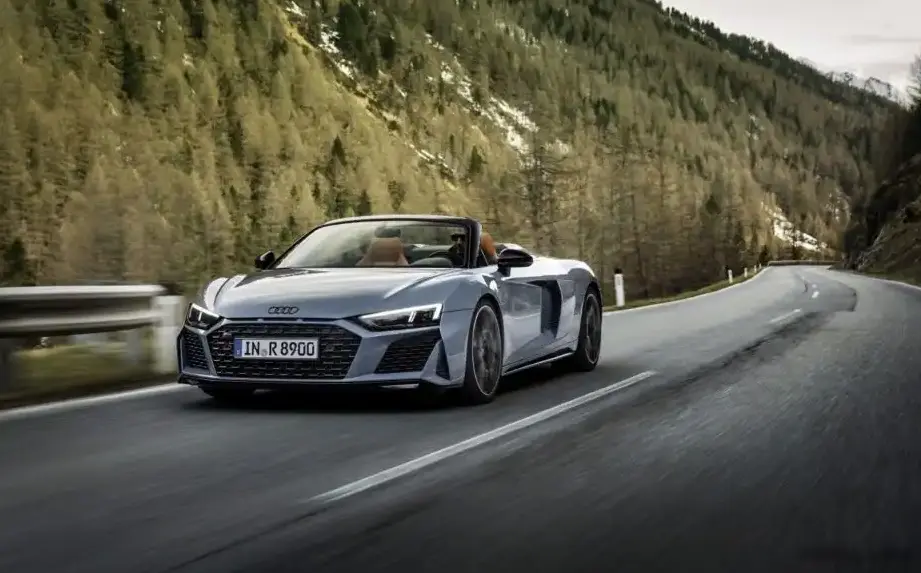
The Audi R8 II Spyder Performance 5.2 FSI V10 (4S, facelift 2019) represents the pinnacle of Audi’s open-top, high-performance sports car offerings. Produced from October 2021 to October 2023, this variant sits at the top of the R8 Spyder range, building upon the already impressive second-generation (4S) platform. It’s positioned as a direct competitor to other high-end roadsters like the Porsche 911 Turbo Cabriolet and McLaren 570S Spider, offering a blend of exhilarating performance, sophisticated technology, and luxurious appointments. The “Performance” designation signifies a significant upgrade over the standard R8 Spyder, focusing on increased power, reduced weight, and enhanced track capability.
Technical Specifications
| Brand | Audi |
| Model | R8 |
| Generation | R8 II Spyder (4S, facelift 2019) |
| Type (Engine) | Performance 5.2 FSI V10 (570 Hp) RWD S tronic |
| Start of production | October, 2021 |
| End of production | October, 2023 |
| Powertrain Architecture | Internal Combustion engine |
| Body type | Cabriolet |
| Seats | 2 |
| Doors | 2 |
| Fuel consumption at Low speed (WLTP) | 25.4 l/100 km (9.3 US mpg, 11.1 UK mpg, 3.9 km/l) |
| Fuel consumption at Medium speed (WLTP) | 13.7 l/100 km (17.2 US mpg, 20.6 UK mpg, 7.3 km/l) |
| Fuel consumption at high speed (WLTP) | 11.6 l/100 km (20.3 US mpg, 24.4 UK mpg, 8.6 km/l) |
| Fuel consumption at very high speed (WLTP) | 11.2 l/100 km (21 US mpg, 25.2 UK mpg, 8.9 km/l) |
| Combined fuel consumption (WLTP) | 13.7 l/100 km (17.2 US mpg, 20.6 UK mpg, 7.3 km/l) |
| CO2 emissions (WLTP) | 311 g/km |
| Fuel consumption (economy) – urban (NEDC, WLTP equivalent) | 19.6 l/100 km (12 US mpg, 14.4 UK mpg, 5.1 km/l) |
| Fuel consumption (economy) – extra urban (NEDC, WLTP equivalent) | 9.1 l/100 km (25.8 US mpg, 31 UK mpg, 11 km/l) |
| Fuel consumption (economy) – combined (NEDC, WLTP equivalent) | 13 l/100 km (18.1 US mpg, 21.7 UK mpg, 7.7 km/l) |
| CO2 emissions (NEDC, WLTP equivalent) | 298 g/km |
| Fuel Type | Petrol (Gasoline) |
| Acceleration 0 – 100 km/h | 3.8 sec |
| Acceleration 0 – 62 mph | 3.8 sec |
| Acceleration 0 – 60 mph | 3.6 sec |
| Maximum speed | 327 km/h (203.19 mph) |
| Emission standard | Euro 6d-ISC-FCM |
| Weight-to-power ratio | 3 kg/Hp, 336.3 Hp/tonne |
| Weight-to-torque ratio | 3.1 kg/Nm, 324.5 Nm/tonne |
| Power | 570 Hp @ 8000 rpm |
| Power per litre | 109.5 Hp/l |
| Torque | 550 Nm @ 6400 rpm (405.66 lb.-ft. @ 6400 rpm) |
| Engine layout | Middle, Longitudinal |
| Engine Model/Code | DKAC |
| Engine displacement | 5204 cm3 (317.57 cu. in.) |
| Number of cylinders | 10 |
| Engine configuration | V-engine |
| Cylinder Bore | 84.5 mm (3.33 in.) |
| Piston Stroke | 92.8 mm (3.65 in.) |
| Compression ratio | 12.7:1 |
| Number of valves per cylinder | 4 |
| Fuel injection system | Direct injection and Multi-port manifold injection |
| Engine aspiration | Naturally aspirated engine |
| Valvetrain | DOHC |
| Engine oil capacity | 8.3 l (8.77 US qt | 7.3 UK qt) |
| Coolant | 24.7 l (26.1 US qt | 21.73 UK qt) |
| Kerb Weight | 1695 kg (3736.84 lbs.) |
| Max. weight | 1995 kg (4398.22 lbs.) |
| Max load | 300 kg (661.39 lbs.) |
| Trunk (boot) space – minimum | 112 l (3.96 cu. ft.) |
| Fuel tank capacity | 80 l (21.13 US gal | 17.6 UK gal) |
| Length | 4429 mm (174.37 in.) |
| Width | 1940 mm (76.38 in.) |
| Width including mirrors | 2037 mm (80.2 in.) |
| Height | 1242 mm (48.9 in.) |
| Wheelbase | 2650 mm (104.33 in.) |
| Front track | 1645 mm (64.76 in.) |
| Rear (Back) track | 1599 mm (62.95 in.) |
| Front overhang | 993 mm (39.09 in.) |
| Rear overhang | 786 mm (30.94 in.) |
| Drag coefficient (Cd) | 0.36 |
| Minimum turning circle (turning diameter) | 11.2 m (36.75 ft.) |
| Drivetrain Architecture | The Internal combustion engine (ICE) drives the rear wheels of the vehicle. |
| Drive wheel | Rear wheel drive |
| Number of gears and type of gearbox | 7 gears, automatic transmission S tronic |
| Front suspension | Coil spring, Double wishbone, Transverse stabilizer |
| Rear suspension | Double wishbone, Transverse stabilizer, Coil spring |
| Front brakes | Ventilated discs |
| Rear brakes | Ventilated discs |
| Assisting systems | ABS (Anti-lock braking system) |
| Steering type | Steering rack and pinion |
| Power steering | Electric Steering |
| Tires size | Front wheel tires: 245/35 R19; 245/30 R20 Rear wheel tires: 295/35 R19; 305/30 R20 |
| Wheel rims size | Front wheel rims: 8.5J x 19; 8.5J x 20 Rear wheel rims: 11J x 19; 11J x 20 |
INTRODUCTION
The Audi R8 II Spyder Performance 5.2 FSI V10, part of the second-generation R8 (4S) family, represents a significant evolution of Audi’s flagship sports car. Introduced with the facelift in 2019 and produced through 2023, this model builds upon the foundation laid by the original R8, offering a more focused and aggressive driving experience. The Spyder variant, with its retractable soft top, adds an element of open-air enjoyment without sacrificing the core performance characteristics of the coupe. This particular “Performance” trim level is the most potent version of the R8 Spyder, designed to deliver uncompromising performance on both the road and the track.
Powertrain & Engine Architecture
At the heart of the R8 Spyder Performance lies Audi’s naturally aspirated 5.2-liter V10 engine, designated the DKAC code. This engine produces 570 horsepower at 8,000 rpm and 405.66 lb.-ft. of torque at 6,400 rpm. It utilizes a combination of direct and multi-port fuel injection, optimizing both power and efficiency. The engine features a dual overhead camshaft (DOHC) valvetrain with four valves per cylinder, ensuring optimal breathing and high-revving capability. The engine is longitudinally mounted in a mid-engine configuration, contributing to exceptional balance and handling. Power is transmitted to the rear wheels via a seven-speed S tronic dual-clutch automatic transmission. This transmission offers incredibly fast and precise shifts, enhancing the car’s acceleration and responsiveness. The S tronic gearbox is known for its efficiency and ability to seamlessly deliver power.
Driving Characteristics
The R8 Spyder Performance delivers a truly exhilarating driving experience. The combination of the high-revving V10 engine and the quick-shifting S tronic transmission results in a 0-60 mph time of just 3.6 seconds and a top speed of 203.19 mph. The rear-wheel-drive configuration provides a more engaging and traditional sports car feel, allowing for precise control and predictable handling. The gear ratios are tuned for both rapid acceleration and comfortable high-speed cruising. Compared to lower-powered R8 variants, the Performance model offers a significantly more visceral and engaging driving experience, with a more immediate throttle response and a more aggressive exhaust note. While the automatic transmission doesn’t offer the same level of driver involvement as a manual gearbox, its speed and efficiency are undeniable.
Equipment & Trim Levels
The R8 Spyder Performance comes standard with a comprehensive array of features, reflecting its position as the top-tier model. Interior appointments include premium leather upholstery, carbon fiber trim, and sport seats designed to provide excellent support during spirited driving. Standard technology includes Audi’s virtual cockpit digital instrument cluster, a navigation system, and a premium sound system. Optional extras include a Bang & Olufsen sound system, dynamic steering, and a variety of exterior customization options. The interior design is driver-focused, with all essential controls within easy reach. The soft top is electrically operated and can be raised or lowered in seconds, even while driving at moderate speeds.
Chassis & Braking
The R8 Spyder Performance utilizes a lightweight aluminum chassis, contributing to its impressive power-to-weight ratio. The suspension features coil springs, double wishbones, and transverse stabilizers at both the front and rear, providing a balanced and responsive ride. Ventilated disc brakes are fitted on all four wheels, providing ample stopping power. The car is equipped with Audi’s ABS anti-lock braking system and electronic stability control, enhancing safety and control. The suspension is tuned to provide a firm but compliant ride, offering a good balance between comfort and handling. The rear track is slightly narrower than the front, contributing to the car’s agile handling characteristics.
Market Reception & Comparison
The Audi R8 Spyder Performance was generally well-received by automotive critics, who praised its exhilarating performance, sophisticated technology, and luxurious interior. Compared to other R8 variants, the Performance model was lauded for its increased power and sharper handling. Fuel economy, however, was a common criticism, with the combined WLTP figure of 13.7 l/100 km (17.2 US mpg) being relatively high. However, this is typical for a high-performance sports car of this caliber. Compared to competitors like the Porsche 911 Turbo Cabriolet, the R8 Spyder Performance offered a slightly more raw and visceral driving experience, while the Porsche provided a more refined and technologically advanced package.
Legacy
The Audi R8 II Spyder Performance 5.2 FSI V10 represents a high point in Audi’s sports car development. The naturally aspirated V10 engine is a particularly noteworthy feature, offering a unique and engaging driving experience that is becoming increasingly rare in modern sports cars. While the R8 line has been discontinued, the Spyder Performance variant is expected to remain a desirable and collectible vehicle in the used car market. The powertrain, while requiring regular maintenance, is generally considered to be reliable, and parts availability should remain good for the foreseeable future. The R8 Spyder Performance stands as a testament to Audi’s engineering prowess and its commitment to delivering exceptional performance and driving pleasure.