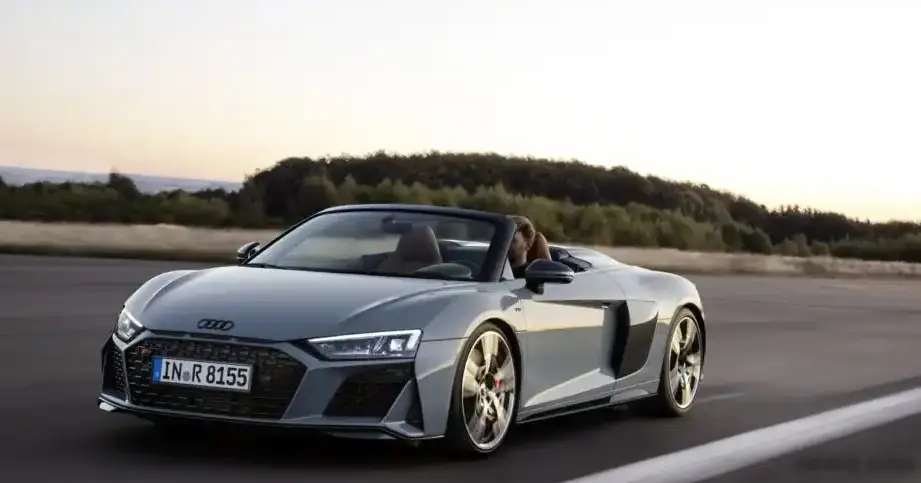
The Audi R8 II Spyder Performance 5.2 FSI V10 quattro S tronic, produced from February 2019 to October 2023, represents the pinnacle of Audi’s open-top, high-performance sports car lineage. This facelifted version of the second-generation R8 Spyder (internally designated 4S) focused on refining the already potent formula with increased power, enhanced aerodynamics, and a more focused driving experience. Positioned as the top-tier Spyder variant, it offered a significant step up in performance compared to the standard R8 Spyder V10, targeting enthusiasts seeking uncompromising speed and exclusivity. It sits within the broader R8 family, sharing its core platform with the coupe version but distinguished by its convertible top and unique character.
Technical Specifications
| Brand | Audi |
| Model | R8 |
| Generation | R8 II Spyder (4S, facelift 2019) |
| Type (Engine) | Performance 5.2 FSI V10 (620 Hp) quattro S tronic |
| Start of production | February, 2019 |
| End of production | October, 2023 |
| Powertrain Architecture | Internal Combustion engine |
| Body type | Cabriolet |
| Seats | 2 |
| Doors | 2 |
| Fuel consumption at Low speed (WLTP) | 24.2-25.2 l/100 km (9.7 – 9.3 US mpg, 11.7 – 11.2 UK mpg, 4.1 – 4 km/l) |
| Fuel consumption at Medium speed (WLTP) | 13.5-13.8 l/100 km (17.4 – 17 US mpg, 20.9 – 20.5 UK mpg, 7.4 – 7.2 km/l) |
| Fuel consumption at high speed (WLTP) | 11.2-11.6 l/100 km (21 – 20.3 US mpg, 25.2 – 24.4 UK mpg, 8.9 – 8.6 km/l) |
| Fuel consumption at very high speed (WLTP) | 10.9-11.3 l/100 km (21.6 – 20.8 US mpg, 25.9 – 25 UK mpg, 9.2 – 8.8 km/l) |
| Combined fuel consumption (WLTP) | 13.3-13.9 l/100 km (17.7 – 16.9 US mpg, 21.2 – 20.3 UK mpg, 7.5 – 7.2 km/l) |
| CO2 emissions (WLTP) | 301-316 g/km |
| Fuel consumption (economy) – urban | 20.2 l/100 km (11.6 US mpg, 14 UK mpg, 5 km/l) |
| Fuel consumption (economy) – extra urban | 9.2 l/100 km (25.6 US mpg, 30.7 UK mpg, 10.9 km/l) |
| Fuel consumption (economy) – combined | 13.3 l/100 km (17.7 US mpg, 21.2 UK mpg, 7.5 km/l) |
| CO2 emissions | 301 g/km |
| Fuel Type | Petrol (Gasoline) |
| Acceleration 0 – 100 km/h | 3.2 sec |
| Acceleration 0 – 62 mph | 3.2 sec |
| Acceleration 0 – 60 mph | 3 sec |
| Maximum speed | 329 km/h (204.43 mph) |
| Emission standard | Euro 6d-ISC-FCM |
| Weight-to-power ratio | 2.7 kg/Hp, 365.8 Hp/tonne |
| Weight-to-torque ratio | 2.9 kg/Nm, 342.2 Nm/tonne |
| Power | 620 Hp @ 8000 rpm |
| Power per litre | 119.1 Hp/l |
| Torque | 580 Nm @ 6600 rpm (427.79 lb.-ft. @ 6600 rpm) |
| Engine layout | Middle, Longitudinal |
| Engine Model/Code | DMWA |
| Engine displacement | 5204 cm3 (317.57 cu. in.) |
| Number of cylinders | 10 |
| Engine configuration | V-engine |
| Cylinder Bore | 84.5 mm (3.33 in.) |
| Piston Stroke | 92.8 mm (3.65 in.) |
| Compression ratio | 12.7:1 |
| Number of valves per cylinder | 4 |
| Fuel injection system | Direct injection and Multi-port manifold injection |
| Engine aspiration | Naturally aspirated engine |
| Valvetrain | DOHC |
| Engine oil capacity | 8.3 l (8.77 US qt | 7.3 UK qt) |
| Coolant | 24.7 l (26.1 US qt | 21.73 UK qt) |
| Kerb Weight | 1695 kg (3736.84 lbs.) |
| Max. weight | 2015 kg (4442.31 lbs.) |
| Max load | 320 kg (705.48 lbs.) |
| Trunk (boot) space – minimum | 112 l (3.96 cu. ft.) |
| Fuel tank capacity | 80 l (21.13 US gal | 17.6 UK gal) |
| Length | 4429 mm (174.37 in.) |
| Width | 1940 mm (76.38 in.) |
| Width including mirrors | 2037 mm (80.2 in.) |
| Height | 1242 mm (48.9 in.) |
| Wheelbase | 2650 mm (104.33 in.) |
| Front track | 1645 mm (64.76 in.) |
| Rear (Back) track | 1599 mm (62.95 in.) |
| Front overhang | 993 mm (39.09 in.) |
| Rear overhang | 786 mm (30.94 in.) |
| Drag coefficient (Cd) | 0.36 |
| Minimum turning circle (turning diameter) | 11.2 m (36.75 ft.) |
| Drivetrain Architecture | The Internal combustion engine (ICE) drives the rear wheels permanently, and the front wheels are driven through an electrically or mechanically operated clutch if necessary. |
| Drive wheel | All wheel drive (4×4) |
| Number of gears and type of gearbox | 7 gears, automatic transmission S tronic |
| Front suspension | Coil spring, Double wishbone, Transverse stabilizer |
| Rear suspension | Double wishbone, Transverse stabilizer, Coil spring |
| Front brakes | Ventilated discs, 380 mm |
| Rear brakes | Ventilated discs, 356 mm |
| Assisting systems | ABS (Anti-lock braking system) |
| Steering type | Steering rack and pinion |
| Power steering | Electric Steering |
| Tires size | Front wheel tires: 245/35 R19; 245/30 R20 Rear wheel tires: 295/35 R19; 305/30 R20 |
| Wheel rims size | Front wheel rims: 8.5J x 19; 8.5J x 20 Rear wheel rims: 11J x 19; 11J x 20 |
INTRODUCTION
The Audi R8 II Spyder Performance 5.2 FSI V10 quattro S tronic, launched in 2019 as part of a mid-cycle refresh, builds upon the foundation laid by the first-generation R8 and the initial release of the second generation. It’s built on the 4S platform, sharing its core structure with the Lamborghini Huracán. This variant represents the highest performance level available in the Spyder body style at the time of its production. The facelift brought subtle but effective styling updates, along with significant mechanical enhancements focused on increasing power and improving handling. The Spyder, with its retractable soft top, offers an open-air driving experience without sacrificing the performance credentials of the R8.
Powertrain & Engine Architecture
At the heart of the R8 Spyder Performance lies Audi’s naturally aspirated 5.2-liter V10 engine, designated DMWA. This engine produces 620 horsepower at 8,000 rpm and 427.79 lb-ft of torque at 6,600 rpm. The engine utilizes a combination of direct and multi-port fuel injection, optimizing combustion efficiency and power delivery across the rev range. The dual-injection system allows for precise fuel control, enhancing both performance and fuel economy. The engine features a double overhead camshaft (DOHC) valvetrain with four valves per cylinder, ensuring optimal gas flow. Power is transmitted to all four wheels via Audi’s seven-speed S tronic dual-clutch transmission. This transmission offers incredibly fast and smooth gear changes, contributing to the car’s blistering acceleration. The quattro all-wheel-drive system intelligently distributes torque between the front and rear axles, maximizing traction and stability. The system typically favors a rear-wheel bias, enhancing the sporty driving experience.
Driving Characteristics
The R8 Spyder Performance delivers a truly exhilarating driving experience. The combination of the high-revving V10 engine and the quick-shifting S tronic transmission results in a 0-60 mph time of around 3 seconds and a top speed of 204.43 mph. The all-wheel-drive system provides exceptional grip, allowing the car to confidently tackle corners at high speeds. Compared to the standard R8 Spyder V10, the Performance variant offers noticeably sharper throttle response and a more aggressive power delivery. The S tronic transmission’s gear ratios are optimized for both acceleration and high-speed cruising. While the automatic transmission removes the involvement of a manual clutch, it provides incredibly fast and precise shifts, often faster than a skilled driver could achieve with a manual gearbox. The Spyder’s chassis is well-balanced, providing a stable and predictable platform for spirited driving. The retractable soft top adds some weight compared to the coupe, but the impact on handling is minimal.
Equipment & Trim Levels
The R8 Spyder Performance came generously equipped as standard. Interior features included leather upholstery, heated and ventilated sport seats, a premium Bang & Olufsen sound system, and a fully digital Audi virtual cockpit instrument cluster. Standard exterior features included a performance exhaust system, carbon fiber exterior trim, and unique alloy wheels. Optional extras included a carbon fiber engine bay, upgraded interior trim materials, and various customization options through Audi Exclusive. The interior design focused on creating a driver-centric environment, with all controls positioned for easy access and intuitive operation. The dashboard layout is clean and modern, with a focus on functionality.
Chassis & Braking
The R8 Spyder Performance utilizes a lightweight aluminum chassis, contributing to its impressive power-to-weight ratio. The suspension system consists of double wishbones at all four corners, with coil springs and transverse stabilizers. This setup provides excellent handling and ride comfort. The braking system features ventilated discs on all four wheels, with large calipers providing ample stopping power. The ABS (Anti-lock braking system) ensures optimal braking performance in all conditions. The Spyder’s chassis is specifically reinforced to compensate for the lack of a fixed roof, maintaining structural rigidity and minimizing body flex.
Market Reception & Comparison
The R8 Spyder Performance was widely praised by automotive critics for its exceptional performance, handling, and overall driving experience. It was often compared favorably to other high-performance convertibles, such as the Porsche 911 Turbo Cabriolet and the McLaren 720S Spider. While the Spyder’s fuel economy (around 17.7 mpg combined) was not a primary concern for its target audience, it was noted to be relatively efficient for a car of its performance caliber. Compared to the standard R8 Spyder V10, the Performance variant offered a significant performance upgrade for a premium price. The higher price reflected the increased power, enhanced handling, and exclusive features.
Legacy
The Audi R8 II Spyder Performance 5.2 FSI V10 quattro S tronic represents a high point in Audi’s sports car development. Its naturally aspirated V10 engine is a testament to Audi’s engineering prowess, and its all-wheel-drive system provides exceptional traction and stability. On the used car market, these models hold their value well, attracting collectors and enthusiasts who appreciate their performance and exclusivity. The DMWA engine, while requiring regular maintenance, is generally considered reliable when properly cared for. The S tronic transmission is also known for its durability, but regular fluid changes are essential. The R8 Spyder Performance remains a desirable and highly capable sports car, offering a unique blend of performance, luxury, and open-air driving enjoyment.