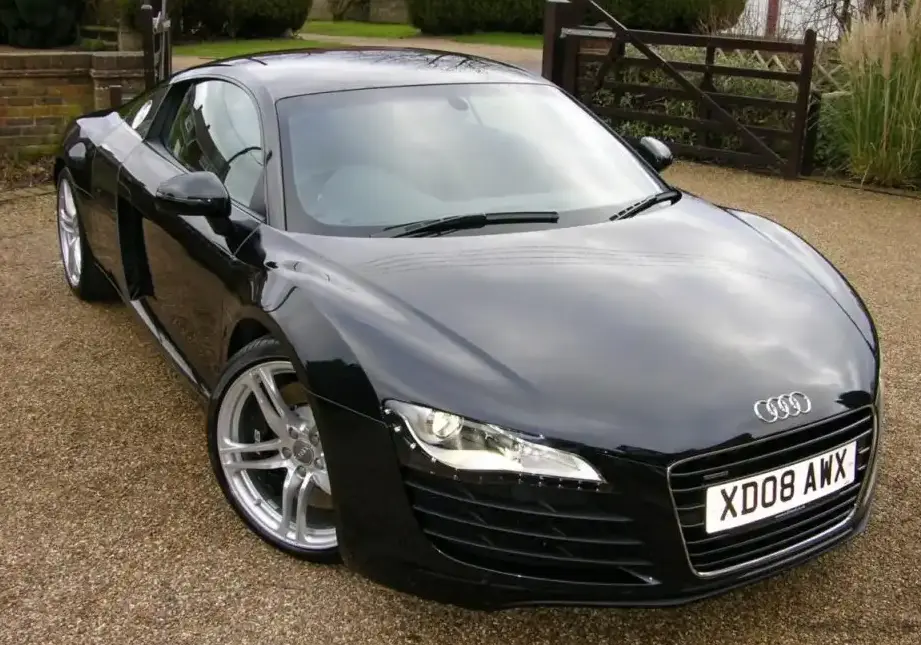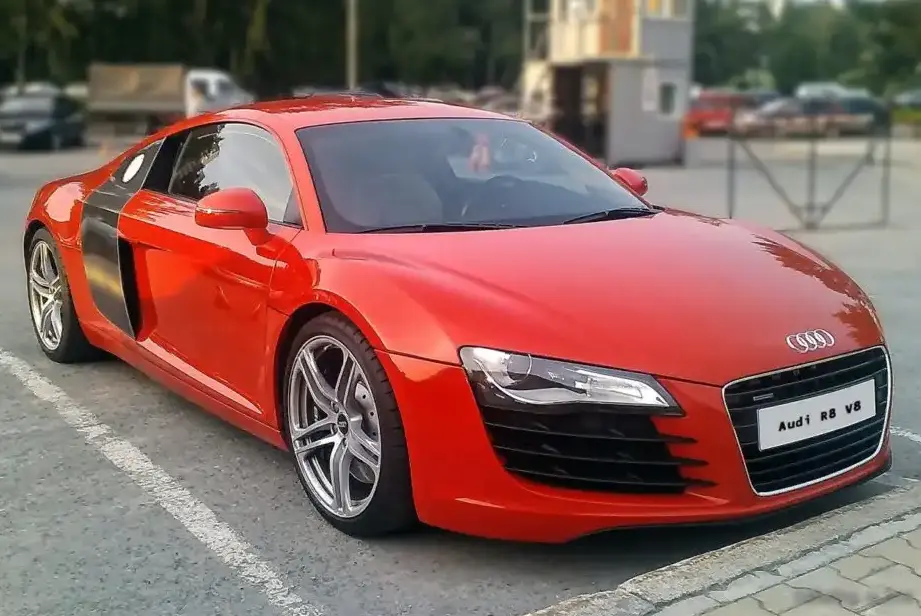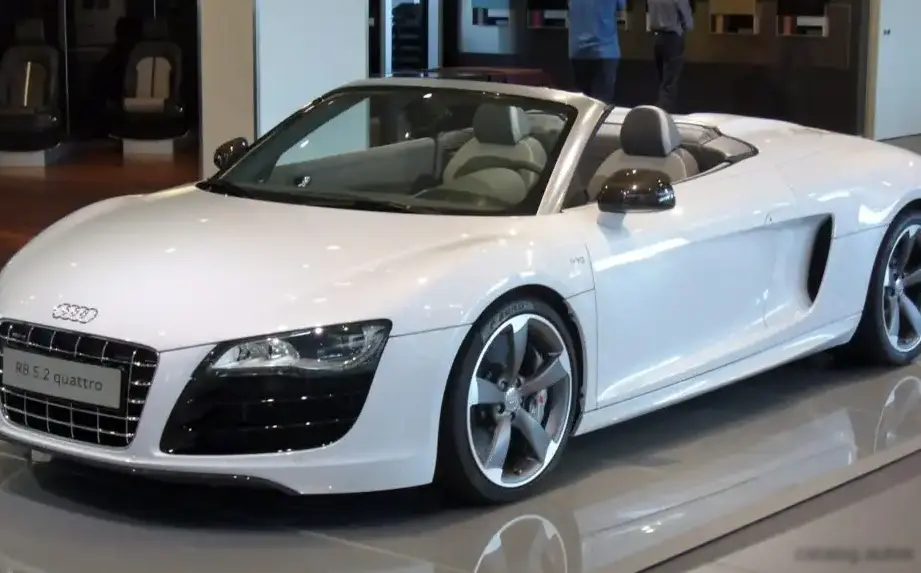
The Audi R8 Spyder (42) 5.2 FSI V10 quattro R tronic, produced from 2010 to October 2012, represents the open-top variant of Audi’s flagship supercar. Positioned as the more luxurious and accessible version of the R8 coupe, the Spyder offered a thrilling driving experience combined with the added enjoyment of open-air motoring. It was built on the R8 (42) platform, sharing its core structure and technology with the coupe, but distinguished by its fully automatic soft top. This model aimed to compete with other high-end roadsters like the Porsche 911 Turbo Cabriolet and the Ferrari California, offering a blend of performance, technology, and everyday usability.
Technical Specifications
| Brand | Audi |
| Model | R8 |
| Generation | R8 Spyder (42) |
| Type (Engine) | 5.2 FSI V10 (525 Hp) quattro R tronic |
| Start of production | 2010 |
| End of production | October, 2012 |
| Powertrain Architecture | Internal Combustion engine |
| Body type | Cabriolet |
| Seats | 2 |
| Doors | 2 |
| Fuel consumption (economy) – urban | 21.5 l/100 km (10.9 US mpg, 13.1 UK mpg, 4.7 km/l) |
| Fuel consumption (economy) – extra urban | 10.2 l/100 km (23.1 US mpg, 27.7 UK mpg, 9.8 km/l) |
| Fuel consumption (economy) – combined | 14.2 l/100 km (16.6 US mpg, 19.9 UK mpg, 7 km/l) |
| CO2 emissions | 332 g/km |
| Fuel Type | Petrol (Gasoline) |
| Acceleration 0 – 100 km/h | 4.1 sec |
| Acceleration 0 – 62 mph | 4.1 sec |
| Acceleration 0 – 60 mph | 3.9 sec |
| Maximum speed | 313 km/h (194.49 mph) |
| Emission standard | Euro 5 |
| Weight-to-power ratio | 3.3 kg/Hp, 304.3 Hp/tonne |
| Weight-to-torque ratio | 3.3 kg/Nm, 307.2 Nm/tonne |
| Power | 525 Hp @ 8000 rpm |
| Power per litre | 100.9 Hp/l |
| Torque | 530 Nm @ 6500 rpm (390.91 lb.-ft. @ 6500 rpm) |
| Engine layout | Rear, Longitudinal |
| Engine Model/Code | BUJ |
| Engine displacement | 5204 cm3 (317.57 cu. in.) |
| Number of cylinders | 10 |
| Engine configuration | V-engine |
| Cylinder Bore | 84.5 mm (3.33 in.) |
| Piston Stroke | 92.8 mm (3.65 in.) |
| Compression ratio | 12.5:1 |
| Number of valves per cylinder | 4 |
| Fuel injection system | Direct injection |
| Engine aspiration | Naturally aspirated engine |
| Valvetrain | DOHC |
| Engine oil capacity | 8.3 l (8.77 US qt | 7.3 UK qt) |
| Kerb Weight | 1725 kg (3802.97 lbs.) |
| Max. weight | 2025 kg (4464.36 lbs.) |
| Max load | 300 kg (661.39 lbs.) |
| Trunk (boot) space – minimum | 100 l (3.53 cu. ft.) |
| Fuel tank capacity | 80 l (21.13 US gal | 17.6 UK gal) |
| Length | 4434 mm (174.57 in.) |
| Width | 1904 mm (74.96 in.) |
| Width including mirrors | 2029 mm (79.88 in.) |
| Height | 1244 mm (48.98 in.) |
| Wheelbase | 2650 mm (104.33 in.) |
| Front track | 1638 mm (64.49 in.) |
| Rear (Back) track | 1595 mm (62.8 in.) |
| Front overhang | 999 mm (39.33 in.) |
| Rear overhang | 785 mm (30.91 in.) |
| Drag coefficient (Cd) | 0.37 |
| Minimum turning circle (turning diameter) | 11.8 m (38.71 ft.) |
| Drive wheel | All wheel drive (4×4) |
| Number of gears and type of gearbox | 6 gears, automatic transmission R tronic |
| Front suspension | Independent, type McPherson with coil spring and anti-roll bar |
| Rear suspension | Independent multi-link spring suspension with stabilizer |
| Front brakes | Ventilated discs |
| Rear brakes | Ventilated discs |
| Assisting systems | ABS (Anti-lock braking system) |
| Steering type | Steering rack and pinion |
| Power steering | Hydraulic Steering |
| Tires size | 235/35 R19; 295/30 R19 |
| Wheel rims size | 8.5J x 19; 11J x 19 |
INTRODUCTION
The Audi R8 Spyder 5.2 FSI V10 quattro R tronic, launched in 2010, built upon the success of the first-generation R8. It represented a significant step forward in terms of performance and refinement for an open-top Audi. The “42” designation refers to the internal chassis code. The Spyder’s appeal lay in its ability to deliver the exhilarating performance of the R8 coupe with the added sensory experience of a convertible. The R tronic transmission, a single-clutch automated manual, was a key feature, offering quick shifts but differing in character from traditional automatic transmissions.
Powertrain & Engine Architecture
At the heart of the R8 Spyder 5.2 FSI V10 lay the BUJ engine code, a naturally aspirated 5.2-liter V10 engine. This engine was a marvel of engineering, featuring direct fuel injection (FSI) and a double overhead camshaft (DOHC) valvetrain. The direct injection system precisely meters fuel into the combustion chambers, improving efficiency and power output. The engine produced 525 horsepower at 8,000 rpm and 390.91 lb-ft of torque at 6,500 rpm. The R tronic transmission, a six-speed automated manual, was specifically tuned for quick and precise gear changes. Unlike a traditional automatic, R tronic uses a single clutch and requires a brief interruption of power during shifts, resulting in a more engaging, albeit sometimes jerky, driving experience. The engine is longitudinally mounted at the rear of the vehicle, contributing to its balanced handling characteristics.
Driving Characteristics
The R8 Spyder 5.2 FSI V10 quattro R tronic delivered breathtaking performance. Acceleration from 0 to 60 mph took approximately 3.9 seconds, and it could reach a top speed of 194.49 mph. The R tronic transmission, while quick, demanded a degree of driver involvement. Downshifts were particularly rapid, but upshifts could sometimes feel abrupt. The quattro all-wheel-drive system provided exceptional traction, allowing the R8 Spyder to confidently handle even challenging road conditions. Compared to the manual transmission R8, the R tronic version offered greater convenience, especially in urban driving, but some enthusiasts preferred the more direct control of a traditional manual gearbox. The Spyder’s soft top added weight compared to the coupe, slightly impacting handling agility, but the trade-off for open-air driving was considered worthwhile by many.
Equipment & Trim Levels
The R8 Spyder 5.2 FSI V10 quattro R tronic came standard with a comprehensive list of features. Interior appointments included leather upholstery, power-adjustable seats, and a premium sound system. Standard exterior features included 19-inch alloy wheels, LED headlights, and a power-operated soft top. Optional extras included carbon fiber trim, upgraded navigation systems, and a Bang & Olufsen sound system. The interior design was driver-focused, with a clean and minimalist layout. The dashboard featured a combination of analog gauges and a central infotainment screen. The overall ambiance was one of understated luxury and high-tech sophistication.
Chassis & Braking
The R8 Spyder’s chassis was constructed primarily of aluminum, contributing to its relatively low weight. The suspension system featured independent McPherson struts at the front and an independent multi-link setup at the rear, both with coil springs and anti-roll bars. This configuration provided a good balance between ride comfort and handling precision. The braking system consisted of ventilated discs at all four corners, providing ample stopping power. ABS (Anti-lock braking system) was standard, enhancing safety and control. The Spyder’s chassis was reinforced compared to the coupe to compensate for the lack of a fixed roof, ensuring structural rigidity.
Market Reception & Comparison
The Audi R8 Spyder 5.2 FSI V10 quattro R tronic was generally well-received by automotive critics. It was praised for its stunning performance, luxurious interior, and advanced technology. However, the R tronic transmission received mixed reviews, with some critics finding it less refined than traditional automatic transmissions. Fuel economy was predictably poor, averaging around 16.6 US mpg in combined driving. Compared to the R8 coupe, the Spyder offered a more visceral driving experience but came at a slight premium in price. Against competitors like the Porsche 911 Turbo Cabriolet, the R8 Spyder offered a compelling alternative, with a unique design and a powerful V10 engine.
Legacy
The Audi R8 Spyder 5.2 FSI V10 quattro R tronic remains a desirable supercar in the used car market. The 5.2-liter V10 engine has proven to be remarkably reliable, provided it has been properly maintained. The R tronic transmission, while occasionally requiring servicing, is generally durable. The Spyder’s aluminum chassis is resistant to corrosion, and the overall build quality is excellent. Today, these cars are sought after by collectors and enthusiasts who appreciate their combination of performance, luxury, and exclusivity. The R8 Spyder helped establish Audi as a serious contender in the supercar segment and paved the way for future high-performance models.