Technical Specifications
| Brand | Audi |
| Model | R8 |
| Generation | R8 Spyder (42, facelift 2012) |
| Type (Engine) | 4.2 FSI V8 (430 Hp) quattro S tronic |
| Start of production | 2012 |
| End of production | July, 2015 |
| Powertrain Architecture | Internal Combustion engine |
| Body type | Coupe |
| Seats | 2 |
| Doors | 2 |
| Fuel consumption (urban) | 19.6 l/100 km (12 US mpg, 14.4 UK mpg, 5.1 km/l) |
| Fuel consumption (extra urban) | 8.6 l/100 km (27.4 US mpg, 32.8 UK mpg, 11.6 km/l) |
| Fuel consumption (combined) | 12.6 l/100 km (18.7 US mpg, 22.4 UK mpg, 7.9 km/l) |
| CO2 emissions | 294 g/km |
| Fuel Type | Petrol (Gasoline) |
| Acceleration 0 – 100 km/h | 4.5 sec |
| Acceleration 0 – 62 mph | 4.5 sec |
| Acceleration 0 – 60 mph | 4.3 sec |
| Maximum speed | 300 km/h (186.41 mph) |
| Emission standard | Euro 5 |
| Weight-to-power ratio | 3.9 kg/Hp, 255.2 Hp/tonne |
| Weight-to-torque ratio | 3.9 kg/Nm, 255.2 Nm/tonne |
| Power | 430 Hp @ 7900 rpm |
| Power per litre | 103.3 Hp/l |
| Torque | 430 Nm @ 4500-6000 rpm (317.15 lb.-ft. @ 4500-6000 rpm) |
| Engine layout | Rear, Longitudinal |
| Engine Model/Code | CNDA |
| Engine displacement | 4163 cm3 (254.04 cu. in.) |
| Number of cylinders | 8 |
| Engine configuration | V-engine |
| Cylinder Bore | 84.5 mm (3.33 in.) |
| Piston Stroke | 92.8 mm (3.65 in.) |
| Compression ratio | 12.5:1 |
| Number of valves per cylinder | 4 |
| Fuel injection system | Direct injection |
| Engine aspiration | Naturally aspirated engine |
| Valvetrain | DOHC |
| Engine oil capacity | 10 l (10.57 US qt | 8.8 UK qt) |
| Kerb Weight | 1685 kg (3714.79 lbs.) |
| Max. weight | 1985 kg (4376.18 lbs.) |
| Max load | 300 kg (661.39 lbs.) |
| Trunk (boot) space – minimum | 100 l (3.53 cu. ft.) |
| Fuel tank capacity | 80 l (21.13 US gal | 17.6 UK gal) |
| Length | 4440 mm (174.8 in.) |
| Width | 1904 mm (74.96 in.) |
| Width including mirrors | 2029 mm (79.88 in.) |
| Height | 1244 mm (48.98 in.) |
| Wheelbase | 2650 mm (104.33 in.) |
| Front track | 1638 mm (64.49 in.) |
| Rear (Back) track | 1595 mm (62.8 in.) |
| Front overhang | 1007 mm (39.65 in.) |
| Rear overhang | 783 mm (30.83 in.) |
| Drag coefficient (Cd) | 0.36 |
| Minimum turning circle (turning diameter) | 11.8 m (38.71 ft.) |
| Drive wheel | All wheel drive (4×4) |
| Number of gears and type of gearbox | 7 gears, automatic transmission S tronic |
| Front suspension | Independent, type McPherson with coil spring and anti-roll bar |
| Rear suspension | Independent multi-link spring suspension with stabilizer |
| Front brakes | Ventilated discs |
| Rear brakes | Ventilated discs |
| Assisting systems | ABS (Anti-lock braking system) |
| Steering type | Steering rack and pinion |
| Power steering | Hydraulic Steering |
| Tires size | 235/35 R19; 295/30 R19 |
| Wheel rims size | 8.5J x 19; 11J x 19 |
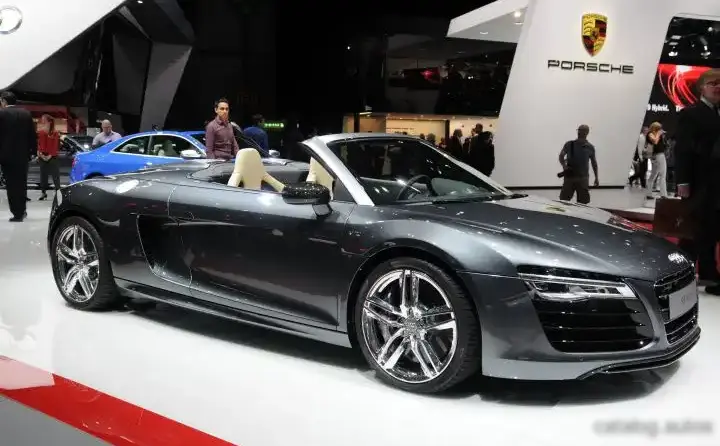
The 2012 facelift of the Audi R8 Spyder, featuring the 4.2 FSI V8 engine and S tronic transmission, represented a refinement of the original R8 formula. Launched in 2006, the R8 was Audi’s first mid-engine sports car, designed to compete with established players like Ferrari and Porsche. The Spyder variant, introduced shortly after the coupe, offered open-top driving thrills. The 2012 update brought subtle styling changes, improved aerodynamics, and a more efficient version of the 4.2-liter V8. Positioned as the ‘entry-level’ R8 (though still a very expensive vehicle), this variant offered a compelling blend of performance and relative affordability compared to the higher-spec 5.2-liter V10 models. It was built on the Audi/Lamborghini platform known as the 42 platform.
Powertrain & Engine Architecture
At the heart of the R8 Spyder 4.2 FSI lies the CNDA engine code, a naturally aspirated 4.2-liter V8. This engine utilizes Audi’s FSI (Fuel Stratified Injection) direct injection technology, delivering fuel directly into the combustion chamber for improved efficiency and power. The engine boasts a 12.5:1 compression ratio and a dual overhead camshaft (DOHC) valvetrain with four valves per cylinder. The engine produces 430 horsepower at 7900 rpm and 430 Nm (317 lb-ft) of torque between 4500 and 6000 rpm. The S tronic 7-speed dual-clutch transmission is a key component, offering incredibly fast and smooth gear changes. Unlike a traditional automatic, the S tronic uses two separate clutches – one for odd gears and one for even gears – allowing for pre-selection of the next gear, resulting in near-instantaneous shifts. This transmission is fully automatic but also offers manual control via steering wheel-mounted paddles.
Driving Characteristics
The R8 Spyder 4.2 FSI delivers a thrilling driving experience, though it differs noticeably from the more potent V10 models. Acceleration from 0 to 60 mph takes approximately 4.3 seconds, and it reaches a top speed of 186 mph. The S tronic transmission contributes to this performance, providing quick and precise shifts. However, the 4.2-liter V8 lacks the raw, visceral power of the V10. The power delivery is more linear, making it more accessible and predictable. The gear ratios are tuned for a balance between acceleration and fuel efficiency. While the V10 R8 feels like a race car for the road, the 4.2-liter version is more of a refined grand tourer, capable of comfortable long-distance driving. The all-wheel-drive quattro system provides excellent traction and stability, inspiring confidence in various weather conditions.
Equipment & Trim Levels
The R8 Spyder 4.2 FSI came well-equipped as standard. Interior features included leather upholstery, power-adjustable seats, a premium sound system, and a navigation system. The dashboard featured Audi’s MMI (Multi Media Interface) system for controlling various vehicle functions. Optional extras were plentiful, including carbon fiber interior trim, upgraded leather packages, a Bang & Olufsen sound system, and various driver assistance features. Exterior options included different wheel designs, body-colored side blades, and a variety of paint colors. The Spyder also featured a fully automatic soft top that could be raised or lowered in around 19 seconds at speeds up to 31 mph.
Chassis & Braking
The R8 Spyder utilizes an aluminum space frame chassis, providing a lightweight and rigid foundation. The suspension consists of independent McPherson struts at the front and an independent multi-link setup at the rear, both with coil springs and anti-roll bars. The braking system features ventilated discs on all four wheels, providing ample stopping power. ABS (Anti-lock Braking System) is standard. The Spyder’s chassis was tuned to provide a comfortable ride without sacrificing handling precision. The steering is a hydraulic rack and pinion system, offering precise and responsive control.
Market Reception & Comparison
Critics generally praised the R8 Spyder 4.2 FSI for its stunning design, exhilarating performance, and refined driving experience. However, some reviewers noted that the 4.2-liter V8 lacked the drama and excitement of the V10 engine. Fuel economy was also a concern, with combined fuel consumption averaging around 18.7 US mpg. Compared to the V10 models, the 4.2-liter version offered a more accessible price point, making it a more attractive option for buyers who wanted the R8 experience without the higher cost. Reliability was generally good, although some owners reported issues with the S tronic transmission and the convertible top mechanism.
Legacy
The Audi R8 Spyder 4.2 FSI remains a highly desirable sports car in the used car market. Its combination of performance, style, and relative affordability has made it a popular choice among enthusiasts. The 4.2-liter V8 engine, while not as iconic as the V10, is known for its reliability and durability. The S tronic transmission, when properly maintained, is also a robust unit. However, potential buyers should be aware of the potential for transmission issues and the cost of maintaining a high-performance sports car. The R8 Spyder 4.2 FSI represents a significant milestone in Audi’s history, establishing the brand as a serious contender in the high-end sports car segment.