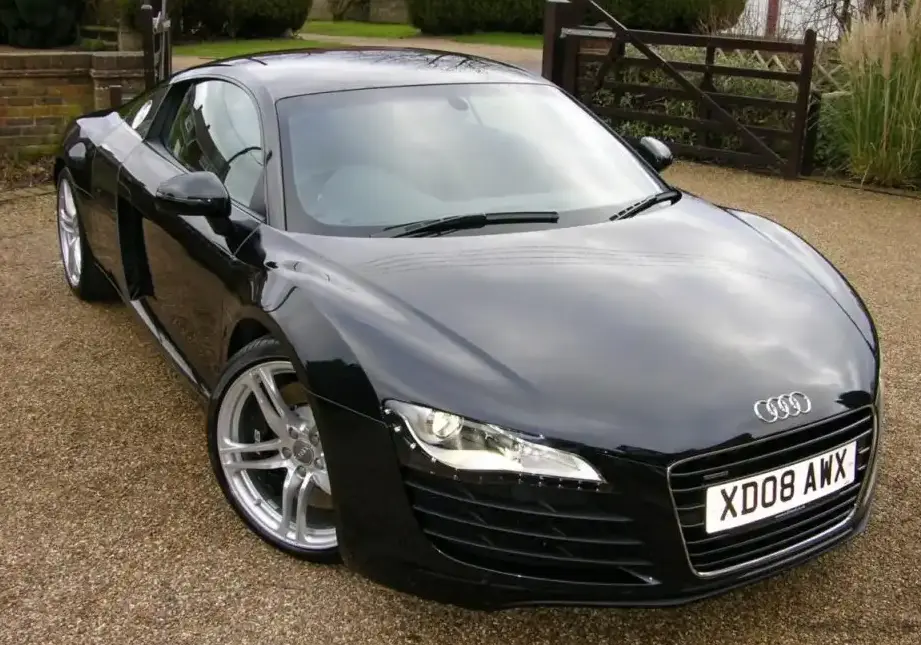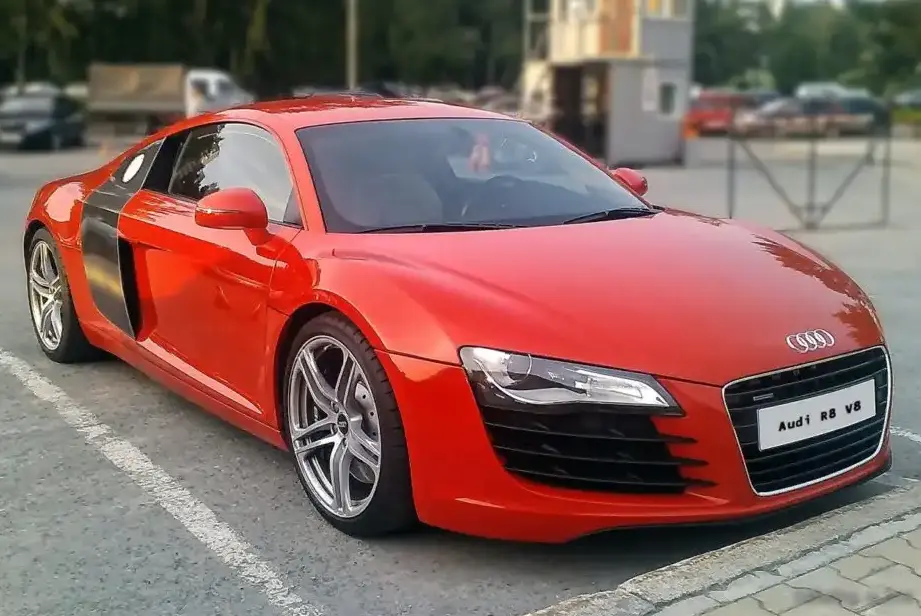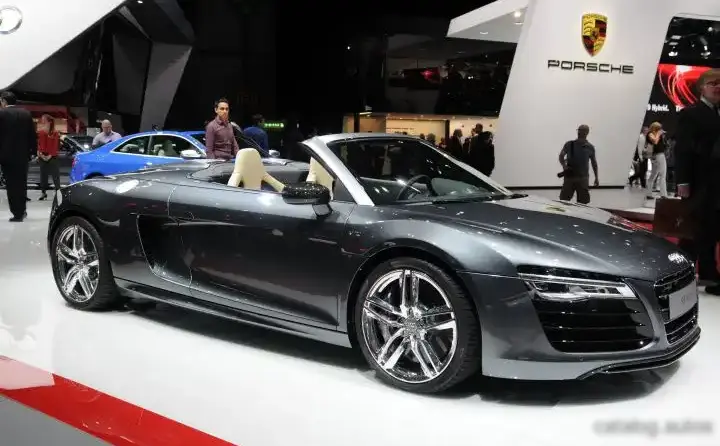
The Audi R8 Spyder (42, facelift) equipped with the 5.2 FSI V10 engine producing 525 horsepower and paired with the S tronic dual-clutch transmission represents the pinnacle of Audi’s open-top supercar offerings from the 2012 to 2015 model years. This variant sat at the top of the R8 Spyder lineup, offering significantly more performance than the V8 models and serving as a direct competitor to other high-end roadsters like the Porsche 911 Turbo Cabriolet and McLaren 12C Spider. The “42” designation refers to the internal Audi model code for this generation of the R8, while the “facelift” denotes the mid-cycle refresh introduced in 2012, which included revised styling and updated technology.
Technical Specifications
| Brand | Audi |
| Model | R8 |
| Generation | R8 Spyder (42, facelift 2012) |
| Type (Engine) | 5.2 FSI V10 (525 Hp) quattro S tronic |
| Start of production | July, 2012 |
| End of production | July, 2015 |
| Powertrain Architecture | Internal Combustion engine |
| Body type | Coupe |
| Seats | 2 |
| Doors | 2 |
| Fuel consumption (urban) | 20.5 l/100 km (11.5 US mpg, 13.8 UK mpg, 4.9 km/l) |
| Fuel consumption (extra urban) | 9.2 l/100 km (25.6 US mpg, 30.7 UK mpg, 10.9 km/l) |
| Fuel consumption (combined) | 13.3 l/100 km (17.7 US mpg, 21.2 UK mpg, 7.5 km/l) |
| CO2 emissions | 310 g/km |
| Fuel Type | Petrol (Gasoline) |
| Acceleration 0 – 100 km/h | 3.8 sec |
| Acceleration 0 – 62 mph | 3.8 sec |
| Acceleration 0 – 60 mph | 3.6 sec |
| Maximum speed | 311 km/h (193.25 mph) |
| Emission standard | Euro 5 |
| Weight-to-power ratio | 3.3 kg/Hp, 300.9 Hp/tonne |
| Weight-to-torque ratio | 3.3 kg/Nm, 303.7 Nm/tonne |
| Power | 525 Hp @ 8000 rpm |
| Power per litre | 100.9 Hp/l |
| Torque | 530 Nm @ 6500 rpm (390.91 lb.-ft. @ 6500 rpm) |
| Engine layout | Rear, Longitudinal |
| Engine Model/Code | CTYA |
| Engine displacement | 5204 cm3 (317.57 cu. in.) |
| Number of cylinders | 10 |
| Engine configuration | V-engine |
| Cylinder Bore | 84.5 mm (3.33 in.) |
| Piston Stroke | 92.8 mm (3.65 in.) |
| Compression ratio | 12.5:1 |
| Number of valves per cylinder | 4 |
| Fuel injection system | Direct injection |
| Engine aspiration | Naturally aspirated engine |
| Valvetrain | DOHC |
| Engine oil capacity | 8.3 l (8.77 US qt | 7.3 UK qt) |
| Kerb Weight | 1745 kg (3847.07 lbs.) |
| Max. weight | 2045 kg (4508.45 lbs.) |
| Max load | 300 kg (661.39 lbs.) |
| Trunk (boot) space – minimum | 100 l (3.53 cu. ft.) |
| Fuel tank capacity | 80 l (21.13 US gal | 17.6 UK gal) |
| Length | 4440 mm (174.8 in.) |
| Width | 1929 mm (75.94 in.) |
| Width including mirrors | 2029 mm (79.88 in.) |
| Height | 1244 mm (48.98 in.) |
| Wheelbase | 2650 mm (104.33 in.) |
| Front track | 1638 mm (64.49 in.) |
| Rear (Back) track | 1595 mm (62.8 in.) |
| Front overhang | 1007 mm (39.65 in.) |
| Rear overhang | 783 mm (30.83 in.) |
| Drag coefficient (Cd) | 0.36 |
| Minimum turning circle | 11.8 m (38.71 ft.) |
| Drive wheel | All wheel drive (4×4) |
| Number of gears | 7 |
| Gearbox type | automatic transmission S tronic |
| Front suspension | Independent, type McPherson with coil spring and anti-roll bar |
| Rear suspension | Independent multi-link spring suspension with stabilizer |
| Front brakes | Ventilated discs |
| Rear brakes | Ventilated discs |
| Assisting systems | ABS (Anti-lock braking system) |
| Steering type | Steering rack and pinion |
| Power steering | Electric Steering |
| Tires size | 235/35 R19; 295/30 R19 |
| Wheel rims size | 8.5J x 19; 11J x 19 |
Powertrain & Engine Architecture
At the heart of the R8 Spyder 5.2 FSI quattro S tronic lies the CTYA engine, a naturally aspirated 5.2-liter V10. This engine is a direct descendant of the V10 used in the Lamborghini Gallardo and Huracán, showcasing Audi’s close ties to its Italian sister brand. The “FSI” designation indicates the use of direct fuel injection, a technology that improves both power and fuel efficiency. The engine boasts a high compression ratio of 12.5:1 and utilizes a dual overhead camshaft (DOHC) valvetrain with four valves per cylinder. This configuration allows for excellent breathing and contributes to the engine’s high-revving nature and 525 horsepower output. The S tronic transmission is a seven-speed dual-clutch unit, offering incredibly fast and smooth gear changes. This transmission is crucial for maximizing the engine’s performance and providing a responsive driving experience. The quattro all-wheel-drive system distributes power between all four wheels, enhancing traction and stability, particularly during acceleration and cornering.
Driving Characteristics
The 5.2-liter V10 engine delivers a thrilling driving experience. Acceleration from 0 to 60 mph takes just 3.6 seconds, and the car can reach a top speed of 193.25 mph. The S tronic transmission provides near-instantaneous shifts, keeping the engine in its optimal power band. While the V10 offers immense power, it’s also remarkably tractable, making it surprisingly usable in everyday driving situations. Compared to the earlier R8 V8 models, the 5.2 FSI offers a significant performance upgrade, with a noticeable increase in both acceleration and overall responsiveness. The all-wheel-drive system provides exceptional grip, inspiring confidence in various weather conditions. However, the car’s weight (approximately 3,847 pounds) is noticeable, and it doesn’t possess the same level of agility as some lighter sports cars.
Equipment & Trim Levels
The R8 Spyder 5.2 FSI quattro S tronic came generously equipped as standard. Interior features included leather upholstery, power-adjustable seats, a premium sound system, and a navigation system. Optional extras included carbon fiber interior trim, upgraded leather packages, and a variety of exterior customization options. The Spyder also featured a fully automatic soft top that could be raised or lowered in around 19 seconds, even while driving at speeds up to 30 mph. The dashboard layout was driver-focused, with clear and concise instrumentation. Audi’s Multi Media Interface (MMI) system controlled the infotainment functions, offering a user-friendly interface.
Chassis & Braking
The R8 Spyder’s chassis is constructed primarily of aluminum, contributing to its relatively low weight. The suspension utilizes independent McPherson struts at the front and a multi-link setup at the rear, providing a comfortable yet controlled ride. Ventilated disc brakes are fitted to all four wheels, providing ample stopping power. The braking system is further enhanced by ABS (Anti-lock Braking System) and electronic stability control. The steering is a rack-and-pinion system with electric power assistance, offering precise and responsive handling.
Market Reception & Comparison
The Audi R8 Spyder 5.2 FSI quattro S tronic was widely praised by automotive critics for its stunning performance, luxurious interior, and sophisticated technology. It was often lauded as a more practical and user-friendly alternative to some of its more hardcore competitors. Fuel economy, however, was a common criticism, with combined fuel consumption averaging around 17.7 US mpg. Compared to the R8 V8 models, the 5.2 FSI offered a significant performance advantage but came at a higher price point. Reliability was generally good, although some owners reported minor issues with the infotainment system and the soft top mechanism.
Legacy
The Audi R8 Spyder 5.2 FSI quattro S tronic remains a highly desirable supercar in the used car market. Its combination of performance, luxury, and all-weather capability makes it a compelling choice for enthusiasts. The 5.2-liter V10 engine is known for its durability, and with proper maintenance, it can provide years of reliable service. While maintenance costs can be higher than those of more mainstream vehicles, the R8’s enduring appeal and iconic status ensure that it will continue to be a sought-after collectible for years to come.