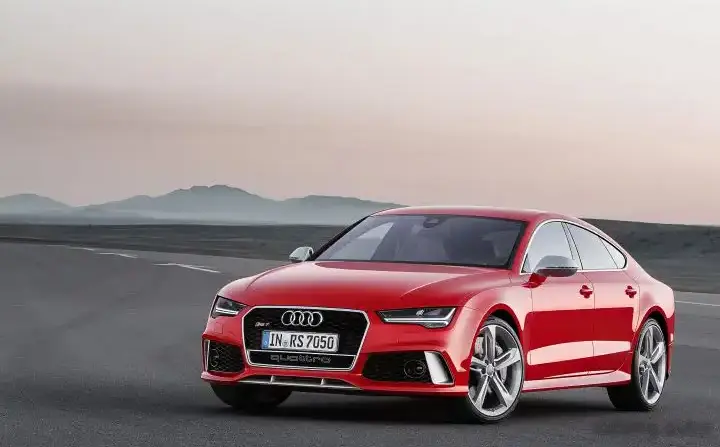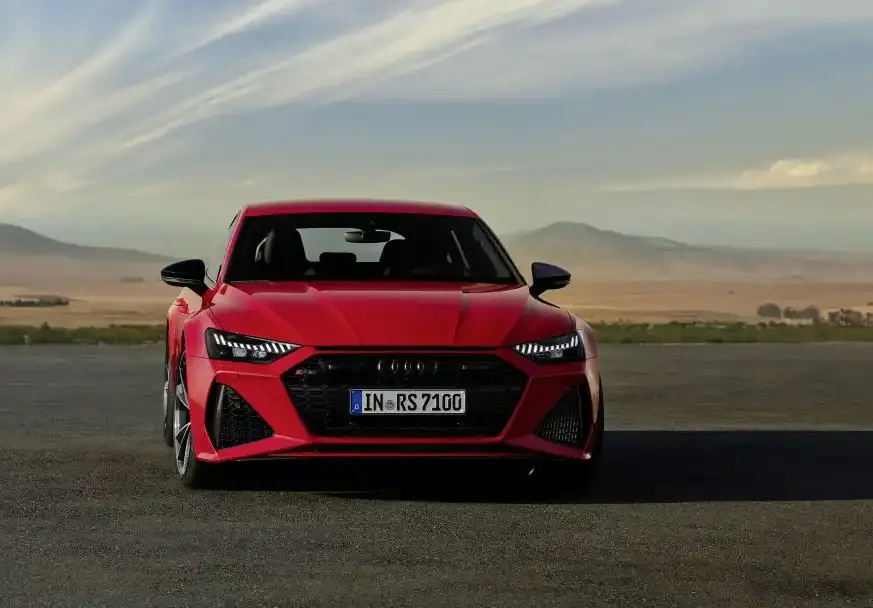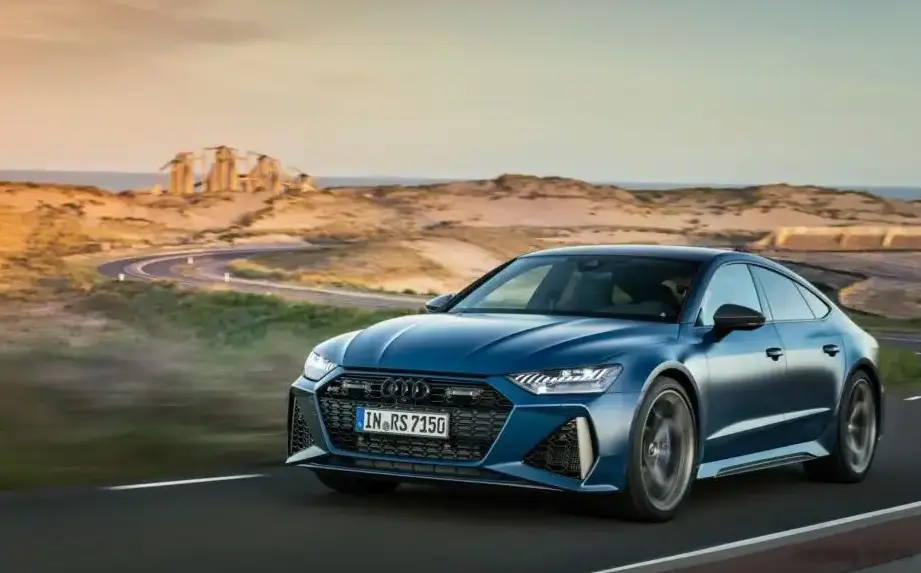
The Audi RS7 Sportback (C8) performance 4.0 TFSI V8 represents the pinnacle of performance within the C8 generation RS7 lineup, produced from November 2022 through 2025. Positioned as the flagship variant, it combines a potent twin-turbocharged V8 engine with a mild-hybrid system and Audi’s renowned quattro all-wheel-drive. This liftback sedan caters to drivers seeking uncompromising performance, luxurious appointments, and advanced technology. It builds upon the foundation of the A7 Sportback, offering a significantly enhanced driving experience focused on speed and handling.
Technical Specifications
| Brand | Audi |
| Model | RS7 |
| Generation | RS7 Sportback (C8) |
| Type | performance 4.0 TFSI V8 (630 Hp) Mild Hybrid quattro tiptronic |
| Start of production | November, 2022 |
| End of production | 2025 |
| Powertrain Architecture | MHEV (Mild Hybrid Electric Vehicle) |
| Body type | Liftback |
| Seats | 5 |
| Doors | 5 |
| Combined fuel consumption (WLTP) | 12-12.5 l/100 km (19.6 – 18.8 US mpg, 23.5 – 22.6 UK mpg, 8.3 – 8 km/l) |
| CO2 emissions (WLTP) | 273-284 g/km |
| Fuel Type | Petrol (Gasoline) |
| Acceleration 0 – 100 km/h | 3.4 sec |
| Acceleration 0 – 62 mph | 3.4 sec |
| Acceleration 0 – 60 mph | 3.2 sec |
| Maximum speed | 280 km/h (173.98 mph), Electronically limited |
| Emission standard | Euro 6d-ISC-FCM |
| Weight-to-power ratio | 3.3 kg/Hp, 305.1 Hp/tonne |
| Weight-to-torque ratio | 2.4 kg/Nm, 411.6 Nm/tonne |
| Battery voltage | 48 V |
| Battery technology | Lithium-ion (Li-Ion) |
| Battery location | Under the trunk |
| Power | 630 Hp @ 6000 rpm |
| Power per litre | 157.7 Hp/l |
| Torque | 850 Nm @ 2300-4500 rpm (626.93 lb.-ft. @ 2300-4500 rpm) |
| Engine layout | Front, Longitudinal |
| Engine displacement | 3996 cm3 (243.85 cu. in.) |
| Number of cylinders | 8 |
| Engine configuration | V-engine |
| Cylinder Bore | 86 mm (3.39 in.) |
| Piston Stroke | 86 mm (3.39 in.) |
| Compression ratio | 9.7:1 |
| Number of valves per cylinder | 4 |
| Fuel injection system | Direct injection |
| Engine aspiration | 2 x Twin-scroll turbo, Intercooler |
| Valvetrain | DOHC |
| Engine oil capacity | 9.5 l (10.04 US qt | 8.36 UK qt) |
| Coolant | 12.1 l (12.79 US qt | 10.65 UK qt) |
| Kerb Weight | 2065 kg (4552.55 lbs.) |
| Max. weight | 2735 kg (6029.64 lbs.) |
| Max load | 670 kg (1477.1 lbs.) |
| Trunk (boot) space – minimum | 523 l (18.47 cu. ft.) |
| Trunk (boot) space – maximum | 1382 l (48.8 cu. ft.) |
| Fuel tank capacity | 73 l (19.28 US gal | 16.06 UK gal) |
| Max. roof load | 90 kg (198.42 lbs.) |
| Length | 5008 mm (197.17 in.) |
| Width | 1951 mm (76.81 in.) |
| Width including mirrors | 2118 mm (83.39 in.) |
| Height | 1424 mm (56.06 in.) |
| Wheelbase | 2929 mm (115.31 in.) |
| Front track | 1668 mm (65.67 in.) |
| Rear (Back) track | 1650 mm (64.96 in.) |
| Drag coefficient (Cd) | 0.32 |
| Minimum turning circle | 12.1 m (39.7 ft.) |
| Drive wheel | All wheel drive (4×4) |
| Number of gears | 8 |
| Gearbox type | automatic transmission tiptronic |
| Front suspension | Independent multi-link suspension |
| Rear suspension | Independent multi-link suspension |
| Front brakes | Ventilated discs, 420 mm |
| Rear brakes | Ventilated discs, 370 mm |
| Tires size | 275/35 R21 |
| Wheel rims size | 10.5J x 21 |
Powertrain & Engine Architecture
At the heart of the RS7 Sportback performance lies the 4.0-liter twin-turbocharged V8 engine, designated internally as the 4.0 TFSI. This engine produces 630 horsepower at 6000 rpm and a substantial 850 Nm (626.93 lb.-ft.) of torque available from 2300 to 4500 rpm. The engine utilizes a direct injection fuel system and employs two twin-scroll turbochargers to minimize turbo lag and maximize power delivery. The mild-hybrid system, operating at 48 volts, incorporates a belt alternator-starter (BAS) and allows for features like extended engine-off coasting, regenerative braking, and smoother start-stop operation. This contributes to improved fuel efficiency, albeit marginally given the engine’s performance focus. The engine’s architecture is longitudinal, meaning it’s mounted lengthwise in the chassis. The eight-speed tiptronic automatic transmission is specifically tuned for rapid shifts and provides precise control. It’s a torque-converter automatic, offering smooth operation in normal driving and aggressive shifts in dynamic modes.
Driving Characteristics
The RS7 Sportback performance delivers exhilarating acceleration, achieving 0-60 mph in approximately 3.2 seconds. The quattro all-wheel-drive system plays a crucial role in managing the power, providing exceptional traction and stability, particularly in adverse weather conditions. The eight-speed tiptronic transmission is well-matched to the engine’s characteristics, offering quick and seamless gear changes. While the automatic transmission doesn’t offer the same level of driver engagement as a manual, it prioritizes performance and ease of use. The suspension is tuned for a balance between comfort and handling, providing a relatively compliant ride for a high-performance vehicle. The RS-specific exhaust system delivers a distinctive and aggressive sound, enhancing the driving experience.
Equipment & Trim Levels
The RS7 Sportback performance comes standard with a comprehensive suite of features, including a luxurious interior with Valcona leather upholstery, heated and ventilated front seats, a panoramic sunroof, and a premium Bang & Olufsen sound system. Audi’s virtual cockpit, a fully digital instrument cluster, is also standard. Optional extras include carbon fiber trim, RS sport seats with honeycomb stitching, and a head-up display. The exterior features a distinctive RS-specific styling package, including a gloss black grille, large air intakes, and a rear diffuser.
Chassis & Braking
The RS7 Sportback performance features an independent multi-link suspension at both the front and rear axles, optimized for handling and ride comfort. Large ventilated disc brakes, measuring 420 mm at the front and 370 mm at the rear, provide exceptional stopping power. The braking system is further enhanced by ABS (Anti-lock braking system) and electronic stability control. Available options include carbon ceramic brakes for even greater stopping performance. The vehicle also incorporates 4-wheel steering (4WS), which enhances agility at low speeds and stability at high speeds.
Market Reception & Comparison
The RS7 Sportback performance was generally well-received by automotive critics, praised for its blistering performance, luxurious interior, and advanced technology. Compared to the standard RS7, the performance variant offers a noticeable increase in power and a more aggressive driving experience. Fuel economy, however, is relatively poor, averaging around 12-12.5 l/100 km. Reliability has been generally good, although the complex engine and drivetrain components can be expensive to repair. Compared to rivals like the Porsche Panamera Turbo S and the BMW M8 Competition, the RS7 Sportback performance offers a compelling combination of performance, luxury, and practicality.
Legacy
The Audi RS7 Sportback (C8) performance 4.0 TFSI V8 is expected to be a highly sought-after vehicle in the used car market. Its potent powertrain, luxurious appointments, and distinctive styling will likely appeal to enthusiasts for years to come. While long-term reliability remains to be fully assessed, the Audi’s reputation for build quality and engineering suggests that it will prove to be a durable and rewarding vehicle, provided it receives regular maintenance. The combination of a powerful V8 engine, mild-hybrid technology, and quattro all-wheel drive represents a significant achievement in automotive engineering.