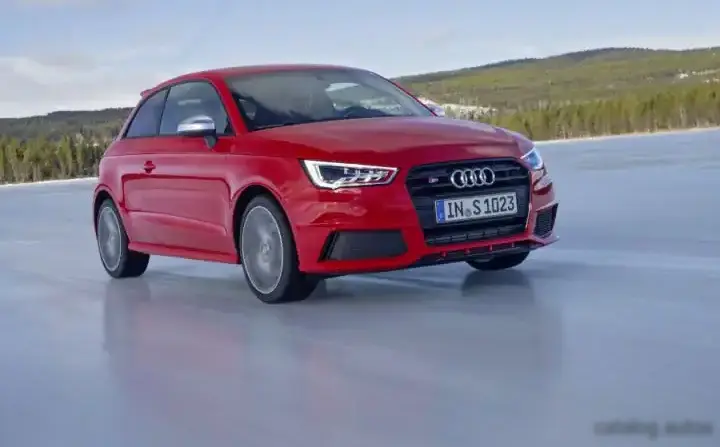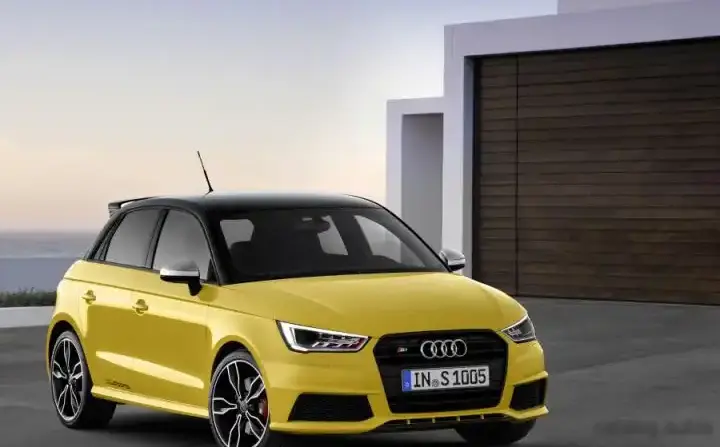
The Audi S1 Sportback 2.0 TFSI quattro, produced between 2014 and 2018, represents the high-performance variant of the Audi A1 Sportback subcompact hatchback. Positioned as the flagship model within the A1 range, the S1 Sportback aimed to deliver a compelling blend of everyday usability and engaging driving dynamics. It was primarily marketed in Europe, where the A1 platform found its greatest success, offering a premium alternative to rivals like the MINI Cooper and Volkswagen Polo GTI. This specific 2.0 TFSI quattro configuration, boasting 231 horsepower, was the most potent engine option available for the S1 Sportback.
Technical Specifications
| Brand | Audi |
| Model | S1 |
| Generation | S1 Sportback |
| Type (Engine) | 2.0 TFSI (231 Hp) quattro |
| Start of production | 2014 |
| End of production | 2018 |
| Powertrain Architecture | Internal Combustion engine |
| Body type | Hatchback |
| Seats | 5 |
| Doors | 5 |
| Fuel consumption (urban) | 9.2-9.3 l/100 km (25.6 – 25.3 US mpg) |
| Fuel consumption (extra urban) | 5.9-6 l/100 km (39.9 – 39.2 US mpg) |
| Fuel consumption (combined) | 7.1-7.2 l/100 km (33.1 – 32.7 US mpg) |
| CO2 emissions | 166-168 g/km |
| Fuel Type | Petrol (Gasoline) |
| Acceleration 0 – 100 km/h | 5.9 sec |
| Acceleration 0 – 62 mph | 5.9 sec |
| Acceleration 0 – 60 mph | 5.6 sec |
| Maximum speed | 250 km/h (155.34 mph) – Electronically limited |
| Emission standard | Euro 6 |
| Weight-to-power ratio | 5.8 kg/Hp |
| Weight-to-torque ratio | 3.6 kg/Nm |
| Power | 231 Hp @ 6000 rpm |
| Torque | 370 Nm @ 1600-3000 rpm (272.9 lb.-ft. @ 1600-3000 rpm) |
| Engine layout | Front, Transverse |
| Engine Model/Code | EA888 / CWZA |
| Engine displacement | 1984 cm3 (121.07 cu. in.) |
| Number of cylinders | 4 |
| Engine configuration | Inline |
| Cylinder Bore | 82.5 mm (3.25 in.) |
| Piston Stroke | 92.8 mm (3.65 in.) |
| Compression ratio | 9.3:1 |
| Number of valves per cylinder | 4 |
| Fuel injection system | Direct injection and Multi-port manifold injection |
| Engine aspiration | Turbocharger, Intercooler |
| Valvetrain | DOHC |
| Engine oil capacity | 5.8 l (6.13 US qt | 5.1 UK qt) |
| Coolant | 8.6 l (9.09 US qt | 7.57 UK qt) |
| Kerb Weight | 1340 kg (2954.19 lbs.) |
| Max. weight | 1790 kg (3946.27 lbs.) |
| Max load | 450 kg (992.08 lbs.) |
| Trunk (boot) space – minimum | 210 l (7.42 cu. ft.) |
| Trunk (boot) space – maximum | 860 l (30.37 cu. ft.) |
| Fuel tank capacity | 45 l (11.89 US gal | 9.9 UK gal) |
| Max. roof load | 75 kg (165.35 lbs.) |
| Length | 3975 mm (156.5 in.) |
| Width | 1746 mm (68.74 in.) |
| Width including mirrors | 1906 mm (75.04 in.) |
| Height | 1423 mm (56.02 in.) |
| Wheelbase | 2469 mm (97.2 in.) |
| Front track | 1474 mm (58.03 in.) |
| Rear (Back) track | 1452 mm (57.17 in.) |
| Front overhang | 816 mm (32.13 in.) |
| Rear overhang | 690 mm (27.17 in.) |
| Drag coefficient (Cd) | 0.34 |
| Minimum turning circle | 10.6 m (34.78 ft.) |
| Drivetrain Architecture | All wheel drive (4×4) |
| Number of gears | 6 |
| Type of gearbox | Manual transmission |
| Front suspension | Independent, type McPherson with coil spring and anti-roll bar |
| Rear suspension | Independent multi-link spring suspension with stabilizer |
| Front brakes | Ventilated discs |
| Rear brakes | Disc |
| Assisting systems | ABS (Anti-lock braking system) |
| Steering type | Steering rack and pinion |
| Power steering | Electric Steering |
| Tires size | 215/40 R17; 225/35 R18 |
| Wheel rims size | 7.5J x 17; 7.5J x 18 |
INTRODUCTION
The Audi S1 Sportback 2.0 TFSI quattro, launched in 2014, was a performance-oriented derivative of the A1 Sportback. Built on the Volkswagen Group’s PQ25 platform (also known as the 1HX0/A3 platform), it aimed to provide a more engaging driving experience than the standard A1. The S1 Sportback filled a niche for a premium, compact hot hatch, offering a blend of practicality, style, and performance. It was discontinued in 2018, coinciding with the introduction of the next-generation A1.
Powertrain & Engine Architecture
At the heart of the S1 Sportback 2.0 TFSI quattro lies the EA888 engine, specifically the CWZA variant. This 1.984-liter, turbocharged four-cylinder engine utilizes direct fuel injection combined with multi-point injection, optimizing both power delivery and fuel efficiency. The engine features a single-scroll turbocharger with an intercooler, boosting output to 231 horsepower at 6,000 rpm and 370 Nm (272.9 lb-ft) of torque between 1,600 and 3,000 rpm. The engine employs a dual overhead camshaft (DOHC) valvetrain with four valves per cylinder. The six-speed manual transmission was standard, delivering power to all four wheels via Audi’s renowned quattro all-wheel-drive system. The quattro system utilizes a multi-plate clutch to distribute torque between the front and rear axles as needed, enhancing traction and stability.
Driving Characteristics
The S1 Sportback 2.0 TFSI quattro offered a noticeably more spirited driving experience compared to the standard A1. The 231 hp engine and all-wheel-drive system combined to deliver a 0-60 mph time of around 5.6 seconds and a limited top speed of 155 mph. The manual transmission provided precise gear changes, and the quattro system instilled confidence in various driving conditions. While not as brutally fast as some of its rivals, the S1 Sportback excelled in providing accessible performance and a balanced chassis. The relatively short wheelbase contributed to a nimble feel, making it enjoyable on twisty roads. Compared to the base A1 models, the S1 Sportback’s suspension was firmer, offering improved body control, but without sacrificing too much ride comfort.
Equipment & Trim Levels
The S1 Sportback came generously equipped as standard. Key features included sport seats upholstered in a combination of cloth and leather, a leather-wrapped multi-function steering wheel, and Audi’s MMI infotainment system with a 6.5-inch display screen. Exterior styling cues included unique S line bumpers, side skirts, and a rear spoiler. Optional extras included LED headlights, a panoramic sunroof, and a Bang & Olufsen sound system. Interior trim options allowed for some personalization, with choices in dashboard and door panel materials. The S1 Sportback was positioned as the premium offering in the A1 range, and its price reflected this.
Chassis & Braking
The S1 Sportback featured a McPherson strut front suspension and a multi-link rear suspension, optimized for performance handling. The suspension was lowered compared to the standard A1, contributing to a lower center of gravity. Braking duties were handled by ventilated front discs and solid rear discs. Anti-lock braking system (ABS) was standard, along with electronic stability control (ESC). The chassis was reinforced in key areas to handle the increased power and torque. The standard tire size was 215/40 R17, with larger 225/35 R18 tires available as an option.
Market Reception & Comparison
The Audi S1 Sportback was generally well-received by automotive critics. It was praised for its engaging driving dynamics, refined interior, and stylish design. However, some reviewers noted that its performance, while respectable, wasn’t quite as exhilarating as some of its more focused rivals, such as the MINI John Cooper Works. Fuel economy was reasonable for a performance car, averaging around 33 mpg in combined driving. Reliability was generally good, although the turbocharger and direct injection system required careful maintenance. Compared to the standard A1 models, the S1 Sportback commanded a significant price premium, but offered a substantial upgrade in performance and features.
Legacy
The Audi S1 Sportback 2.0 TFSI quattro has established itself as a desirable used car. The EA888 engine, while requiring regular maintenance, is generally considered robust and reliable. The quattro all-wheel-drive system remains a key selling point, providing excellent traction in all weather conditions. The S1 Sportback’s combination of practicality, style, and performance continues to appeal to enthusiasts seeking a premium compact hot hatch. Values have remained relatively stable, reflecting the car’s enduring appeal and the reputation of the Audi brand.