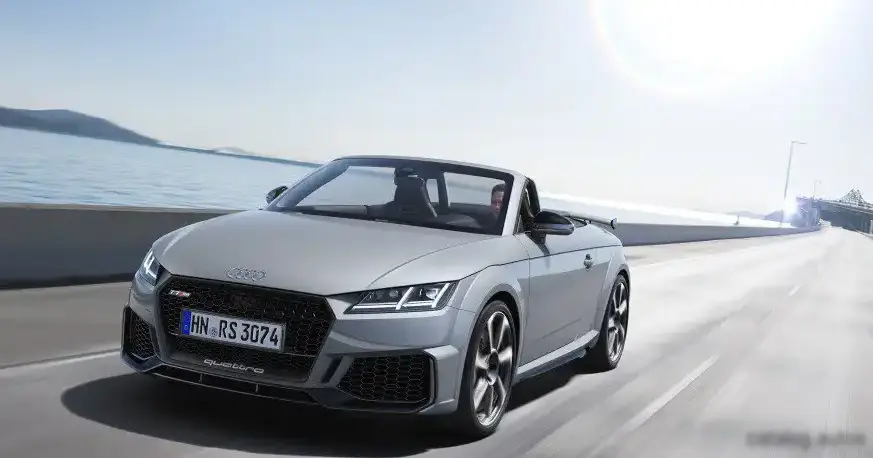
The Audi TT RS Roadster (8S, facelifted in 2019) represents the high-performance, open-top variant of the second-generation TT RS. Produced from February 2019 to October 2020, this model combined the potent 2.5-liter turbocharged five-cylinder engine with Audi’s quattro all-wheel-drive system and a seven-speed S tronic dual-clutch transmission. Positioned as the flagship Roadster within the TT lineup, it offered a more visceral and engaging driving experience than the standard TT or even the TT S. The facelift brought minor styling updates and refinements to the already capable platform, solidifying its status as a desirable sports car for enthusiasts.
Technical Specifications
| Brand | Audi |
| Model | TT |
| Generation | TT RS Roadster (8S, facelift 2019) |
| Type (Engine) | 2.5 TFSI (400 Hp) quattro S tronic |
| Start of production | February, 2019 |
| End of production | October, 2020 |
| Powertrain Architecture | Internal Combustion engine |
| Body type | Cabriolet |
| Seats | 4 |
| Doors | 2 |
| Combined fuel consumption (WLTP) | 9.4-9.5 l/100 km (25 – 24.8 US mpg, 30.1 – 29.7 UK mpg, 10.6 – 10.5 km/l) |
| CO2 emissions (WLTP) | 213-215 g/km |
| Fuel consumption (urban) | 10.6 l/100 km (22.2 US mpg, 26.6 UK mpg, 9.4 km/l) |
| Fuel consumption (extra urban) | 6.5-6.6 l/100 km (36.2 – 35.6 US mpg, 43.5 – 42.8 UK mpg, 15.4 – 15.2 km/l) |
| Fuel consumption (combined) | 8-8.1 l/100 km (29.4 – 29 US mpg, 35.3 – 34.9 UK mpg, 12.5 – 12.3 km/l) |
| CO2 emissions (NEDC) | 182-183 g/km |
| Fuel Type | Petrol (Gasoline) |
| Acceleration 0 – 100 km/h | 3.9 sec |
| Acceleration 0 – 62 mph | 3.9 sec |
| Acceleration 0 – 60 mph | 3.7 sec |
| Maximum speed | 250 km/h (155.34 mph), Electronically limited |
| Emission standard | Euro 6d-TEMP-EVAP |
| Weight-to-power ratio | 3.9 kg/Hp, 259.7 Hp/tonne |
| Weight-to-torque ratio | 3.2 kg/Nm, 311.7 Nm/tonne |
| Power | 400 Hp @ 5850-7000 rpm |
| Power per litre | 161.3 Hp/l |
| Torque | 480 Nm @ 1700-5850 rpm (354.03 lb.-ft. @ 1700-5850 rpm) |
| Engine layout | Front, Transverse |
| Engine Model/Code | EA855 evo / DAZA |
| Engine displacement | 2480 cm3 (151.34 cu. in.) |
| Number of cylinders | 5 |
| Engine configuration | Inline |
| Cylinder Bore | 82.5 mm (3.25 in.) |
| Piston Stroke | 92.8 mm (3.65 in.) |
| Compression ratio | 10:1 |
| Number of valves per cylinder | 4 |
| Fuel injection system | Direct injection and Multi-port manifold injection |
| Engine aspiration | Turbocharger, Intercooler |
| Valvetrain | DOHC |
| Engine oil capacity | 7.1 l (7.5 US qt | 6.25 UK qt) |
| Coolant | 9.1 l (9.62 US qt | 8.01 UK qt) |
| Kerb Weight | 1540 kg (3395.12 lbs.) |
| Max. weight | 1885 kg (4155.71 lbs.) |
| Max load | 345 kg (760.59 lbs.) |
| Trunk (boot) space – minimum | 280 l (9.89 cu. ft.) |
| Fuel tank capacity | 55 l (14.53 US gal | 12.1 UK gal) |
| Length | 4201 mm (165.39 in.) |
| Width | 1832 mm (72.13 in.) |
| Width including mirrors | 1966 mm (77.4 in.) |
| Height | 1346 mm (52.99 in.) |
| Wheelbase | 2505 mm (98.62 in.) |
| Front track | 1564 mm (61.57 in.) |
| Rear track | 1543 mm (60.75 in.) |
| Front overhang | 893 mm (35.16 in.) |
| Rear overhang | 803 mm (31.61 in.) |
| Drag coefficient (Cd) | 0.35 |
| Minimum turning circle | 10.96 m (35.96 ft.) |
| Drivetrain Architecture | All wheel drive (4×4). ICE drives front wheels, rear driven by clutch. |
| Number of gears | 7 |
| Gearbox type | Automatic transmission S tronic |
| Front suspension | Independent, McPherson with coil spring and anti-roll bar |
| Rear suspension | Independent multi-link spring suspension with stabilizer |
| Front brakes | Ventilated discs |
| Rear brakes | Disc |
| Assisting systems | ABS (Anti-lock braking system) |
| Steering type | Steering rack and pinion |
| Power steering | Electric |
| Tires size | 245/35 R 19; 255/30 R20 |
| Wheel rims size | 9J x 19; 9J x 20 |
INTRODUCTION
The 2019-2020 Audi TT RS Roadster, a product of the 8S generation’s facelift, is a performance-focused convertible built upon the Volkswagen Group’s MQB platform. This platform underpins a wide range of vehicles, including the Audi A3, Volkswagen Golf, and SEAT Leon. The TT RS Roadster distinguishes itself through its high-revving, turbocharged five-cylinder engine, quattro all-wheel drive, and a sporty suspension setup. It aimed to deliver a thrilling open-air driving experience without sacrificing the everyday usability expected of an Audi. The facelift brought subtle cosmetic changes, primarily to the front and rear fascias, along with updated infotainment and driver-assistance systems.
Powertrain & Engine Architecture
At the heart of the TT RS Roadster lies the EA855 evo 2.5-liter inline-five cylinder engine, internally designated as the DAZA code. This engine is a significant departure from the four-cylinder engines found in most TT models. It utilizes a cast iron block with an aluminum cylinder head, and employs both direct injection and multi-port fuel injection to optimize combustion efficiency and power delivery. The engine is turbocharged with a twin-scroll turbocharger, which minimizes turbo lag and provides a broad torque curve. The valvetrain features dual overhead camshafts (DOHC) and four valves per cylinder. The seven-speed S tronic dual-clutch transmission provides rapid and precise gear changes, contributing to the car’s impressive acceleration. This transmission features a multi-plate wet clutch and allows for both automatic and manual shifting via steering wheel-mounted paddles.
Driving Characteristics
The 2.5 TFSI engine in the TT RS Roadster delivers a unique driving experience. The 400 horsepower and 354 lb-ft of torque are readily available, providing strong acceleration throughout the rev range. The S tronic transmission complements the engine perfectly, offering quick shifts and a responsive feel. The quattro all-wheel-drive system ensures excellent traction, particularly in challenging conditions. While the Roadster adds weight compared to the coupe, the 0-60 mph sprint still takes a mere 3.7 seconds. The gear ratios are tuned for performance, prioritizing acceleration over outright fuel economy. Compared to the standard TT or TT S, the RS Roadster offers a significantly more engaging and visceral driving experience, with a more aggressive exhaust note and sharper handling.
Equipment & Trim Levels
The TT RS Roadster came generously equipped as standard. Key features included sport seats upholstered in Nappa leather with diamond stitching, a flat-bottomed steering wheel, Audi’s Virtual Cockpit digital instrument cluster, and a premium Bang & Olufsen sound system. Exterior features included a unique RS honeycomb grille, large exhaust outlets, and RS-specific badging. Optional extras included carbon fiber trim pieces, upgraded wheels, and various driver-assistance systems such as adaptive cruise control and blind-spot monitoring. The interior design was focused on a driver-centric layout, with controls positioned for easy access and a sporty aesthetic.
Chassis & Braking
The TT RS Roadster features a fully independent suspension system. The front utilizes a McPherson strut setup with a stabilizer bar, while the rear employs a multi-link suspension with a stabilizer bar. This configuration provides a good balance between ride comfort and handling precision. The braking system consists of ventilated discs at all four corners, providing ample stopping power. The ABS (Anti-lock Braking System) is standard, enhancing safety and control. The chassis is reinforced compared to the standard TT to handle the increased power and torque of the RS engine. The steering is a rack-and-pinion system with electric power assistance, offering precise and responsive steering feel.
Market Reception & Comparison
The Audi TT RS Roadster was generally well-received by automotive critics. It was praised for its powerful engine, engaging driving dynamics, and stylish design. However, some reviewers noted that the Roadster’s added weight compared to the coupe slightly diminished its handling agility. Compared to other trims in the TT lineup, the RS Roadster represented a significant performance upgrade. The standard TT focused on style and comfort, while the TT S offered a balance between performance and practicality. The RS Roadster, however, was purely focused on delivering a thrilling driving experience. Fuel economy was a compromise, with the RS Roadster consuming significantly more fuel than its less powerful siblings.
Legacy
The 2.5 TFSI engine in the TT RS Roadster has proven to be a robust and reliable powertrain when properly maintained. While the engine itself is generally considered durable, regular oil changes and adherence to the manufacturer’s maintenance schedule are crucial. The S tronic transmission is also generally reliable, but can be expensive to repair if issues arise. In the used car market, the TT RS Roadster holds its value well, due to its limited production numbers and desirable performance characteristics. It remains a popular choice for enthusiasts seeking a high-performance, open-top sports car with a unique engine and engaging driving dynamics.