
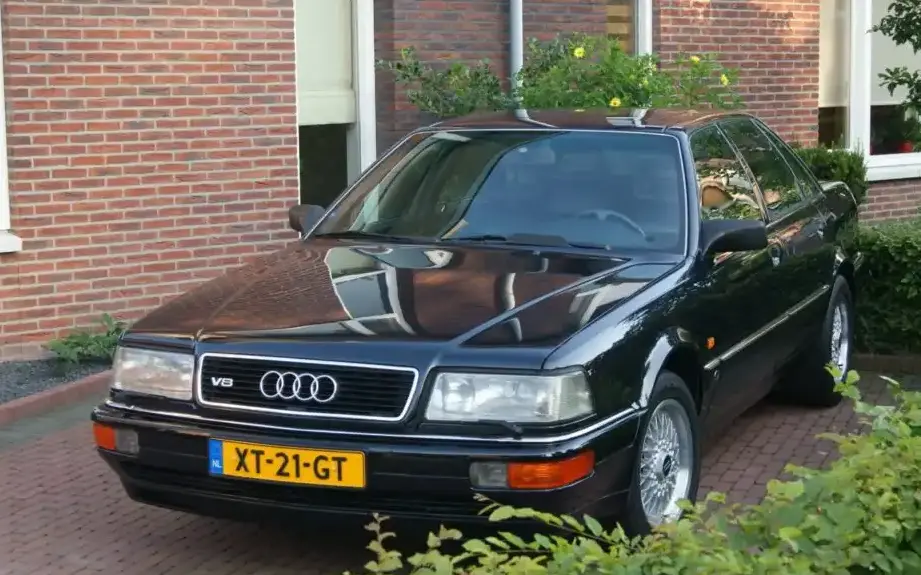
The Audi V8 (D11) 3.6 quattro, produced between October 1988 and November 1993, represented a significant step forward for Audi, establishing the brand firmly in the luxury performance sedan segment. This model, the flagship of the D11 series, was the first Audi to feature permanent all-wheel drive combined with a V8 engine. It served as a technological showcase for the brand, previewing many features that would become hallmarks of Audi’s quattro lineage. The 3.6-liter variant, producing 250 horsepower, occupied the top position in the V8 range, offering a blend of performance and refinement aimed at discerning buyers.
Technical Specifications
| Brand | Audi |
| Model | V8 |
| Generation | V8 (D11) |
| Type (Engine) | 3.6 (250 Hp) quattro |
| Start of production | October, 1988 |
| End of production | November, 1993 |
| Powertrain Architecture | Internal Combustion engine |
| Body type | Sedan |
| Seats | 5 |
| Doors | 4 |
| Fuel consumption (urban) | 17.5 l/100 km (13.4 US mpg, 16.1 UK mpg, 5.7 km/l) |
| Fuel consumption (extra urban) | 8.7 l/100 km (27 US mpg, 32.5 UK mpg, 11.5 km/l) |
| Fuel consumption (combined) | 10.5 l/100 km (22.4 US mpg, 26.9 UK mpg, 9.5 km/l) |
| Fuel Type | Petrol (Gasoline) |
| Acceleration 0 – 100 km/h | 7.6 sec |
| Acceleration 0 – 62 mph | 7.6 sec |
| Acceleration 0 – 60 mph | 7.2 sec |
| Maximum speed | 244 km/h (151.61 mph) |
| Weight-to-power ratio | 6.8 kg/Hp, 146.2 Hp/tonne |
| Weight-to-torque ratio | 5 kg/Nm, 198.8 Nm/tonne |
| Power | 250 Hp @ 5800 rpm |
| Power per litre | 70.2 Hp/l |
| Torque | 340 Nm @ 4000 rpm (250.77 lb.-ft. @ 4000 rpm) |
| Engine layout | Front, Longitudinal |
| Engine Model/Code | PT |
| Engine displacement | 3562 cm3 (217.37 cu. in.) |
| Number of cylinders | 8 |
| Engine configuration | V-engine |
| Cylinder Bore | 81 mm (3.19 in.) |
| Piston Stroke | 86.4 mm (3.4 in.) |
| Compression ratio | 10.6:1 |
| Number of valves per cylinder | 4 |
| Fuel injection system | Multi-port manifold injection |
| Engine aspiration | Naturally aspirated engine |
| Valvetrain | DOHC |
| Engine oil capacity | 8 l (8.45 US qt | 7.04 UK qt) |
| Coolant | 10.5 l (11.1 US qt | 9.24 UK qt) |
| Kerb Weight | 1710 kg (3769.9 lbs.) |
| Max. weight | 2310 kg (5092.68 lbs.) |
| Max load | 600 kg (1322.77 lbs.) |
| Trunk (boot) space – minimum | 570 l (20.13 cu. ft.) |
| Fuel tank capacity | 80 l (21.13 US gal | 17.6 UK gal) |
| Length | 4874 mm (191.89 in.) |
| Width | 1814 mm (71.42 in.) |
| Height | 1420 mm (55.91 in.) |
| Wheelbase | 2702 mm (106.38 in.) |
| Front track | 1514 mm (59.61 in.) |
| Rear (Back) track | 1531 mm (60.28 in.) |
| Drag coefficient (Cd) | 0.35 |
| Minimum turning circle | 11.5 m (37.73 ft.) |
| Drive wheel | All wheel drive (4×4) |
| Number of gears | 5 gears, manual transmission |
| Front suspension | Wishbone |
| Rear suspension | Double wishbone |
| Front brakes | Ventilated discs |
| Rear brakes | Disc |
| Assisting systems | ABS (Anti-lock braking system) |
| Steering type | Steering rack and pinion |
| Power steering | Hydraulic Steering |
| Tires size | 215/60 R15 |
| Wheel rims size | 15 |
INTRODUCTION
The Audi V8 (D11) was a pivotal model for Audi, launched in 1988 as a direct competitor to the BMW 7 Series and Mercedes-Benz S-Class. It represented a significant departure from Audi’s traditionally front-wheel-drive offerings, embracing a longitudinal engine layout and permanent all-wheel drive – the quattro system – as standard equipment. The 3.6-liter quattro variant was the range-topper, offering the most powerful engine available and a comprehensive list of standard features. It was built on the Audi D11 platform, which also underpinned the later Audi 100. The V8 aimed to establish Audi as a true luxury brand capable of challenging the established German giants.
Powertrain & Engine Architecture
The heart of the V8 3.6 quattro is the PT engine, a naturally aspirated 3.6-liter (3562 cc) V8. This engine, based on a 90-degree V-angle configuration, was designed for smooth operation and high torque output. It featured a cast iron block and aluminum cylinder heads, employing dual overhead camshafts (DOHC) and four valves per cylinder. Fuel delivery was handled by a Bosch Motronic multi-port fuel injection system, optimizing fuel efficiency and performance. The engine produced 250 horsepower at 5800 rpm and 340 Nm (250.77 lb-ft) of torque at 4000 rpm. The engine’s longitudinal mounting allowed for a more balanced weight distribution, contributing to improved handling. The standard transmission was a five-speed manual, although a four-speed automatic transmission was also available, though less common and generally considered to diminish the car’s performance potential.
Driving Characteristics
The V8 3.6 quattro offered a refined and capable driving experience. The 3.6-liter V8 provided ample power for effortless cruising and brisk acceleration. Acceleration from 0 to 60 mph took approximately 7.2 seconds, and it could reach a top speed of 151.61 mph. The permanent all-wheel drive system provided excellent traction in all weather conditions, enhancing stability and control. The five-speed manual transmission offered precise shifts and allowed the driver to fully exploit the engine’s power. While not a sports car in the purest sense, the V8 3.6 quattro delivered a confident and engaging driving experience, blending performance with luxury. Compared to the later 2.8L V6 models, the 3.6 offered significantly more power and torque, resulting in a more responsive and rewarding driving experience.
Equipment & Trim Levels
The V8 3.6 quattro was generously equipped as standard. Interior features included leather upholstery, power-adjustable front seats with memory function, climate control, and a high-quality sound system. Exterior features included alloy wheels, a sunroof, and body-colored bumpers and mirrors. Optional extras included a premium sound system, upgraded leather trim, and a rear window sunshade. The interior design was understated and elegant, reflecting Audi’s commitment to quality and refinement. The dashboard layout was functional and ergonomic, providing easy access to all controls.
Chassis & Braking
The V8 3.6 quattro featured a robust chassis designed to handle the power of the V8 engine and the demands of all-wheel drive. The suspension consisted of independent wishbone suspension at the front and a double wishbone setup at the rear, providing a comfortable ride and precise handling. Ventilated disc brakes were fitted to all four wheels, providing ample stopping power. An Anti-lock Braking System (ABS) was standard, enhancing safety and control during emergency braking. The steering was a rack-and-pinion system with hydraulic power assistance, offering precise and responsive steering feel.
Market Reception & Comparison
The Audi V8 3.6 quattro was generally well-received by automotive critics, who praised its performance, refinement, and all-wheel-drive system. However, it was often criticized for its relatively high price compared to its competitors. Fuel economy was also a concern, with combined fuel consumption averaging around 22.4 US mpg. Compared to the 2.8L V6 models, the 3.6 offered a significant performance advantage but came at a higher price and with increased running costs. The 3.6 quattro appealed to buyers who prioritized performance and luxury over fuel efficiency and value.
Legacy
The Audi V8 (D11) 3.6 quattro holds a significant place in Audi’s history as the first model to combine a V8 engine with the quattro all-wheel-drive system. It established Audi as a serious contender in the luxury performance sedan segment and paved the way for future generations of high-performance Audis. Today, the V8 3.6 quattro is a sought-after classic car, appreciated by enthusiasts for its rarity, performance, and technological innovation. While maintenance can be costly due to the age and complexity of the vehicle, well-maintained examples are becoming increasingly valuable. The PT engine, while robust, requires regular maintenance to ensure longevity, and parts availability can be a challenge. The V8 remains a testament to Audi’s engineering prowess and a symbol of the brand’s commitment to innovation.
