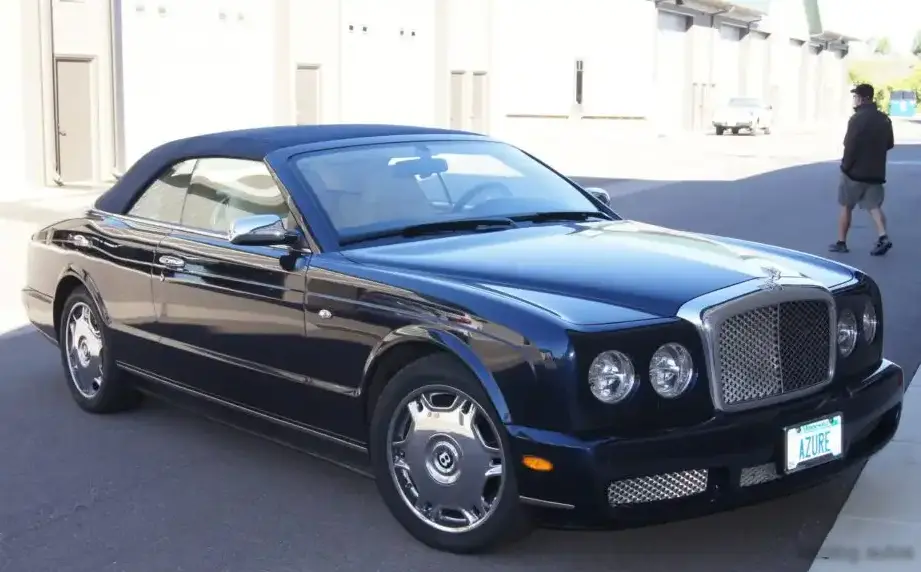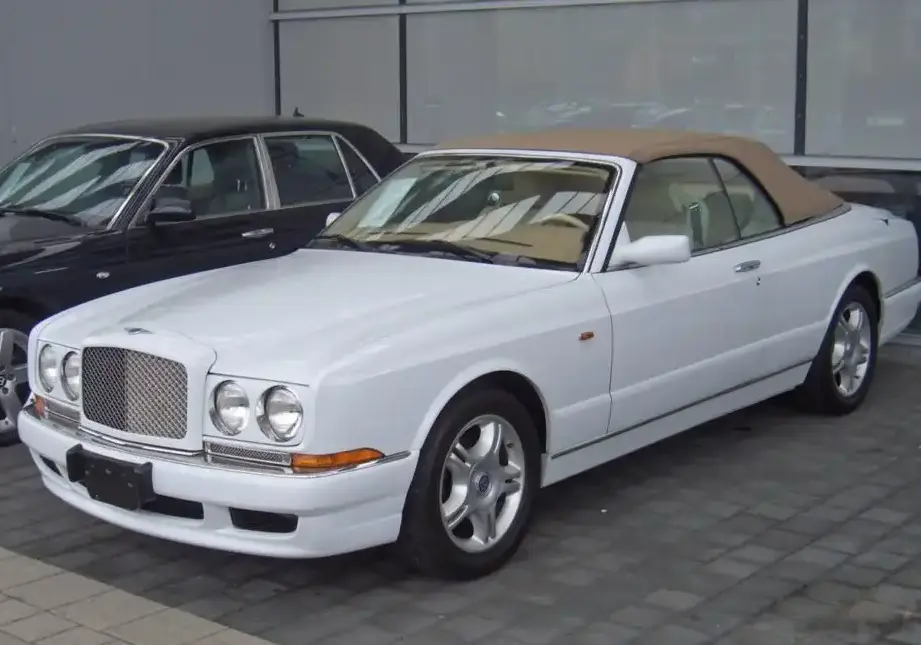
The Bentley Azure is a large, four-seater, luxury convertible grand tourer that was launched in 1995 and built by the British automobile manufacturer Bentley Motors. Derived from the Continental R coupe, the Azure was designed to be the pinnacle of open-top motoring, combining traditional British craftsmanship with formidable performance. The first-generation model, produced from 1995 until 2003, is particularly notable for its imposing presence and its use of Bentley’s legendary V8 engine. The initial and most common variant of this automobile is the Bentley Azure 6.7 i V8 (389 Hp), a machine that defined an era of unapologetic opulence and effortless power, representing one of the last true expressions of Crewe’s engineering before the full integration into the Volkswagen Group.
History and Development
The genesis of the Bentley Azure can be traced to the significant success of the Bentley Continental R, which had re-established Bentley as a producer of high-performance luxury coupes in its own right, distinct from its parent company, Rolls-Royce. The demand for an equally impressive convertible version was palpable, and Bentley began development to create a worthy flagship for its open-air offerings.
However, the engineering challenge of converting the substantial monocoque structure of the Continental R into a convertible without compromising structural integrity was immense. Removing the roof from a vehicle of such size and weight could have led to significant chassis flex, negatively impacting handling and refinement. To overcome this, Bentley enlisted the expertise of the renowned Italian design house and coachbuilder, Pininfarina. The collaboration was a logical step, as Pininfarina possessed extensive experience in engineering and producing limited-run convertibles for major manufacturers.
Pininfarina was responsible for the entire conversion process, which included engineering the complex, electro-hydraulic, fully automatic convertible hood, manufacturing the roof mechanism and body shell modifications, and performing the final assembly. The process was detailed and expensive. Partially assembled bodies were shipped from Bentley’s Crewe factory in England to Pininfarina’s facility in Turin, Italy, where the convertible structure was integrated. This included the addition of substantial under-body reinforcements, strengthened A-pillars, and a robust rear bulkhead to restore torsional rigidity. Once this work was completed, the bodies were returned to Crewe for the installation of the powertrain, suspension, electronics, and the meticulously handcrafted interior. This complex international production process contributed significantly to the Azure’s high price and exclusivity. The fully-lined fabric roof was a marvel of its time, celebrated for its size, insulation, and smooth operation, tucking away neatly beneath a hand-stitched leather tonneau cover.
Design and Styling
Exterior
The Bentley Azure’s design is a statement of grandeur and presence. With a length of 5,342 mm (210.31 in.) and a width of 1,878 mm (73.94 in.), it is an exceptionally large vehicle, commanding attention on any road. The styling is a direct evolution of the Continental R, featuring a low-slung but powerful stance, long bonnet, and muscular rear haunches. The front is dominated by Bentley’s iconic matrix grille and the classic quad-headlamp arrangement, which gave the car an assertive yet elegant face. The lines are clean and flowing, intended to evoke a sense of motion even when stationary.
With the roof up, the Azure maintains a sleek, coupe-like silhouette, thanks to the well-designed fabric top. However, it is with the roof down that the car’s true character as a luxurious four-seater convertible is revealed. The vast, open cabin and the unbroken beltline that sweeps from the bonnet around the passenger compartment create an aesthetic of unparalleled opulence and freedom. The standard 17-inch alloy wheels, fitted with 255/55 R17 tires, appear suitably proportioned to the car’s massive scale and contribute to its planted, reassuring stance.
Interior
The cabin of the Bentley Azure is where the brand’s reputation for bespoke luxury is most evident. It is a masterpiece of traditional craftsmanship, featuring materials of the highest quality. Vast expanses of hand-stitched Connolly leather cover nearly every surface, from the seats and dashboard to the door panels and even the tonneau cover. Customers could choose from a virtually limitless palette of hide colours and piping options.
Polished burr walnut veneers, sourced from a single tree to ensure a perfect match in grain and colour, adorn the dashboard, centre console, and door cappings. The instrumentation is housed in classic chrome-bezelled dials, providing a clear and timeless display of the car’s vital statistics. Every switch, knob, and air vent is crafted from solid metal, contributing to the feeling of immense quality and durability. Deep-pile Wilton carpets line the floor, further enhancing the sense of luxury.
Unlike many convertibles that offer only token rear seats, the Azure was designed as a genuine four-seater. The rear passengers are afforded generous legroom and comfortable, individually sculpted seats, making the car a practical choice for long-distance touring with friends or family.
Powertrain and Performance of the Bentley Azure 6.7 i V8 (389 Hp)
At the heart of the first-generation Azure lies Bentley’s legendary 6.75-litre L-Series V8 engine. This engine, with a lineage dating back to 1959, had been continuously developed over decades and, in the Azure, featured a single, large Garrett turbocharger and an air-to-water intercooler. The version used in the Bentley Azure 6.7 i V8 (389 Hp) model produced 389 horsepower (290 kW) at a leisurely 4,000 rpm.
While the horsepower figure was impressive for its time, the engine’s defining characteristic was its monumental torque. It generated a staggering 750 Nm (553 lb-ft) of torque from just 2,000 rpm. This immense low-end pulling power is what shaped the Azure’s driving character. Rather than requiring high revs to deliver performance, the V8 provided a massive, instantaneous surge of acceleration from almost any speed. This wave of torque allowed the 2,610 kg (5,754 lbs) car to gather momentum with deceptive and effortless ease.
This powertrain enabled the Bentley Azure 6.7 i V8 (389 Hp) to accelerate from 0 to 100 km/h (62 mph) in a brisk 6.7 seconds and reach a top speed of 241 km/h (150 mph). These figures were remarkable for a vehicle of its size, weight, and luxury orientation. The performance was delivered not with the frenetic urgency of a sports car, but with the composed, relentless push of a locomotive.
Power was sent to the rear wheels via a GM-sourced 4L80-E four-speed automatic transmission. This gearbox was one of the few available at the time robust enough to reliably handle the V8 engine’s prodigious torque output. It was calibrated for smooth, almost imperceptible shifts, prioritizing refinement and comfort over lightning-fast gear changes, in keeping with the car’s grand touring mission.
Chassis, Suspension, and Handling
The Azure’s underpinnings were based on the Continental R but were extensively re-engineered to handle the demands of its convertible body. The significant chassis strengthening resulted in a curb weight of 2,610 kg, making it one of the heaviest passenger cars on the market. This weight, combined with its long wheelbase of 3,061 mm (120.51 in.), defined its handling characteristics.
The suspension setup featured double wishbones at the front and a coil spring arrangement at the rear, complete with an adaptive damping system. This electronically controlled system continuously adjusted the stiffness of the dampers to balance a cosseting ride quality with controlled body movements during cornering and braking. The primary focus was on comfort and stability, allowing the Azure to glide over road imperfections with serene composure.
While not a nimble sports car, its handling was safe and predictable. The power-assisted rack-and-pinion steering was light and geared for effortless cruising rather than sharp driver feedback. The massive ventilated front disc and solid rear disc brakes, equipped with an anti-lock braking system (ABS), provided sufficient stopping power to haul the heavyweight convertible down from speed with confidence. The Azure’s domain was the open road—motorways and sweeping coastal routes—where its combination of immense power, supreme comfort, and high-speed stability made it an unparalleled long-distance tourer