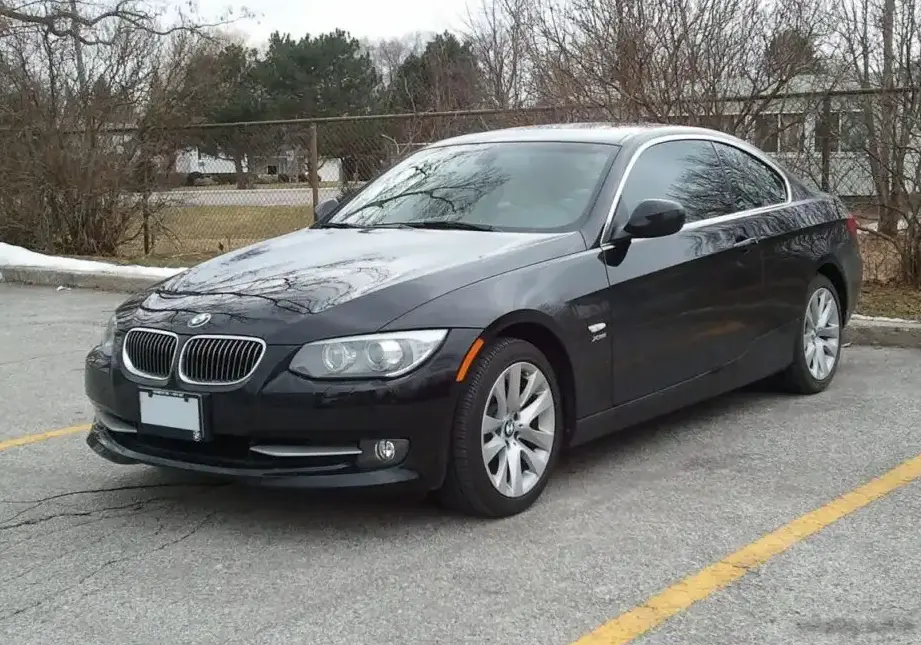
Technical Specifications
| Brand | BMW |
| Model | 3 Series |
| Generation | 3 Series Coupe (E92 LCI, facelift 2010) |
| Type (Engine) | 320d (184 Hp) |
| Start of production | 2010 |
| End of production | 2013 |
| Powertrain Architecture | Internal Combustion engine |
| Body type | Coupe |
| Seats | 4 |
| Doors | 2 |
| Fuel consumption (urban) | 5.9 l/100 km (39.9 US mpg, 47.9 UK mpg, 16.9 km/l) |
| Fuel consumption (extra urban) | 4 l/100 km (58.8 US mpg, 70.6 UK mpg, 25 km/l) |
| Fuel consumption (combined) | 4.7 l/100 km (50 US mpg, 60.1 UK mpg, 21.3 km/l) |
| CO2 emissions | 125 g/km |
| Fuel Type | Diesel |
| Acceleration 0 – 100 km/h | 7.5 sec |
| Acceleration 0 – 62 mph | 7.5 sec |
| Acceleration 0 – 60 mph | 7.1 sec |
| Maximum speed | 237 km/h (147.26 mph) |
| Emission standard | Euro 5 |
| Weight-to-power ratio | 7.7 kg/Hp, 129.6 Hp/tonne |
| Weight-to-torque ratio | 3.7 kg/Nm, 267.6 Nm/tonne |
| Power | 184 Hp @ 4000 rpm |
| Torque | 380 Nm @ 1900-2750 rpm (280.27 lb.-ft. @ 1900-2750 rpm) |
| Engine layout | Front, Longitudinal |
| Engine Model/Code | N47D20C |
| Engine displacement | 1995 cm3 (121.74 cu. in.) |
| Number of cylinders | 4 |
| Engine configuration | Inline |
| Cylinder Bore | 84 mm (3.31 in.) |
| Piston Stroke | 90 mm (3.54 in.) |
| Compression ratio | 16.5:1 |
| Number of valves per cylinder | 4 |
| Fuel injection system | Diesel Commonrail |
| Engine aspiration | Turbocharger, Intercooler |
| Engine oil capacity | 5.2 l (5.49 US qt | 4.58 UK qt) |
| Coolant | 7.5 l (7.93 US qt | 6.6 UK qt) |
| Kerb Weight | 1420 kg (3130.56 lbs.) |
| Max. weight | 1900 kg (4188.78 lbs.) |
| Max load | 480 kg (1058.22 lbs.) |
| Trunk (boot) space – minimum | 440 l (15.54 cu. ft.) |
| Fuel tank capacity | 61 l (16.11 US gal | 13.42 UK gal) |
| Max. roof load | 75 kg (165.35 lbs.) |
| Permitted trailer load with brakes (12%) | 1600 kg (3527.4 lbs.) |
| Permitted trailer load without brakes | 745 kg (1642.44 lbs.) |
| Permitted towbar download | 75 kg (165.35 lbs.) |
| Length | 4612 mm (181.57 in.) |
| Width | 1782 mm (70.16 in.) |
| Width including mirrors | 1961 mm (77.2 in.) |
| Height | 1395 mm (54.92 in.) |
| Wheelbase | 2760 mm (108.66 in.) |
| Front track | 1500 mm (59.06 in.) |
| Rear (Back) track | 1513 mm (59.57 in.) |
| Ride height (ground clearance) | 143 mm (5.63 in.) |
| Drag coefficient (Cd) | 0.28 |
| Minimum turning circle (turning diameter) | 11.0 m (36.09 ft.) |
| Drivetrain Architecture | The Internal combustion engine (ICE) drives the rear wheels of the vehicle. |
| Drive wheel | Rear wheel drive |
| Number of gears and type of gearbox | 6 gears, manual transmission |
| Front suspension | Independent coil spring |
| Rear suspension | Independent multi-link suspension |
| Front brakes | Ventilated discs |
| Rear brakes | Ventilated discs |
| Assisting systems | ABS (Anti-lock braking system) |
| Steering type | Steering rack and pinion |
| Power steering | Electric Steering |
| Tires size | 225/45 R17 91V |
| Wheel rims size | 8J x 17 |
The BMW 3 Series Coupe (E92 LCI) 320d, produced from 2010 through 2013, represents a refined iteration of BMW’s popular sports coupe. Introduced with the Life Cycle Impulse (LCI) facelift, this model aimed to enhance the E92 platform with updated styling, improved efficiency, and modern technology. Positioned as an accessible entry point into the 3 Series Coupe range, the 320d offered a compelling blend of performance and fuel economy, appealing to a wide range of buyers. It sat below the more powerful 335i and 335d models, targeting customers who valued efficiency and refinement over outright speed.
Powertrain & Engine Architecture
The 320d Coupe LCI is powered by the N47D20C 2.0-liter inline-four diesel engine. This engine is a key component of BMW’s strategy to improve fuel economy and reduce emissions. The N47 engine family, first introduced in 2007, was distinguished by its second-generation common rail direct injection system, capable of operating at pressures up to 1,800 bar. This high-pressure injection, combined with a variable geometry turbocharger and intercooler, allowed for a favorable balance between power and fuel efficiency. The N47D20C specifically generates 184 horsepower at 4,000 rpm and 380 Nm (280 lb-ft) of torque between 1,900 and 2,750 rpm. The engine features four valves per cylinder and utilizes a timing chain, contributing to its overall durability. The 320d was typically offered with a six-speed manual transmission, although a six-speed automatic transmission was also available. The automatic transmission provided smooth gear changes and enhanced driving ease, but at the cost of some performance and fuel economy compared to the manual version.
Driving Characteristics
The 320d Coupe LCI, when equipped with the manual transmission, delivered a reasonably engaging driving experience. While not as thrilling as the 335i, the 320d provided sufficient torque for everyday driving and confident overtaking maneuvers. The six-speed manual gearbox was precise and well-weighted, enhancing driver involvement. The automatic transmission, while smooth, felt somewhat less responsive and occasionally exhibited gear hunting. The rear-wheel-drive configuration contributed to the car’s balanced handling, and the E92’s chassis provided a firm yet comfortable ride. Compared to the higher-output models, the 320d felt less stressed during spirited driving, potentially contributing to its long-term reliability. However, it lacked the immediate acceleration and high-end power of its more potent counterparts.
Equipment & Trim Levels
The 320d Coupe LCI came standard with a solid array of features. These typically included automatic climate control, a multi-function steering wheel, power windows and mirrors, and a basic audio system. The LCI facelift brought updated interior trim options and improved infotainment systems. Numerous optional extras were available, such as leather upholstery, a premium sound system, navigation, parking sensors, and a sunroof. Sport packages were also offered, adding features like sport seats, a sport-tuned suspension, and unique exterior styling elements. The interior design was generally well-executed, prioritizing functionality and driver ergonomics.
Chassis & Braking
The E92 Coupe employed a MacPherson strut front suspension and a multi-link rear suspension, providing a good compromise between ride comfort and handling precision. The 320d typically featured ventilated disc brakes on all four wheels, offering adequate stopping power for its weight and performance capabilities. Anti-lock braking system (ABS) was standard, along with electronic brake-force distribution (EBD). The suspension was tuned to provide a slightly firmer ride than the 3 Series sedan, reflecting the coupe’s sporting intentions. Stabilizer bars were fitted to both the front and rear axles to minimize body roll during cornering.
Market Reception & Comparison
The 320d Coupe LCI was generally well-received by automotive critics. It was praised for its fuel efficiency, comfortable ride quality, and refined interior. Some reviewers did note that the engine could be somewhat noisy under heavy acceleration. Compared to the 335i, the 320d offered a more affordable entry point into the 3 Series Coupe range, albeit with a trade-off in performance. When compared to competitors like the Audi A5 Coupe and Mercedes-Benz C-Class Coupe, the 320d held its own in terms of driving dynamics and overall refinement. Its fuel economy was particularly competitive, making it an attractive option for buyers prioritizing efficiency.
Legacy
The N47 engine family, including the N47D20C found in the 320d Coupe LCI, has proven to be generally reliable, although early versions were known to experience issues with the timing chain. Consistent maintenance, including regular oil changes and timing chain inspections, is crucial for ensuring long-term durability. Today, the 320d Coupe LCI represents a relatively affordable and well-rounded sports coupe. Its combination of fuel efficiency, comfortable ride, and stylish design continues to appeal to used car buyers. While it may not be the fastest or most luxurious option in its class, it offers a compelling blend of practicality and driving enjoyment.