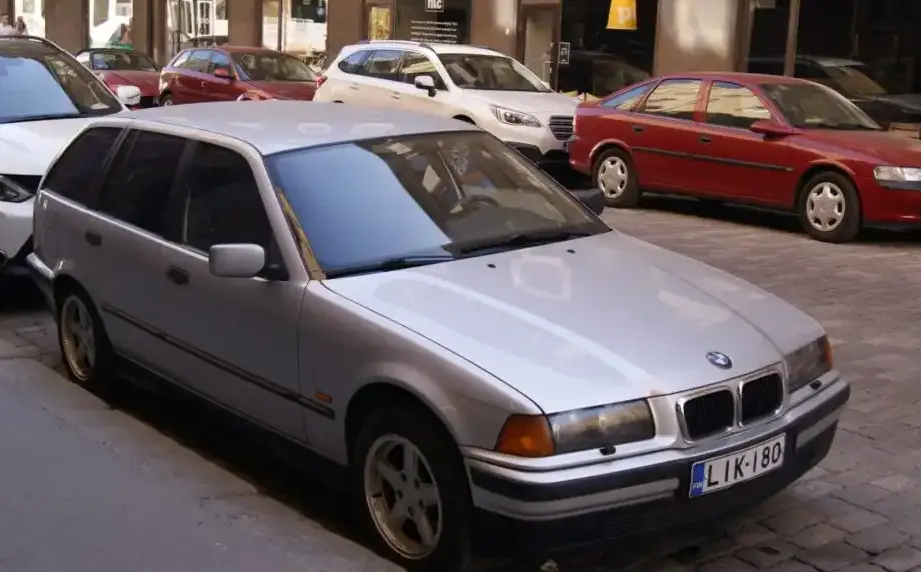
The BMW 3 Series Touring (E36) 318tds, produced from 1995 to 2000, represents a unique offering within the broader E36 3 Series range. This variant combined the practicality of the Touring (station wagon) body style with a fuel-efficient, albeit modestly powered, diesel engine. Positioned as an entry-level or mid-range option depending on the market, the 318tds catered to buyers prioritizing economy and usability over outright performance. It was particularly popular in Europe, where diesel engines held a significant market share, and offered a compelling alternative to gasoline-powered 3 Series models.
Technical Specifications
| Brand | BMW |
| Model | 3 Series |
| Generation | 3 Series Touring (E36) |
| Type (Engine) | 318tds (90 Hp) |
| Start of production | 1995 |
| End of production | 2000 |
| Powertrain Architecture | Internal Combustion engine |
| Body type | Station wagon (estate) |
| Seats | 5 |
| Doors | 5 |
| Fuel consumption (economy) – urban | 8.8 l/100 km (26.7 US mpg, 32.1 UK mpg, 11.4 km/l) |
| Fuel consumption (economy) – extra urban | 5.2 l/100 km (45.2 US mpg, 54.3 UK mpg, 19.2 km/l) |
| Fuel consumption (economy) – combined | 6.5 l/100 km (36.2 US mpg, 43.5 UK mpg, 15.4 km/l) |
| Fuel Type | Diesel |
| Acceleration 0 – 100 km/h | 14.5 sec |
| Acceleration 0 – 62 mph | 14.5 sec |
| Acceleration 0 – 60 mph | 13.8 sec |
| Maximum speed | 179 km/h (111.23 mph) |
| Weight-to-power ratio | 14.7 kg/Hp, 67.9 Hp/tonne |
| Weight-to-torque ratio | 7 kg/Nm, 143.4 Nm/tonne |
| Power | 90 Hp @ 4400 rpm |
| Power per litre | 54.1 Hp/l |
| Torque | 190 Nm @ 2000 rpm (140.14 lb.-ft. @ 2000 rpm) |
| Engine layout | Front, Longitudinal |
| Engine Model/Code | M41D17 |
| Engine displacement | 1665 cm3 (101.6 cu. in.) |
| Number of cylinders | 4 |
| Engine configuration | Inline |
| Cylinder Bore | 80 mm (3.15 in.) |
| Piston Stroke | 82.8 mm (3.26 in.) |
| Compression ratio | 22:1 |
| Number of valves per cylinder | 2 |
| Fuel injection system | Precombustion chamber injection |
| Engine aspiration | Turbocharger, Intercooler |
| Valvetrain | OHC |
| Engine oil capacity | 5 l (5.28 US qt | 4.4 UK qt) |
| Coolant | 7.5 l (7.93 US qt | 6.6 UK qt) |
| Kerb Weight | 1325 kg (2921.12 lbs.) |
| Max. weight | 1825 kg (4023.44 lbs.) |
| Max load | 500 kg (1102.31 lbs.) |
| Trunk (boot) space – minimum | 370 l (13.07 cu. ft.) |
| Trunk (boot) space – maximum | 1320 l (46.62 cu. ft.) |
| Fuel tank capacity | 62 l (16.38 US gal | 13.64 UK gal) |
| Length | 4433 mm (174.53 in.) |
| Width | 1698 mm (66.85 in.) |
| Height | 1391 mm (54.76 in.) |
| Wheelbase | 2700 mm (106.3 in.) |
| Front track | 1418 mm (55.83 in.) |
| Rear (Back) track | 1431 mm (56.34 in.) |
| Ride height (ground clearance) | 110 mm (4.33 in.) |
| Drivetrain Architecture | The Internal combustion engine (ICE) drives the rear wheels of the vehicle. |
| Drive wheel | Rear wheel drive |
| Number of gears and type of gearbox | 5 gears, manual transmission |
| Front suspension | Wishbone |
| Rear suspension | Coil spring |
| Front brakes | Ventilated discs |
| Rear brakes | Disc |
| Assisting systems | ABS (Anti-lock braking system) |
| Steering type | Steering rack and pinion |
| Power steering | Hydraulic Steering |
| Tires size | 185/65 R15 |
| Wheel rims size | 15 |
Powertrain & Engine Architecture
The heart of the 318tds is the M41D17, a 1.7-liter inline-four diesel engine. This engine utilized a precombustion chamber injection system, a common technology for diesel engines of the era, which improved combustion efficiency and reduced noise compared to direct injection systems. A turbocharger with an intercooler was employed to boost power output to 90 horsepower at 4400 rpm and 190 Nm (140 lb-ft) of torque at 2000 rpm. The engine featured an overhead camshaft (OHC) valvetrain with two valves per cylinder. The M41D17 is known for its robust construction and relative simplicity, contributing to its longevity. The 318tds was typically equipped with a 5-speed manual transmission, although an automatic option was available, albeit less common. The automatic transmission, a 4-speed unit, was geared for fuel economy rather than performance.
Driving Characteristics
The 318tds offered a distinctly different driving experience compared to its gasoline-powered siblings. Acceleration was modest, with a 0-60 mph time of around 13.8 seconds. However, the engine’s strong low-end torque made it surprisingly capable in everyday driving situations. The manual transmission provided a more engaging experience, allowing drivers to make the most of the available power. The automatic version, while offering convenience, felt noticeably slower and less responsive. The Touring body style added weight compared to the sedan, further impacting performance. Handling was typical of the E36 3 Series – balanced and predictable – but the diesel engine’s added weight over the front axle could contribute to understeer in certain conditions.
Equipment & Trim Levels
The 318tds Touring generally came with a fairly basic level of equipment, reflecting its position as an entry-level model. Standard features typically included power windows, central locking, and an anti-lock braking system (ABS). Interior upholstery was usually cloth, and the dashboard featured a relatively simple design. Optional extras included air conditioning, a sunroof, and upgraded audio systems. Higher trim levels, if available, might have added features like leather upholstery and wood trim. The focus was on practicality and durability rather than luxury.
Chassis & Braking
The E36 3 Series Touring utilized a MacPherson strut front suspension and a semi-trailing arm rear suspension. The 318tds, due to its weight, often featured slightly stiffer springs and dampers compared to lighter models. Front brakes were ventilated discs, providing adequate stopping power, while rear brakes were typically solid discs. The steering was a hydraulic power-assisted rack and pinion system, offering precise and responsive control. Tire size was commonly 185/65 R15.
Market Reception & Comparison
The 318tds Touring was well-received in Europe as a practical and economical family car. Critics praised its fuel efficiency and durability, but noted its lack of outright performance. Compared to the 318i (gasoline) and 320i models, the 318tds offered significantly better fuel economy but considerably slower acceleration. Against other diesel-powered competitors, such as the Mercedes-Benz C-Class diesel, the 318tds offered a more engaging driving experience. The 318tds was often seen as a sensible choice for high-mileage drivers and those prioritizing fuel costs over performance.
Legacy
The M41D17 engine, while not known for its high performance, has proven to be remarkably durable and reliable. Properly maintained examples can still be found running well today. The 318tds Touring has developed a following among enthusiasts who appreciate its practicality, fuel efficiency, and classic BMW handling characteristics. In the used car market, these models are generally affordable and represent a good value for those seeking a reliable and economical station wagon. However, potential buyers should be aware of the age-related issues common to all E36 models, such as rust and wear on suspension components. The 318tds stands as a testament to BMW’s ability to create a practical and durable vehicle that appeals to a wide range of drivers.