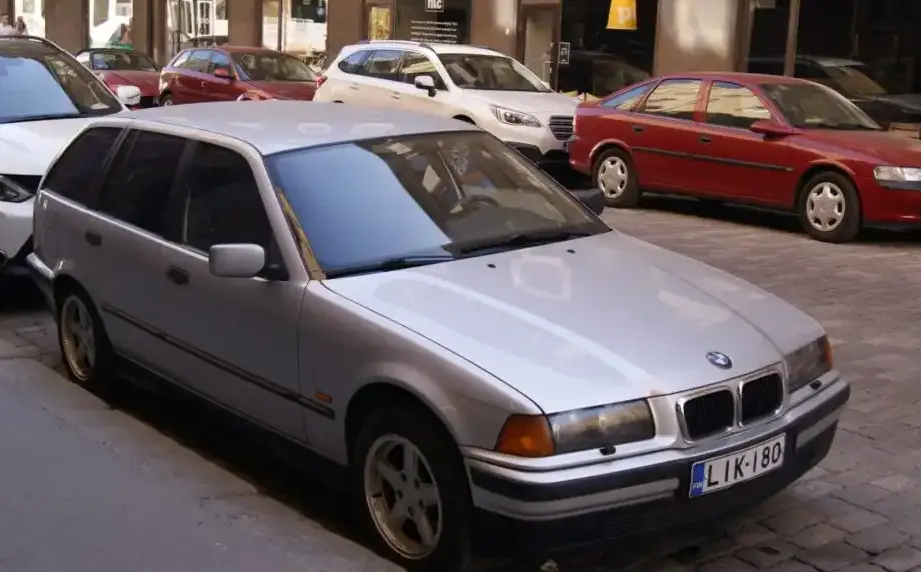
The BMW 3 Series Touring (E36) 320i, produced between 1994 and 1999, represents BMW’s entry into the compact executive estate car market. Positioned as a practical alternative to the 3 Series sedan, the Touring offered the same driving dynamics and build quality in a more versatile body style. The 320i variant, powered by the M52B20 engine, served as the base model for the Touring range, offering a balance of performance and fuel efficiency. It was a key offering for buyers seeking a premium wagon experience without the higher costs associated with the more powerful 328i or later, diesel-powered models.
Technical Specifications
| Brand | BMW |
| Model | 3 Series |
| Generation | 3 Series Touring (E36) |
| Type (Engine) | 320i (150 Hp) |
| Start of production | 1994 |
| End of production | 1999 |
| Powertrain Architecture | Internal Combustion engine |
| Body type | Station wagon (estate) |
| Seats | 5 |
| Doors | 5 |
| Fuel consumption (economy) – urban | 12.9 l/100 km (18.2 US mpg, 21.9 UK mpg, 7.8 km/l) |
| Fuel consumption (economy) – extra urban | 6.8 l/100 km (34.6 US mpg, 41.5 UK mpg, 14.7 km/l) |
| Fuel consumption (economy) – combined | 9 l/100 km (26.1 US mpg, 31.4 UK mpg, 11.1 km/l) |
| Fuel Type | Petrol (Gasoline) |
| Acceleration 0 – 100 km/h | 10.2 sec |
| Acceleration 0 – 62 mph | 10.2 sec |
| Acceleration 0 – 60 mph | 9.7 sec |
| Maximum speed | 212 km/h (131.73 mph) |
| Weight-to-power ratio | 9 kg/Hp, 111.5 Hp/tonne |
| Weight-to-torque ratio | 7.1 kg/Nm, 141.3 Nm/tonne |
| Power | 150 Hp @ 5900 rpm |
| Power per litre | 75.3 Hp/l |
| Torque | 190 Nm @ 4200 rpm (140.14 lb.-ft. @ 4200 rpm) |
| Engine layout | Front, Longitudinal |
| Engine Model/Code | M52B20 |
| Engine displacement | 1991 cm3 (121.5 cu. in.) |
| Number of cylinders | 6 |
| Engine configuration | Inline |
| Cylinder Bore | 80 mm (3.15 in.) |
| Piston Stroke | 66 mm (2.6 in.) |
| Compression ratio | 11:1 |
| Number of valves per cylinder | 4 |
| Fuel injection system | Multi-port manifold injection |
| Engine aspiration | Naturally aspirated engine |
| Valvetrain | DOHC |
| Engine oil capacity | 6.5 l (6.87 US qt | 5.72 UK qt) |
| Coolant | 10.5 l (11.1 US qt | 9.24 UK qt) |
| Kerb Weight | 1345 kg (2965.22 lbs.) |
| Max. weight | 1845 kg (4067.53 lbs.) |
| Max load | 500 kg (1102.31 lbs.) |
| Trunk (boot) space – minimum | 370 l (13.07 cu. ft.) |
| Trunk (boot) space – maximum | 1320 l (46.62 cu. ft.) |
| Fuel tank capacity | 62 l (16.38 US gal | 13.64 UK gal) |
| Length | 4433 mm (174.53 in.) |
| Width | 1698 mm (66.85 in.) |
| Height | 1391 mm (54.76 in.) |
| Wheelbase | 2700 mm (106.3 in.) |
| Front track | 1418 mm (55.83 in.) |
| Rear (Back) track | 1431 mm (56.34 in.) |
| Ride height (ground clearance) | 110 mm (4.33 in.) |
| Drivetrain Architecture | Rear wheel drive |
| Drive wheel | Rear wheel drive |
| Number of gears and type of gearbox | 5 gears, manual transmission |
| Front suspension | Wishbone |
| Rear suspension | Coil spring |
| Front brakes | Ventilated discs |
| Rear brakes | Disc |
| Assisting systems | ABS (Anti-lock braking system) |
| Steering type | Steering rack and pinion |
| Power steering | Hydraulic Steering |
| Tires size | 205/60 R15 |
| Wheel rims size | 15 |
Powertrain & Engine Architecture
The heart of the 320i Touring was the M52B20, a 2.0-liter inline-six cylinder engine. This engine was a significant step forward from its predecessor, the M50, featuring a lighter alloy block and head, along with a revised valvetrain. The M52B20 utilized multi-port fuel injection and a dual overhead camshaft (DOHC) design, contributing to its smooth power delivery and relatively good fuel economy. The engine produced 150 horsepower at 5900 rpm and 190 Nm (140 lb-ft) of torque at 4200 rpm. The 5-speed manual transmission was standard, providing precise gear changes and enhancing the driving experience. A 4-speed automatic transmission was also available, though it did impact acceleration slightly.
Driving Characteristics
The 320i Touring with the manual transmission offered a balanced driving experience. While not as overtly sporty as the 328i, it provided ample power for everyday driving and comfortable cruising. The inline-six engine was known for its smooth and linear power delivery, making it easy to modulate throttle and maintain control. The automatic transmission, while convenient, resulted in a noticeable decrease in acceleration and a less engaging driving experience. The gear ratios were optimized for fuel efficiency rather than outright performance. Compared to the 328i, the 320i felt less urgent, but it was still a capable and enjoyable car to drive, particularly on winding roads.
Equipment & Trim Levels
The 320i Touring typically came standard with features such as power windows, central locking, and an anti-lock braking system (ABS). Interior upholstery was usually cloth, though leather was available as an option. Dashboard configuration was typical of the E36 generation, with a straightforward layout and easy-to-read gauges. Optional extras included a sunroof, air conditioning, upgraded audio systems, and sport seats. The Touring also benefited from the practical advantages of a wagon body style, including a large cargo area accessible through a rear tailgate.
Chassis & Braking
The E36 3 Series Touring utilized a MacPherson strut front suspension and a semi-trailing arm rear suspension. The 320i typically featured smaller diameter rear disc brakes compared to the 328i. ABS was standard, providing enhanced braking performance and stability. The chassis was well-tuned, offering a good balance between ride comfort and handling precision. Stabilizer bars were fitted front and rear to reduce body roll during cornering. The suspension setup was generally softer than that of the 328i, prioritizing comfort over outright sportiness.
Market Reception & Comparison
The 320i Touring was generally well-received by automotive critics as a practical and well-built estate car. It was praised for its comfortable ride, spacious interior, and the smooth operation of the inline-six engine. However, some critics noted that the 320i lacked the outright performance of the 328i. In terms of fuel economy, the 320i offered a noticeable improvement over the 328i, making it a more economical choice for drivers who prioritized efficiency. Compared to other estate cars in its class, the 320i Touring stood out for its premium build quality and engaging driving dynamics.
Legacy
The M52B20 engine is known for its reliability and durability, and well-maintained examples can still provide years of trouble-free service. The E36 3 Series Touring, including the 320i variant, has become a popular choice among enthusiasts and collectors. The combination of practicality, driving enjoyment, and relatively affordable maintenance costs has ensured its continued appeal in the used car market. While finding a pristine example can be challenging, the 320i Touring remains a desirable and rewarding classic car.