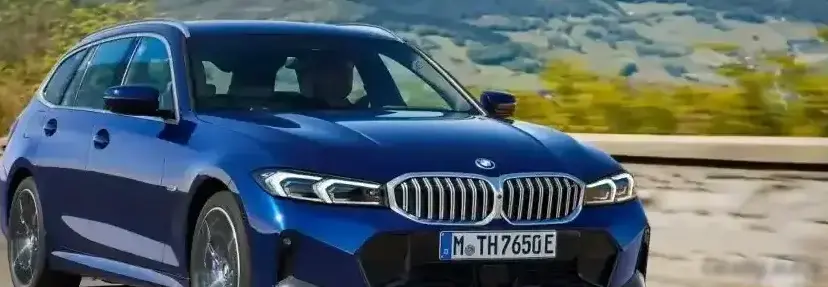
The BMW 3 Series Touring (G21 LCI), specifically the 320e variant introduced with the 2022 facelift, represents BMW’s entry point into the plug-in hybrid estate (wagon) market. Production began in July 2022, and it’s built on the 3 Series (G20/G21) platform, utilizing the 1HX0 chassis code. This model combines a 2.0-liter turbocharged four-cylinder gasoline engine with an electric motor, offering a balance of performance and efficiency within the broader 3 Series Touring lineup. The 320e is positioned as a more economical and environmentally conscious alternative to the higher-performance 330e and traditional combustion engine models.
Technical Specifications
| Brand | BMW |
| Model | 3 Series |
| Generation | 3 Series Touring (G21 LCI, facelift 2022) |
| Type (Engine) | 320e (204 Hp) Plug-in Hybrid Steptronic |
| Start of production | July, 2022 |
| Powertrain Architecture | PHEV (Plug-in Hybrid Electric Vehicle) |
| Body type | Station wagon (estate) |
| Seats | 5 |
| Doors | 5 |
| Combined fuel consumption (WLTP) | 1.4-1.9 l/100 km (168 – 123.8 US mpg, 201.8 – 148.7 UK mpg, 71.4 – 52.6 km/l) |
| CO2 emissions (WLTP) | 31-43 g/km |
| Fuel Type | Petrol / electricity |
| Acceleration 0 – 100 km/h | 7.9 sec |
| Acceleration 0 – 62 mph | 7.9 sec |
| Acceleration 0 – 60 mph | 7.5 sec |
| Maximum speed | 220 km/h (136.7 mph) |
| Emission standard | Euro 6d |
| Weight-to-power ratio | 8.9 kg/Hp, 111.8 Hp/tonne |
| Weight-to-torque ratio | 5.2 kg/Nm, 191.8 Nm/tonne |
| Gross battery capacity | 12 kWh |
| Battery voltage | 354 V |
| Battery technology | Lithium-ion (Li-Ion) |
| Battery location | Under the rear seats |
| Recuperation output | 20 kW |
| All-electric range (WLTP) | 52-61 km (32.31 – 37.9 mi) |
| Average Energy consumption (WLTP) | 16.3-18.3 kWh/100 km (26.23 – 29.45 kWh/100 mi, 128 – 114 MPGe, 6.1 – 5.5 km/kWh, 3.8 – 3.4 mi/kWh) |
| Max speed (electric) | 140 km/h (86.99 mph) |
| Electric motor power | 109 Hp @ 3140 rpm (195.45 lb.-ft. @ 100-2500 rpm) |
| Electric motor torque | 265 Nm @ 100-2500 rpm |
| Electric motor location | Between the combustion engine and the transmission |
| System power | 204 Hp |
| System torque | 350 Nm (258.15 lb.-ft.) |
| Power | 163 Hp @ 5000-6500 rpm (81.6 Hp/l) |
| Torque | 300 Nm @ 1350-3700 rpm (221.27 lb.-ft. @ 1350-3700 rpm) |
| Engine layout | Front, Longitudinal |
| Engine Model/Code | B48B20A |
| Engine displacement | 1998 cm3 (121.93 cu. in.) |
| Number of cylinders | 4 |
| Engine configuration | Inline |
| Cylinder Bore | 82 mm (3.23 in.) |
| Piston Stroke | 94.6 mm (3.72 in.) |
| Compression ratio | 11:1 |
| Number of valves per cylinder | 4 |
| Fuel injection system | Direct injection |
| Engine aspiration | Twin-power turbo, Intercooler |
| Valvetrain | VALVETRONIC |
| Engine oil capacity | 5.25 l (5.55 US qt | 4.62 UK qt) |
| Kerb Weight | 1825 kg (4023.44 lbs.) |
| Max. weight | 2350 kg (5180.86 lbs.) |
| Max load | 525 kg (1157.43 lbs.) |
| Trunk (boot) space – minimum | 410 l (14.48 cu. ft.) |
| Trunk (boot) space – maximum | 1420 l (50.15 cu. ft.) |
| Fuel tank capacity | 40 l (10.57 US gal | 8.8 UK gal) |
| Max. roof load | 75 kg (165.35 lbs.) |
| Permitted trailer load with brakes (12%) | 1500 kg (3306.93 lbs.) |
| Permitted trailer load without brakes | 750 kg (1653.47 lbs.) |
| Permitted towbar download | 75 kg (165.35 lbs.) |
| Length | 4713 mm (185.55 in.) |
| Width | 1827 mm (71.93 in.) |
| Height | 1442 mm (56.77 in.) |
| Wheelbase | 2851 mm (112.24 in.) |
| Front track | 1573 mm (61.93 in.) |
| Rear (Back) track | 1568 mm (61.73 in.) |
| Ride height (ground clearance) | 139 mm (5.47 in.) |
| Drag coefficient (Cd) | 0.28 |
| Minimum turning circle (turning diameter) | 11.4 m (37.4 ft.) |
| Drivetrain Architecture | The Internal combustion engine (ICE) and electric motor drive the rear wheels of the car with the ability to work in full electric or mixed mode. |
| Drive wheel | Rear wheel drive |
| Number of gears and type of gearbox | 8 gears, automatic transmission Steptronic |
| Front suspension | Independent, type McPherson with coil spring and anti-roll bar |
| Rear suspension | Independent multi-link spring suspension with stabilizer |
| Front brakes | Ventilated discs |
| Rear brakes | Ventilated discs |
| Assisting systems | ABS (Anti-lock braking system) |
| Steering type | Steering rack and pinion |
| Power steering | Electric Steering |
| Tires size | 225/50 R17 |
| Wheel rims size | 7.5J x 17 |
INTRODUCTION
The BMW 320e Touring, launched in 2022 as part of the LCI (Life Cycle Impulse) facelift for the G21 3 Series, is a plug-in hybrid station wagon designed to appeal to buyers seeking a practical, efficient, and moderately sporty vehicle. It combines a 2.0-liter four-cylinder gasoline engine with an electric motor, offering both all-electric driving capability and the extended range of a traditional internal combustion engine. This variant slots into the 3 Series Touring lineup below the more powerful 330e plug-in hybrid and the various gasoline and diesel-powered models. The 320e aims to provide a compelling alternative for those prioritizing fuel economy and reduced emissions without sacrificing the driving experience associated with the 3 Series.
Powertrain & Engine Architecture
At the heart of the 320e is BMW’s B48B20A 2.0-liter turbocharged four-cylinder gasoline engine. This engine utilizes direct fuel injection and BMW’s VALVETRONIC variable valve timing system for optimized efficiency and power delivery. It produces 163 horsepower and 300 Nm (221 lb-ft) of torque. The engine is paired with an 80 kW (109 hp) electric motor integrated into the eight-speed Steptronic automatic transmission. The electric motor delivers 265 Nm (195 lb-ft) of torque. The combined system output is 204 horsepower and 350 Nm (258 lb-ft) of torque. The 12 kWh lithium-ion battery pack is located under the rear seats, minimizing impact on cargo space. The powertrain features intelligent energy management, allowing for both all-electric driving and seamless transitions between electric and gasoline power. The Steptronic transmission is specifically tuned to work with the hybrid system, providing smooth and efficient gear changes.
Driving Characteristics
The 320e Touring offers a distinct driving experience compared to its siblings. In all-electric mode, it provides near-silent and responsive acceleration, suitable for urban commutes and short trips. The electric motor’s instant torque contributes to brisk off-the-line performance. When the gasoline engine engages, the transition is generally smooth, and the combined power output delivers adequate acceleration for highway driving and overtaking. While not as overtly sporty as the 330e, the 320e still maintains a level of agility and responsiveness characteristic of the 3 Series. The eight-speed automatic transmission is well-matched to the powertrain, providing quick and precise shifts. The gear ratios are optimized for both fuel efficiency and performance, ensuring that the engine operates within its optimal range. Compared to the manual transmission options available on other 3 Series models, the automatic prioritizes convenience and ease of use, making it a good choice for drivers who prefer a relaxed driving experience.
Equipment & Trim Levels
The 320e Touring typically comes well-equipped as standard. Common features include BMW’s iDrive infotainment system with a touchscreen display, navigation, Apple CarPlay and Android Auto compatibility, automatic climate control, and a suite of driver-assistance systems such as lane departure warning and forward collision warning. Interior upholstery is typically a combination of cloth and synthetic leather, with optional upgrades to full leather available. Dashboard trim options vary depending on the package selected. Optional extras often include a panoramic sunroof, premium sound system, head-up display, and adaptive cruise control. The specific trim levels and available options can vary depending on the market.
Chassis & Braking
The 320e Touring utilizes the standard 3 Series Touring chassis, featuring independent suspension at all four corners. The front suspension employs a McPherson strut design with coil springs and an anti-roll bar, while the rear suspension utilizes a multi-link setup. The suspension is tuned to provide a balance of comfort and handling. Braking duties are handled by ventilated disc brakes on all four wheels. The regenerative braking system captures energy during deceleration, helping to recharge the battery and improve overall efficiency. ABS (Anti-lock Braking System) is standard, along with electronic stability control and traction control.
Market Reception & Comparison
The 320e Touring has been generally well-received by automotive critics as a practical and efficient plug-in hybrid option. Reviewers have praised its comfortable ride, responsive handling, and decent all-electric range. Compared to the 330e, the 320e offers a lower price point and slightly better fuel economy, but with less overall power and performance. Against traditional gasoline and diesel-powered 3 Series models, the 320e provides the benefit of reduced emissions and the ability to drive in all-electric mode, making it an attractive option for environmentally conscious buyers. However, the added weight of the battery pack and electric motor can slightly impact handling compared to lighter models.
Legacy
The BMW 320e Touring (G21 LCI) represents a significant step in BMW’s electrification strategy. While long-term reliability data is still emerging, the B48 engine has proven to be generally robust, and the hybrid system is backed by BMW’s extensive engineering expertise. On the used car market, the 320e is likely to appeal to buyers seeking a well-equipped, fuel-efficient, and technologically advanced estate car. The availability of a plug-in hybrid powertrain adds a layer of future-proofing, as regulations regarding emissions become increasingly stringent. The combination of practicality, efficiency, and the BMW driving experience should ensure that the 320e Touring remains a desirable option for years to come.