
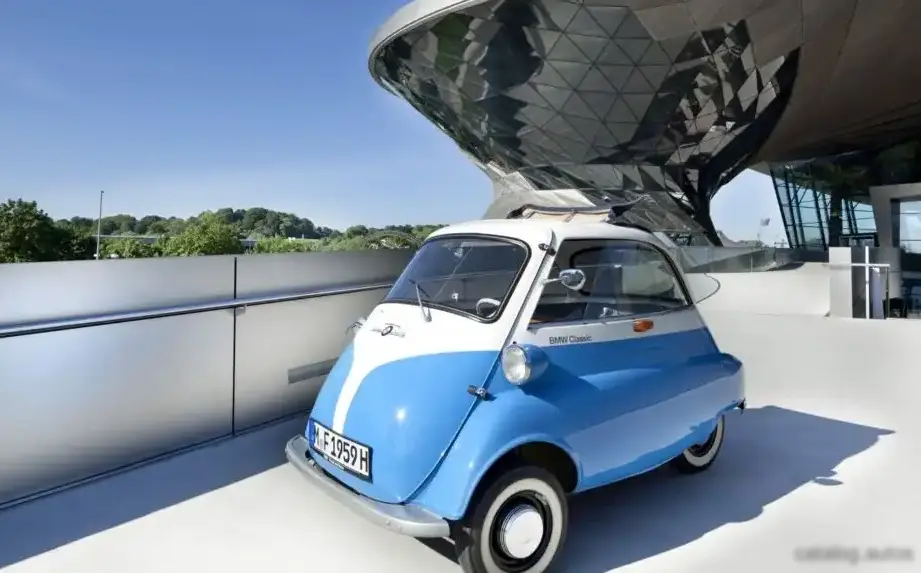
The BMW Isetta 300, manufactured between December 1955 and May 1962, occupies a singular position in BMW’s history. Arising from post-war necessity and licensing agreements with Iso SpA, the Isetta was instrumental in BMW’s revitalization, offering affordable personal transportation in Germany and beyond. This specific variant, the 300, was powered by a 295cc single-cylinder engine producing 13 horsepower. It was a pivotal model for BMW, shifting the brand’s focus towards accessible vehicles, a departure from its pre-war reputation for luxury automobiles. The Isetta 300 is categorized as a “quadricycle,” a classification that significantly influenced its design and regulatory compliance.
Technical Specifications
| Brand | BMW |
| Model | Isetta |
| Generation | Isetta |
| Type (Engine) | 300 (13 Hp) |
| Start of production | December, 1955 |
| End of production | May, 1962 |
| Powertrain Architecture | Internal Combustion engine |
| Body type | Quadricycle |
| Seats | 2 |
| Doors | 1 |
| Fuel consumption (combined) | 3.9 l/100 km (60.3 US mpg, 72.4 UK mpg, 25.6 km/l) |
| Fuel Type | Petrol (Gasoline) |
| Maximum speed | 85 km/h (52.82 mph) |
| Weight-to-power ratio | 28.5 kg/Hp, 35.1 Hp/tonne |
| Weight-to-torque ratio | 20.6 kg/Nm, 48.6 Nm/tonne |
| Power | 13 Hp @ 5800 rpm |
| Power per litre | 44.1 Hp/l |
| Torque | 18 Nm @ 4600 rpm (13.28 lb.-ft. @ 4600 rpm) |
| Engine layout | Middle, Longitudinal |
| Engine displacement | 295 cm3 (18 cu. in.) |
| Number of cylinders | 1 |
| Cylinder Bore | 72 mm (2.83 in.) |
| Piston Stroke | 73 mm (2.87 in.) |
| Compression ratio | 7:1 |
| Number of valves per cylinder | 2 |
| Fuel injection system | Carburettor |
| Engine aspiration | Naturally aspirated engine |
| Valvetrain | OHV |
| Engine oil capacity | 1.8 l (1.9 US qt | 1.58 UK qt) |
| Kerb Weight | 370 kg (815.71 lbs.) |
| Max. weight | 600 kg (1322.77 lbs.) |
| Max load | 230 kg (507.06 lbs.) |
| Fuel tank capacity | 13 l (3.43 US gal | 2.86 UK gal) |
| Length | 2355 mm (92.72 in.) |
| Width | 1380 mm (54.33 in.) |
| Height | 1340 mm (52.76 in.) |
| Wheelbase | 1500 mm (59.06 in.) |
| Front track | 520 mm (20.47 in.) |
| Rear track | 1200 mm (47.24 in.) |
| Minimum turning circle | 8.3 m (27.23 ft.) |
| Drivetrain Architecture | Rear wheel drive |
| Drive wheel | Rear wheel drive |
| Number of gears and type of gearbox | 4 gears, manual transmission |
| Front suspension | Independent coil spring |
| Rear suspension | Leaf spring |
| Front brakes | Drum, 180 mm |
| Rear brakes | Drum, 180 mm |
| Steering type | Worm-reduction unit |
Powertrain & Engine Architecture
The Isetta 300’s engine was a single-cylinder, two-stroke unit displacing 295cc. Initially sourced from Iso SpA in Italy – the original Isetta manufacturer – BMW later produced the engine under license. The engine employed a carburetor fuel system and an overhead valve (OHV) valvetrain. A compression ratio of 7:1 represented a balance between performance and durability for the period. The engine’s longitudinal mid-engine placement was a defining characteristic, contributing to the Isetta’s unique handling dynamics. Power was transferred to the rear wheels through a four-speed manual transmission. The relatively modest horsepower output demanded careful gear selection, particularly when ascending inclines or executing overtaking maneuvers.
Driving Characteristics
The driving experience in the Isetta 300 was, to put it mildly, distinctive. With a mere 13 horsepower on tap, acceleration was decidedly unhurried. The four-speed manual transmission necessitated frequent shifting to maintain momentum. The Isetta wasn’t designed for high-speed travel; its top speed of approximately 53 mph was sufficient for urban environments and rural roads. The mid-engine layout provided surprisingly neutral handling characteristics, although the narrow track and short wheelbase could induce instability at higher speeds or during sudden directional changes. The single front door, hinged on the side, also required a degree of dexterity when entering and exiting the vehicle.
Equipment & Trim Levels
The Isetta 300 was intentionally minimalist in its equipment offerings, reflecting its affordability. Standard features included basic instrumentation – a speedometer and fuel gauge – a simple bench seat, and a small storage compartment. The interior was typically upholstered in vinyl. Optional extras included a sunroof, a heater, and upgraded upholstery choices. The Isetta 300 didn’t offer a broad spectrum of trim levels; it was largely a single-specification model with a limited selection of available options. The primary objective was to deliver basic, reliable transportation at the lowest possible cost.
Chassis & Braking
The Isetta 300’s chassis was constructed from steel monocoque, providing a relatively lightweight and rigid platform. The front suspension utilized independent coil springs, while the rear suspension employed a leaf spring configuration. Braking duties were handled by drum brakes on all four wheels, measuring 180mm in diameter. Considering the Isetta’s low weight and modest performance capabilities, the braking system proved generally adequate for its intended purpose. Steering was accomplished via a worm-reduction unit, offering relatively heavy but precise control.
Market Reception & Comparison
The Isetta 300 enjoyed generally favorable reception within its target market. Critics lauded its fuel economy – around 60 miles per gallon – and its affordability. However, its limited performance and unconventional design also drew criticism. Compared to other small cars of the era, such as the Volkswagen Beetle, the Isetta offered significantly less power and interior space. Nevertheless, it was considerably less expensive, making it accessible to a broader range of potential buyers. Within the Isetta range, the 300 represented a mid-range offering, positioned between the earlier 250cc models and the later, slightly more powerful 400cc versions.
Legacy
The BMW Isetta 300 played a crucial role in BMW’s post-war recovery. It demonstrated the company’s adaptability and its ability to produce affordable vehicles. Although production ceased in 1962, the Isetta left a lasting legacy as a symbol of ingenuity and resourcefulness. Today, the Isetta 300 is a highly sought-after classic car, prized by collectors for its unique design and historical significance. The powertrain, despite its simplicity, proved to be relatively reliable, and a substantial number of examples remain operational today. While parts availability can present challenges, a dedicated community of enthusiasts ensures that the Isetta’s legacy will endure for years to come. The Isetta 300 remains a charming and iconic reminder of a distinctive era in automotive history.
