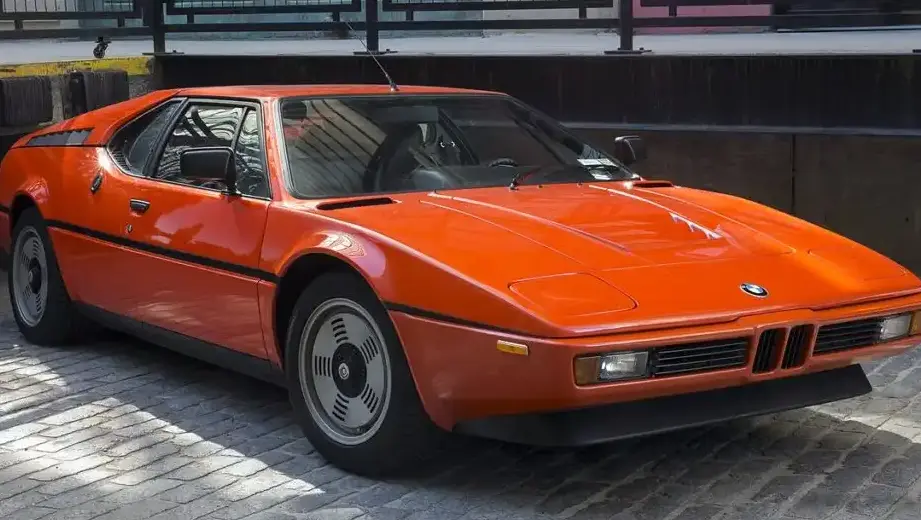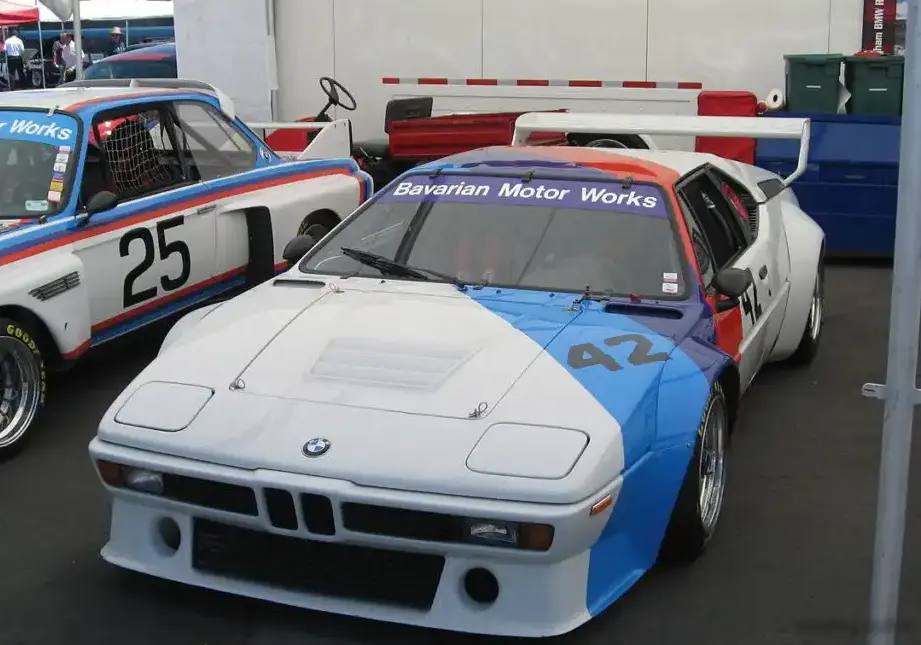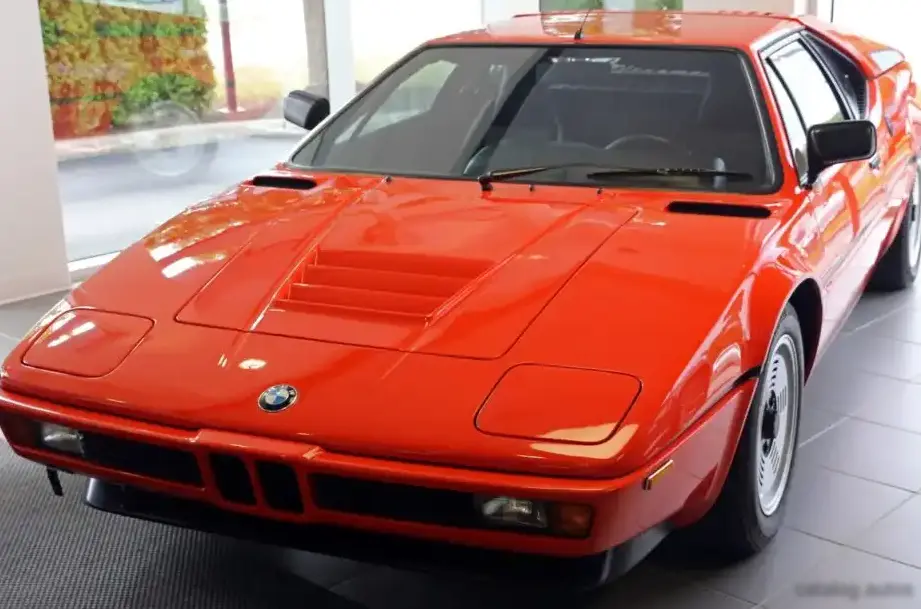
The BMW M1 (E26) was a mid-engine sports car produced by BMW from 1978 to 1981. Conceived as a project to enter the FIA World Sportscar Championship, the M1 ultimately became a limited-production road car, representing BMW’s foray into the exotic supercar market. A total of 453 examples were built, making it a relatively rare and highly sought-after vehicle today. The 3.5-liter variant, producing 277 horsepower, was the standard engine offered throughout its production run. The M1 was notable for its collaboration with Lamborghini for chassis and body construction, and its striking wedge-shaped design penned by Giorgetto Giugiaro.
Technical Specifications
| Brand | BMW |
| Model | M1 |
| Generation | M1 (E26) |
| Type (Engine) | 3.5 (277 Hp) |
| Start of production | 1978 |
| End of production | 1981 |
| Powertrain Architecture | Internal Combustion engine |
| Body type | Coupe |
| Seats | 2 |
| Doors | 2 |
| Fuel consumption (economy) – urban | 19.6 l/100 km (12 US mpg, 14.4 UK mpg, 5.1 km/l) |
| Fuel consumption (economy) – extra urban | 8.9 l/100 km (26.4 US mpg, 31.7 UK mpg, 11.2 km/l) |
| Fuel consumption (economy) – combined | 12.9 l/100 km (18.2 US mpg, 21.9 UK mpg, 7.8 km/l) |
| Fuel Type | Petrol (Gasoline) |
| Acceleration 0 – 100 km/h | 5.6 sec |
| Acceleration 0 – 62 mph | 5.6 sec |
| Acceleration 0 – 60 mph | 5.3 sec |
| Acceleration 0 – 200 km/h | 20.7 sec |
| Maximum speed | 262 km/h (162.8 mph) |
| Weight-to-power ratio | 4.7 kg/Hp, 213.1 Hp/tonne |
| Weight-to-torque ratio | 3.9 kg/Nm, 253.8 Nm/tonne |
| Power | 277 Hp @ 6500 rpm |
| Power per litre | 80.2 Hp/l |
| Torque | 330 Nm @ 5000 rpm (243.4 lb.-ft. @ 5000 rpm) |
| Maximum engine speed | 7000 rpm |
| Engine layout | Middle, Longitudinal |
| Engine Model/Code | M88 |
| Engine displacement | 3453 cm3 (210.71 cu. in.) |
| Number of cylinders | 6 |
| Engine configuration | Inline |
| Cylinder Bore | 93.4 mm (3.68 in.) |
| Piston Stroke | 84 mm (3.31 in.) |
| Compression ratio | 9:1 |
| Number of valves per cylinder | 4 |
| Fuel injection system | Multi-port manifold injection |
| Engine aspiration | Naturally aspirated engine |
| Valvetrain | DOHC |
| Kerb Weight | 1300 kg (2866.01 lbs.) |
| Max. weight | 1600 kg (3527.4 lbs.) |
| Max load | 300 kg (661.39 lbs.) |
| Fuel tank capacity | 116 l (30.64 US gal, 25.52 UK gal) |
| Length | 4360 mm (171.65 in.) |
| Width | 1824 mm (71.81 in.) |
| Height | 1140 mm (44.88 in.) |
| Wheelbase | 2560 mm (100.79 in.) |
| Front track | 1550 mm (61.02 in.) |
| Rear (Back) track | 1576 mm (62.05 in.) |
| Ride height (ground clearance) | 125 mm (4.92 in.) |
| Minimum turning circle | 13 m (42.65 ft.) |
| Drivetrain Architecture | Rear wheel drive |
| Drive wheel | Rear wheel drive |
| Number of gears and type of gearbox | 5 gears, manual transmission |
| Front suspension | Double wishbone, Transverse stabilizer |
| Rear suspension | Double wishbone, Transverse stabilizer |
| Front brakes | Ventilated discs, 300×32 mm |
| Rear brakes | Ventilated discs, 297×26 mm |
| Steering type | Steering rack and pinion |
| Tires size | Front: 205/55 R16, Rear: 225/50 R16 |
| Wheel rims size | Front: 7J x 16, Rear: 8J x 16 |
INTRODUCTION
The BMW M1, launched in 1978, represented a significant departure for the Bavarian automaker. Unlike their traditionally front-engined vehicles, the M1 adopted a mid-engine layout, inspired by the success of Italian supercar manufacturers like Ferrari and Lamborghini. The project originated from a desire to compete in Group 4 and Group 5 racing categories, but ultimately evolved into a low-volume, high-performance road car. The M1’s design was the result of a collaboration between BMW and several external partners, most notably Lamborghini, who were contracted to build the chassis and oversee initial assembly. Giorgetto Giugiaro of Italdesign penned the striking bodywork, characterized by its long, low profile and distinctive pop-up headlights. The 3.5-liter engine, designated M88, became the defining feature of the M1, delivering a potent combination of power and responsiveness.
Powertrain & Engine Architecture
The heart of the M1 is the M88 inline-six engine, a 3.5-liter masterpiece derived from BMW’s racing engines of the time. This engine shares its basic architecture with the M88/1 engine used in the 320iS and 635CSi, but was extensively modified for the M1’s mid-engine application. It features a cast iron block, an aluminum cylinder head with dual overhead camshafts (DOHC), and four valves per cylinder. Fuel delivery is managed by a Bosch K-Jetronic mechanical fuel injection system, providing precise metering for optimal performance. The engine produces 277 horsepower at 6,500 rpm and 330 Nm (243.4 lb-ft) of torque at 5,000 rpm. The M88’s dry-sump lubrication system allowed for a lower engine placement within the chassis, contributing to a lower center of gravity and improved handling. The M1 was exclusively equipped with a five-speed manual transmission, providing direct and engaging control over the engine’s power. The gearbox was mounted directly to the engine, forming a single powertrain unit.
Driving Characteristics
The BMW M1 offered a unique driving experience, blending the performance of a supercar with the relative usability of a grand tourer. The mid-engine layout provided exceptional balance and responsiveness, allowing for precise cornering and confident handling. The 277 horsepower engine delivered strong acceleration, propelling the M1 from 0 to 60 mph in approximately 5.3 seconds and on to a top speed of 162.8 mph. While not the fastest supercar of its era, the M1’s balanced chassis and communicative steering made it a rewarding car to drive. The five-speed manual transmission offered a direct connection to the engine, allowing drivers to fully exploit the M88’s powerband. Compared to potential higher-output versions that were considered during development, the standard M1’s power delivery was considered more accessible and manageable for a wider range of drivers. The relatively lightweight construction (around 2866 lbs) further enhanced the M1’s agility.
Equipment & Trim Levels
The BMW M1 was offered with a relatively limited range of options, reflecting its status as a premium, low-volume vehicle. Standard equipment included leather upholstery, air conditioning, power windows, and a high-quality stereo system. The interior was designed with a focus on functionality and driver comfort, featuring supportive bucket seats and a well-laid-out dashboard. Optional extras included a limited-slip differential, upgraded suspension components, and a choice of exterior colors. The interior trim was generally consistent across all M1s, with a focus on providing a luxurious and sporty environment. The M1 did not have traditional trim levels; all examples were essentially equipped to a similar high standard.
Chassis & Braking
The M1’s chassis was a complex space frame construction, built from steel tubes and clad in fiberglass body panels. Lamborghini was initially responsible for chassis production, but quality control issues led BMW to take over production in-house. The suspension system featured double wishbones at both the front and rear, with transverse stabilizer bars to reduce body roll. The M1’s braking system consisted of ventilated disc brakes on all four wheels, providing ample stopping power. The front brakes measured 300×32 mm, while the rear brakes were 297×26 mm. The steering was a rack-and-pinion system, offering precise and responsive control. The M1 rode on 16-inch wheels, with 205/55R16 tires at the front and 225/50R16 tires at the rear.
Market Reception & Comparison
The BMW M1 was generally well-received by automotive critics, who praised its performance, handling, and striking design. However, its high price tag (around $50,000 in the late 1970s) limited its appeal to a relatively small number of buyers. Compared to other supercars of the era, such as the Ferrari 308 GTB and the Porsche 911 Turbo, the M1 offered a unique combination of performance and usability. While it may not have been as outright fast as some of its rivals, its balanced chassis and communicative steering made it a more engaging car to drive. Fuel economy was predictably poor, averaging around 18.2 US mpg in combined driving. Reliability was generally good, although the complex K-Jetronic fuel injection system could require specialized maintenance.
Legacy
The BMW M1 remains a highly collectible and sought-after vehicle today. Its limited production run and unique design have contributed to its enduring appeal. The M1’s mid-engine layout and advanced technology paved the way for future BMW performance cars. The M88 engine, in particular, is regarded as a masterpiece of engineering. While the M1 was not a commercial success in the traditional sense, it cemented BMW’s reputation as a manufacturer of high-performance automobiles. In the used car market, well-maintained M1s command premium prices, reflecting their rarity and historical significance. The M1’s legacy continues to inspire automotive enthusiasts and collectors around the world.